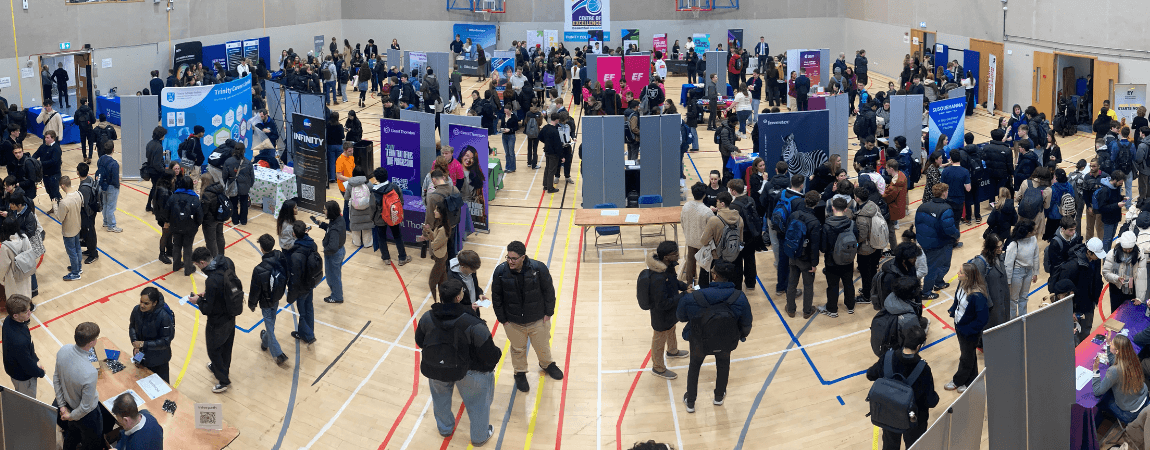
Careers fairs are an assault on the senses: as soon as you walk into the hall, a cacophony of sound hits you, and you need a few minutes to get your bearings before you can begin to navigate the space. The environment itself instils a sense of urgency — you have to start moving as quickly as possible. All around, people your own age eagerly look at you with customer-service smiles, ready to pitch you a job. Paralysed by choice among all the advertisements, you slowly start to follow the stream of people circling the stands.
Most careers fairs take place this time of year, in early autumn, shortly after college starts. It is not enough to slowly ease yourself back into the day-to-day life as a student, going to classes and reading in the library – you’re also encouraged to think ahead, towards the next step. This isn’t just because of careers fairs, though. As college students, we’re not only expected to engage with our chosen subjects, but we’re also expected to have an active and up-to-date LinkedIn profile, a CV ready at a moment’s notice, and an ever-growing collection of corporate jargon to deploy in conversation.
The more careers fairs you go to, the more you realise they’re all the same, operating on a set of norms that you can learn to follow. Some people are perhaps more predisposed to them than others; they know how to dress the part and decisively walk up to people, but there’s no succeeding at a careers fair. Despite this, everyone feels the pressure to attend. Like most others, I have on occasion signed up to a fair, only to do one lap around the hall before walking out again. Leaving doesn’t feel any better, but at least you have a Deloitte pin or an EY tote bag to remind you of the experience. Final-year students are under the most pressure to attend, with the job market practically breathing down their necks, but there are also third-year, second-year, and even first-year students trying their luck. Throughout university, students are encouraged to be on the lookout for new opportunities and tailor their life at university to the kind of career they want after graduation. Platforms like LinkedIn facilitate this: you’re encouraged to be online as often as possible and to post continuously in your free time to establish a name for yourself and build a personal brand.
The relationship between degrees and career aspirations is, of course, formed even before starting university. Degrees have themselves become transactional, and picking one is at least implicitly determined by the job prospects of different fields. Even if your degree is not in the field you want to pursue long-term, it’s made valuable by the transferable skills that it gives you, which you can leverage to obtain a job. The problem we’re all faced with is that as university degrees have become increasingly common, they’ve also become the base requirement for most job applications. Students now have to find other ways to give them an edge or a niche. Freshers’ fairs have effectively become the new careers fairs, where students look for new additions to their CVs. As cynical as it felt for me to promote the University Times as a great addition to your CV, it almost feels like a necessity, as CVs are the standard by which everything else is measured against.
There’s a blurring of the lines between relationships and ‘connections’. When you start to think of yourself as a personal brand, you also start to view others as additions to your team. Under the guise of ‘networking’, you approach other people with an aim in mind, with the thought that they may become useful in the future. Careers fairs serve a purpose in giving students the opportunity to speak to industry professionals about their futures, but the way we interact with people there has permeated our daily lives. LinkedIn, too, by virtue of it being a social media platform, has normalised interacting with others on a transactional basis. Replying to other people’s posts shows you’re a team player — but you always expect something in return. University is largely about meeting new people, but the disturbing reality is that we often see forming relationships as networking in the belief that the success of the people around us will propel us further.
Relationships between students have become increasingly marked by competition. At the careers fair, certain stalls receive more attention than others, and you can watch in real time as students line up to give them a greater chance of securing a coveted graduate job. The scuffling and jostling around these stands shows the desperation with which students are now approaching the job market. Competition forces us to rewrite past experiences as sellable products while always being on the lookout for additional things to add to our CV. This is only made worse when you can see what everyone else is doing, and that you aren’t, on social media platforms. We’re constantly made to feel like we haven’t done enough, that we’re lagging behind, but what we’re chasing is nothing more than appearances. On LinkedIn, your posts aren’t informed by what you do; rather, what you do is informed by how you want to come across on LinkedIn. Ursula Huws, in her essay ‘Begging and Bragging’, discusses how we are forced to brag about our achievements in order to prove them, and to beg for employers to take us on. This fundamentally goes against the ethical codes that we are taught to live by, which leads us to feel humiliated and ashamed. But with the advent of LinkedIn, it’s not so much about boasting your achievements as it is about creating an alter ego. It’s where exaggeration veers into the absurd.
Careers fairs operate on much of the same logic as LinkedIn and don’t serve students in any real way, except as a training ground for an existence that awaits us all. They are a microcosm of a competitive society: we apply the norms and rules that they follow to all other aspects of life. We are never allowed to be just students: we also have to continuously mould and market ourselves in preparation for entering the job market.
Comment & Analysis
Oct 12, 2025
Corporate Alter Egos
Careers fairs, LinkedIn, and networking your way through university
Trinity Careers Service
Sign Up to Our Weekly Newsletters
Editors' Picks

Catering (to) Changes: Is Trinity Going Plant-Based?
Beyond the Suitcase: How Ukrainian Resilience is Rewriting the Irish Economic Playbook

Four TV Series and a Film: April 2026
This year’s Met Gala was a Masterclass in PR

“I Know I Shouldn’t Use It But I Still Do”: The Outward Shunning and Continued Use of AI