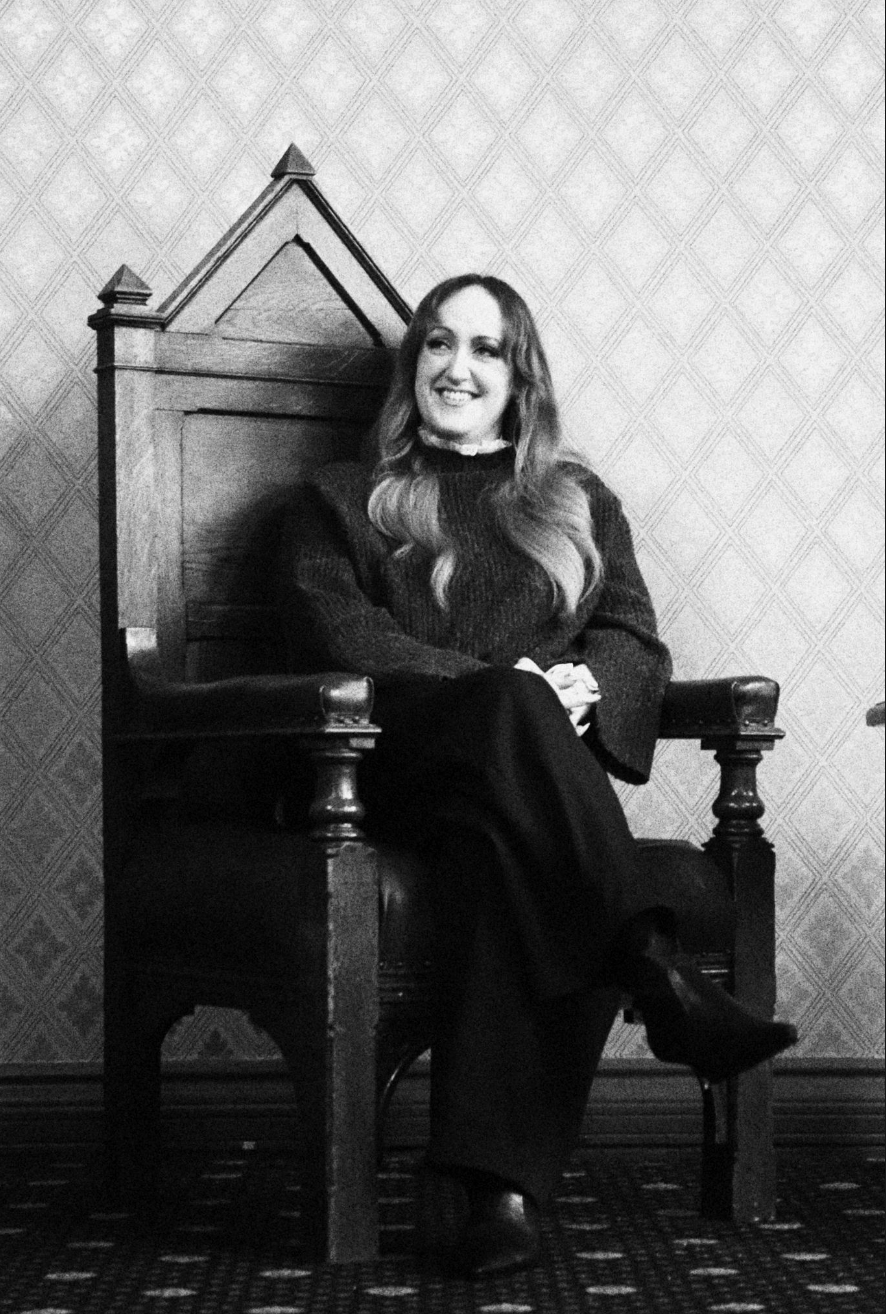

Six months ago, I never expected to find myself alone in a room with people I had previously only seen through a screen. Yet photography has a strange way of collapsing distance. Through photographing events for The Eliz and The University Times, I’ve found myself in some of the most public of spaces and discovered how unexpectedly intimate they can be.
If you are in any way aware of the goings-on around campus, you might have seen that Brittany Broski was hosted by The University Philosophical Society (the Phil), for an honorary patronage award. Photographing the event for The Eliz, I found myself in a room full with members of the Phil council, some members of the subcommittees and then very quickly, Brittany herself.
The realisation hit that not only was I to introduce myself, but also to ask her directly if I could photograph her. In last minute run arounds, people drifted in and out of the room organising water on the tables and setting themselves up in their respective seating arrangements. Watching one more person leave the room, it dawned on me there were now only two people in the Phil Convo room: me and Brittany Broski.

Feeling slightly awkward, I continued a quick conversation, asking her about her recent visit to Ireland and how she was finding it. She spoke highly of Ireland and began her last-minute checks in the mirror. It was a backstage moment, watching someone so widely recognised become suddenly, quietly human. She reapplied her lip combo and adjusted her hair. I double checked with her, not wanting to be invasive of her space or the moment: “May I take a photo of you putting on your lipstick in the mirror?” I asked.
“Of course”, she answered, laughing. “Just me getting into my drag.”
And in those few moments, the camera became a kind of permission to witness. There was an unusual yet comforting calmness in the room. The clicks of my camera shutter and the small shuffle of our feet were the only sounds to be heard as the last tweaks were made before showtime. She took a breath, fixed a final piece of her hair, and turned to me.
“Does it look flat?”
“Not at all,” I said.
Then we waited for someone to come back to signal she could enter the debating chamber, where the real crowd was waiting. A moment later, the door opened and the Auditor of the Phil asked me to follow behind himself and Brittany. Camera in hand, I was ready to capture the crowd. Not really grasping what that would be like, I followed behind.
As the doors opened, the quiet stillness of before dissolved instantly as the room erupted. Cheers from hundreds of people all roared toward Brittany, and for the first time in my life, I was completely elated in a reaction that wasn’t even remotely for me. Being directly behind her, I snapped photos of her walking through the crowd, making her way up toward the podium in which she would be speaking. I could only imagine what that felt like for her as I was so swept up in it, although unfamiliar to me it must have been something entirely different for someone used to that level of attention. The contrast between the silence before, just the two of us, to the energy of the chamber was surreal. Just minutes earlier, it was just the sound of my camera clicking and the few last deep breaths to steady the nerves; then, the heat of a crowded room, with clapping, screaming, awe and joy. It felt like stepping from still water into a tidal wave.
I found myself in a similar situation when photographing Nadya Tolokonnikova. Again, I was briefly left alone with her before she entered the chamber. She asked me about politics in Ireland and where I stood. It struck me as strange, in the best possible way. Just moments earlier she had been a public figure preparing to address a chamber full of students, and now we were simply two people making polite conversation while I adjusted my camera settings. No one ever realises, or at the very least it never fully occurred to me, just how close you have to get to someone physically in distance in order to photograph them. A closeness of conversation, being one-on-one with them and overall, the intimacy of documenting, in some cases, that person’s last moments of humanness before performance sets in. Standing behind the camera, you exist in a strange, transitory liminal space, being neither audience nor performer. You are simply the observer, quietly documenting the seconds before the spotlight turns on, and fame looks a little different from this angle.
It is something I never thought about before I started photography in this way, as like most people, my photography journey began with animals, nature, and a few willing friends. But jumping into this space, suddenly photographing renowned and revered faces, with the status of us both being strangers to each other, is unlike anything I could’ve prepared for; it requires complete immersion, the bonding medium between us both now being a camera lens, as two people who otherwise have no reason to interact. There is a strange balance involved, with an emotional distance and a quiet compassion needed to capture those moments in their rawest form and to document it in an authentic way. You’re documenting someone honestly, but you’re also aware that you are witnessing something private, the last breaths before the performance begins.
There has always been the debate on whether famous people are even “people” in the first place. Some may see famous people as relics posing from far away, things to be adored and admired, not understood or recognised as even human. By their design they are commodified as objects for entertainment, or exceptional talent, allowing the public to use them for escapism, entertainment or even judgement. Even with the rise of influencers and more accessible forms of fame, there is still an invisible boundary that separates public figures from everyday life.
All of this is to say that if you have an interest in really getting to know the person behind the lens there is an intimacy which no interviewer or journalist will ever be able to capture. There are no poised questions, no media training in the moments of small disorganisation, or the last few minutes before the performance. Not even a red-carpet photographer gets to capture these small moments, without the lens of performance being apparent.
With the walls of Trinity housing these celebrities for a short period of time, it creates a unique experience probably unlike anything else in this world. I mean how often do unprofessional photographers get the opportunity to photograph these people?
And in those quiet seconds, the distance between fame and ordinary life becomes much smaller. In those final moments, before the applause begins, before the crowd sees them as a figure on a stage, they are simply a person taking a breath in a quiet room.
And sometimes, the only other person there to witness it is the photographer.