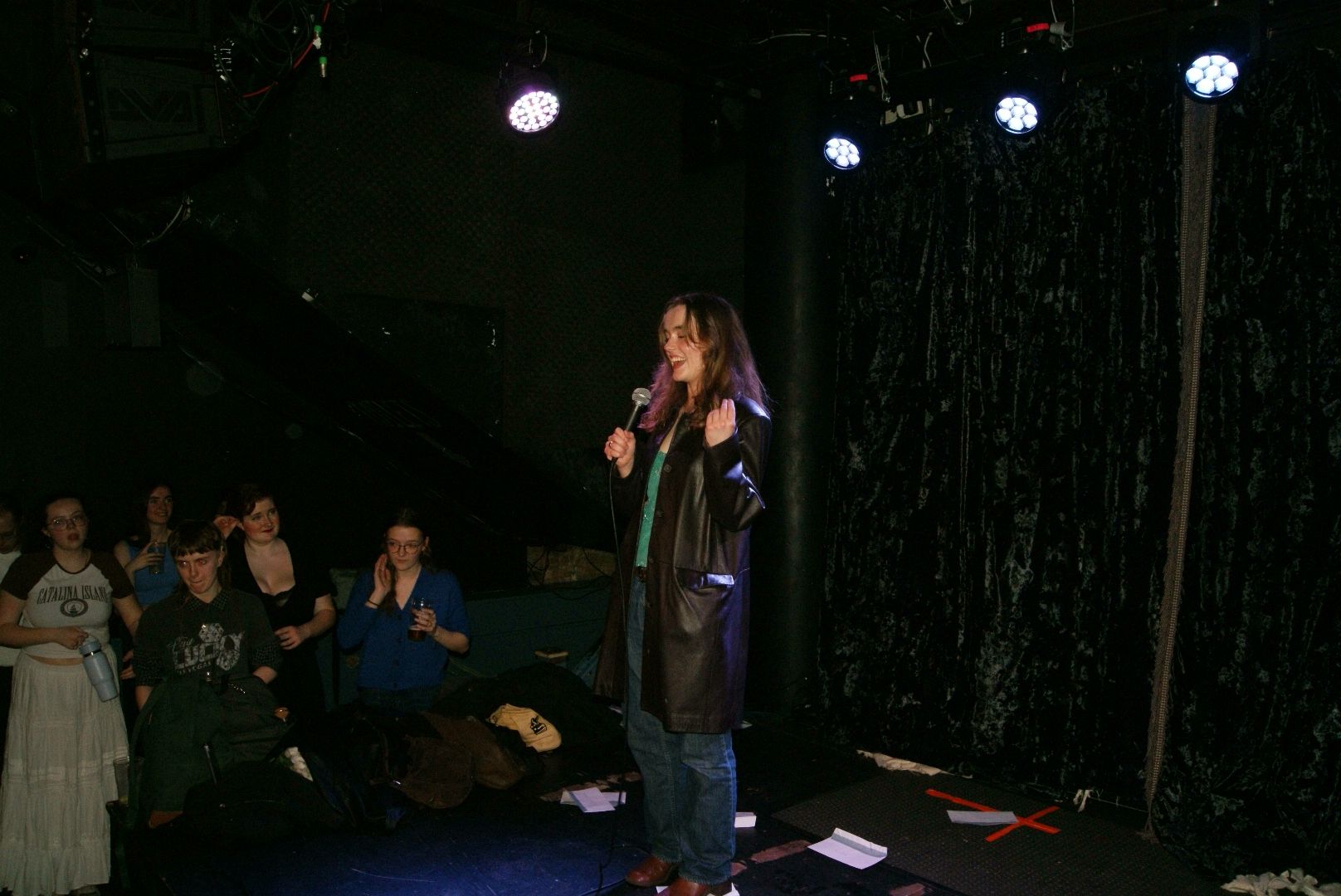
The College Historical Society (Hist) held hustings for the Trinity College Dublin Students’ Union (TCDSU/AMLCT) Presidential Bye-Election. All candidates were present, including Lorenzo Cheasty, Jacob Barron, Grace McNally, and Callum O’Kelly (speaking in that order).
The debate was opened at 3:04pm by Hist Auditor, Hazel Mulkeen. She explained that speeches would last 5 minutes on the motion: “This house believes that the SU has its priorities wrong.” Cheasty, Barron, and O’Kelly spoke for the proposition, while McNally spoke for the opposition.
Cheasty, who was in favour of the motion, was the first to speak. He opened with a description of what he called the “sensational” effigies campaign: referring to a controversial sexual assault awareness campaign orchestrated by the former TCDSU/AMLCT administration. He noted that he objected to the campaign when it was happening, fearing it would “retraumatise” students, and said that it hurt other union campaigns. He said, “student welfare is at the heart of all campaigns”. He moved on to highlight points from his manifesto, including a social supermarket, centering democracy and student welfare through campaigns. He also said he favoured “pragmatism” over short-term campaigning, and ended by underscoring that he wanted to alleviate the “unbearable cost of living”.
Barron spoke second, also in favour of the motion, saying that he was “running on the idea that the SU has its priorities wrong”. He said TCDSU/AMLCT had failed to yield significant results for students, citing that the rent freezes achieved by the union had exclusively applied to those living on campus. He said that protests and campaigns organised by the union had little to do with student life. He said that there were “three sides of campus”: the arts block, the Hamilton building, and St. James’, moving on to say that the union had prioritised arts students. Barron also mentioned the effigy campaign and referred to former Welfare and Equality Officer Hamza Bana’s remark about STEM students being more likely to commit sexual assault. Barron also called the union “toxic”, “performative”, and a mechanism for “bullying”.

McNally spoke third, in opposition to the motion. She opened with a joke that she was “not an SU hack”. McNally reminisced on her pathway into the union as a Health Science student and said: “Students like me who have the least time … are the ones who need [the union] the most.” She said Cheasty contradicted himself by saying the union’s priorities were wrong while sitting on Union Forum, and said she was the only one there “who remembers the good the union does”. She said that the union may “make mistakes”, but that it also “improves students’ lives”. She listed union accomplishments, including the provision of Gaeilge services and divestment from Israel, and said, “you are saying [that] is wrong”. She said she aimed to “give voice to the unheard”, and that she “[stood] [there] without an ego”. She ended by saying that she was “not clouded by [the union’s] mistakes”.
Callum O’Kelly spoke last, also in proposition of the motion. He opened by saying that he wanted to “explain how to put [the unions’ priorities] right”. He continued on to say that media outlets and others highlighted his alleged inexperience and his “not being a class rep”, responding that “involvement is a privilege” and that he did not have time to make ends meet. He cited his experience as a TAP (Trinity Access Program) and HEAR (Higher Education Access Route) student, and his being the first in his family to attend college. He also mentioned that working, disabled, or commuter students “not in this room” had been left behind by the student movement. O’Kelly moved to discuss aims of his manifesto, including price cuts on campus, enforcement of LENS reports, securing a rent freeze, and “no backsliding to apartheid”. He said his campaign was “explicitly activist”, and acknowledged that while the union “does speak about these issues…too often it speaks instead of acts”. He called the union’s priorities “scattered”, and said that the union ought to be “inclusive, unapologetic, and radical”. O’Kelly repeatedly alluded to James Connolly throughout his statement, saying that the Union should serve “neither king nor kaiser” and that “our demands are [most] moderate,” before pivoting to discussing prices in the Buttery.
After the initial speeches, the event moved to questions, where candidates were given 90 seconds to answer. The first question was: “Do you think that defending students’ interests requires a return to direct action?” McNally said she was a “big fan” of direct action, “when necessary”. Cheasty said that direct action “must remain a fundamental part of how our union operates”, and called it a “valuable tool”. Barron said “no”, and said he wanted to make sure that students were “aware of services”. O’Kelly said he was “fighting for a union that fights to win”, and said if the demands were “reasonable” but unmet, that direct action would be necessary.
Chesty was asked directly about his supermarket plan, and the difference between subsidised groceries and student union shops and cafes. Cheasty underscored the “excess of supply [in food] that exists in this country”, and mentioned the “stigma” of food banks. He also said that products “that cost little to buy would cost very little”.
All candidates were asked about student spaces. O’Kelly said he would do “everything in [his] power to either expand libraries…improve seating plans [and] reduce waste of space”, adding that he would not “stand [there] and pretend to have all the answers”. Barron said there needed to be a centralised booking system, and specifically mentioned difficulty in booking rooms in the GMB, saying slots were not allocated for “certain societies”, advocating for a “standardised booking” procedure. Cheasty mentioned the plethora of already empty rooms on campus, also calling the room booking system “unreliable”. He said he would “audit” rooms on campus, which he said had already been done in the business building. McNally mentioned lobbying the college to turn classrooms into student spaces with fridges and microwaves, and said that “[t]he infrastructure is there”, but “college doesn’t want us to have them”. She also said she wanted to get the SU Cafe back in the Health Sciences building.
O’Kelly was asked directly about a statement he made about a “lobbying focused” versus an “activist” president. He said a lobbying president is one who “asks nicely” and gets little done, while an activist president “goes out and delivers”. He underscored “direct and collective action in every possible sense”.
McNally was asked about the financial cost of points in her manifesto on the cost of living and housing. She said, “Trinity has a lot of money”, and she would “lobby with Trinity” and “push and fight with the college as much as [she has] to”.
Barron was asked about his wearing a Turning Point USA hat while on exchange last year, and his association with the Koch-funded Students For Liberty organisation. Students For Liberty is a right-wing libertarian student group. Barron called Turning Point USA a “cringey organisation”, and said, laughing: “I was never bought by the Kochs.”
Cheasty was asked about citing McNally as a reason for running for president due to her involvement in The University Times’ investigation into union sentiments about former TCDSU/AMLCT president Seán Thim. Cheasty said the “previous president” and Cheasty’s own campaigns were “very different” with “lots of different aims”. Cheasty said he and Thim “prioritised direct action in different ways”, and criticised Thim’s “freeze the fees” campaign, calling it “performative”. Cheasty also cited concerns about the mental health element of Thim’s resignation.
When asked about the priorities of the union going forward, McNally said “seven months is a short presidency”, and that she was trying to “put things back in place”. Adding that she wanted to “[bring] it back to where it deserves to be”. To the same question, Cheasty answered “welfare, housing, and reform”, and continued to refer back to his manifesto. Barron said he didn’t want to focus on plans that would cost “millions of euro”, choosing to signpost a jobs board, book service, laptop service, and an accommodation service, as in “promoting services that we already have”. O’Kelly said his priorities were a “cost of living reduction”, “improving the disability service”, and a “top down” reform of the union, “in its entirety”. O’Kelly also drew back to his manifesto, including €4 lunches and self-certified three-day illness notes.
Barron and O’Kelly were then asked about addressing homophobia, racism, and sexual violence on campus, which Mulkeen said were relatively absent from their manifestos. Barron said that the union should “not be performative about it” and that he would “advocate for every student regardless”. O’Kelly said that it wasn’t excluded in “a negative way”, but that the manifesto is “short” and he wants “five big changes”. O’Kelly said he would “be president for all”.
McNally was asked about Cheasty’s comments that she “didn’t properly escalate” her grievances with former president Seán Thim, answering she disagreed. She mentioned that Thim had requested “privacy”, and that she “stood by what [she] said”. McNally said the Oversight Commission had found that Thim “broke the constitution” and that she went through all private forms of communication.
Cheasty was then asked about his role as Housing Rights Officer, specifically being a member of the campaigns committee. Cheasty said he had “no control or jurisdiction” over Thim’s campaigns, and said many of the campaigns had failed. He also highlighted the success of his housing campaigns during his role.
Barron was asked about being mandated to support specific causes that he may disagree with, and he said that if it is something the majority wants, he would back it. O’Kelly was asked about pre-existing €4 lunches, and he said “I would not call that a substantial meal, that’s a sandwich”.
The debate concluded with Barron being asked if he supported voluntary membership of the union, and he said, “in theory, yes” and cited students paying high fees for membership while not having their needs met.
The debate ended with Bailey Armstrong, Chair of the Electoral Commission, reminding audience members to vote. Voting begins tomorrow, November 26th, at 10am, and closes November 28th and 4pm. Voting is available online and in person at the Arts Block, Hamilton Building and select other locations on campus.