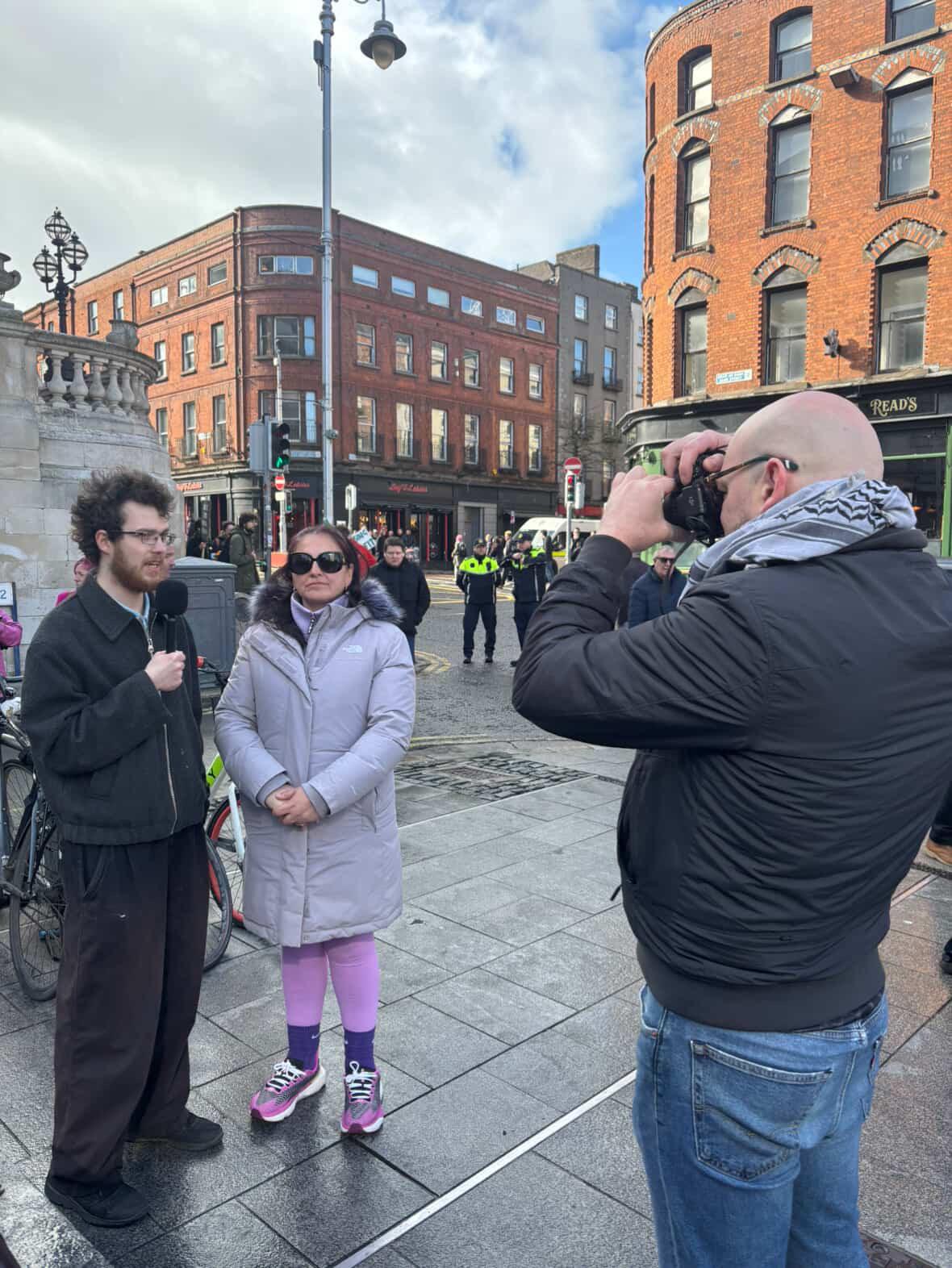
I sat down with Connie Henry, also known by her drag stage name “Sasha Shame”, a pun on the phrase “such a shame”. For Sasha, drag is “the art of expression, specifically of gender. It’s about playing with gender. It’s subversion, changing expectations and giving people new ideas about gender roles, gender presentation and character presentation”. Sasha started drag by dressing up as Marilyn Monroe for Halloween, but now performs regularly at queer bars across Dublin, as well as in the theatre of the UCD Drama Society. “Drag is so multidisciplinary, I write about drag, direct, write plays, poetry, music, do makeup and costume design and I also work with queer youth groups teaching them about Irish queer history,” Sasha told me. She went on to say, “Gender restrictions didn’t feel correct to me; Drag allows me to feel brazen, like nothing could hurt me”.
A very young queen herself, Sasha has nothing but respect for the trailblazing queens of the 1980s and 1990s in Dublin: “Pantie Bliss, Mr Pussy, The Dice Man and Lady Veda are all foundational figures of drag and HIV activism in Ireland. I cannot overstate how much respect I have for especially Veda who keeps queer history alive, who dedicates so much of her work to HIV activism and exploring the shame and the stigma to this very day,” she said.
The Dublin drag scene, a lot like the UK, is spearheaded from the Panto Theatre scene; it’s strongly rooted in panto-dames. Sasha describes how in Irish drag “There is a focus on performance and the artistic vision over polish”. This contrasts highly from the drag scene in the US, which is widely known due to shows like Rupaul’s Drag Race, and due to social media queens. In the states a lot of drag is rooted around the pageant scene, therefore you get a lot of very visually polished performers, with an emphasis on visuals and spectacle. However in Dublin, drag you would see in bars and theatres focus more on politics and performance rather than visual excellence: “You get a lot more loudly political and silly, ugly drag, drag that is willing to get ugly for the sake of a performance. Dublin is a burgeoning scene of variety in drag. Lots of testing the boundaries of what’s next. Irish drag, specifically Dublin drag, really focuses on the individual, being yourself in the most you way you can, regardless of how different you are. If we’re all different no one is compared to a standard in the same way you have that pressure in, for example, the US. In Dublin, I see so many incredible freaks, complete weirdos in drag. I like the disruption, the unsettling aspects of drag. It is an art form rooted in the history of and is building a path for a future of unsettling art. Art that unsettle the status quo that unsettles the standard or expectation, that gives people a surprise, that checks audiences prejudices.”

Connie Henry, the woman behind the persona of Sasha Shame, is an out and proud trans woman. When asked about the difference between Connie’s identity as a trans woman and her performance of drag, she jokingly describes Sasha as “my evil twin, a menace; Ms Hyde to my Dr Jekyll”. Speaking more earnestly, she describes how drag allowed her to explore gender expression before coming out as a trans woman: ”[Sasha] allowed me to explore womanhood and femininity and allowed me to express early on that notion of glamour and womanhood that I didn’t know how to yet. Now that I’m living as a woman day to day she allows me to express hyper-femininity and the utmost glamour and also to express sides of femininity that I don’t get to day to day. Connie and Sasha are intrinsically linked; they’re woven around each other. Sasha allows me to explore more androgynous and freaky out there expressions; To explore the visceral rage of being a woman that I often temper as Connie.”
This visceral female rage encapsulates how politically tuned in the young drag star really is. While Dublin is a relatively progressive city, echoes of the Catholic homophobia and transphobia of Dublin’s past are still present. Whilst she accepts “Dublin is not as bad as it once was”, the far right nationalistic movement in this country can’t be ignored, and queer ambassadors, drag queens, as well as trans people are at the front lines of far right bigotry: “Dublin itself isn’t aggressive, but there are people who are scared and small minded and frustrated about things they can’t explain so they find the easy scapegoat”. With the rise of the liberalism of 21st century Ireland, which culminated in the marriage equality referendum in 2015 and queer visibility and acceptance skyrocketing, however one cannot ignore the new frontier of bigotry that the online space has created: “Dublin itself isn’t scary, the Irish internet space is scary. Far right protests are organised from the online space”. Anti-drag and Anti-trans sentiments are evergreen talking points for the online far right space, leaving queer performers like Sasha with harassment. When asked about JK Rowling, a key spearheader against gender identity expression, Sasha had this to say: “That’s a gross nasty way to be. I don’t want anything to do with her. She chooses to be cruel and it’s pathetic and bizarre. It’s very ironic that she went under a male name as her pen name so she could get published and read by a male audience; She wanted to be perceived as male by readers and now attacks those who want to be perceived as the gender of their choice. Very ironic.”
Drag is a medium of both political and personal expression, yet is also a performance art. Sasha performs drag in local queer bars as well as the UCD Drama Society. When asked how she balances the empowerment aspect of drag with performing for and wanting to entertain an audience, Sasha states, “I think it’s something we all do the dance of a lot. Of like “I wanna do something heartfelt and emotional and really talk about the empowerment of drag and political activism and making a statement that’s hard to swallow sometimes” but also we do wanna keep the audiences on our side. I have enough faith in myself to keep an audience engaged and really get them to listen to a serious performance. Joy and sincerity and silliness are still true to me; giving people levity and hope. As a performer I like to fan the flames of rage and joy and hope and action in people but still keep them entertained. There’s time for seriousness and sadness and I think it’s important that people are made uncomfortable by art. It’s a balance that we walk all the time but once you know how to walk it it’s a lot of fun to test out the boundaries and find where you can do both.”
With the immense publicity of drag in pop culture through shows like Rupaul’s Drag Race and social media, it’s important to also uplift and support local Dublin queens like Sasha Shame, who are on the ground shaking up the gender status quo and acting as leaders of the Irish queer community.