This is a part of history that has been erased by Chinese officials, even though it happened only three years ago.
In November 2022, China had the largest pro-democracy movement since the Tiananmen Square massacre in 1989 — the White Paper Movement. Yet this memory seems to have been almost entirely wiped out under state censorship.
What was the White Paper Movement about? In 2022, the Chinese government was enforcing one of the world’s harshest lockdown policies, which lasted nearly a year. Many residents were fully confined to their apartments. On November 24th, a fire in Urumqi killed 10 people and injured 9 in a lockdown residence. Footage showed that the fire exit had been blocked due to COVID restrictions.

At this point in China there was already public resentment toward the harsh COVID control measures. A month before the Urumqi fire, on 31 October 2022, activist Peng Lifa went on a self-sacrificed protest on Sitong Bridge in Beijing, he lit a fire on the bridge and posted the banner, “say no to covid test, say yes to eat”, “say no to lockdown, say yes to freedom” and other banners criticism Xi Jinping and his party. He was soon arrested by the police and he hasn’t been seen in the public since. Peng’s heroic action inspired more social activists in the country to make actions, and the fire in Urumqi was no doubt lit up the fire of protest.
There are videos of students commemorating the fire victims on social media in big cities. On the night of 26th November, commemoration gradually developed into this social movement, people started to gather on the street in six cities including Shanghai, holding banners that call for the end of the lockdown, an election in the country, and the resignation of Xi Jinping. On the next day, protests spread to other cities including Beijing.
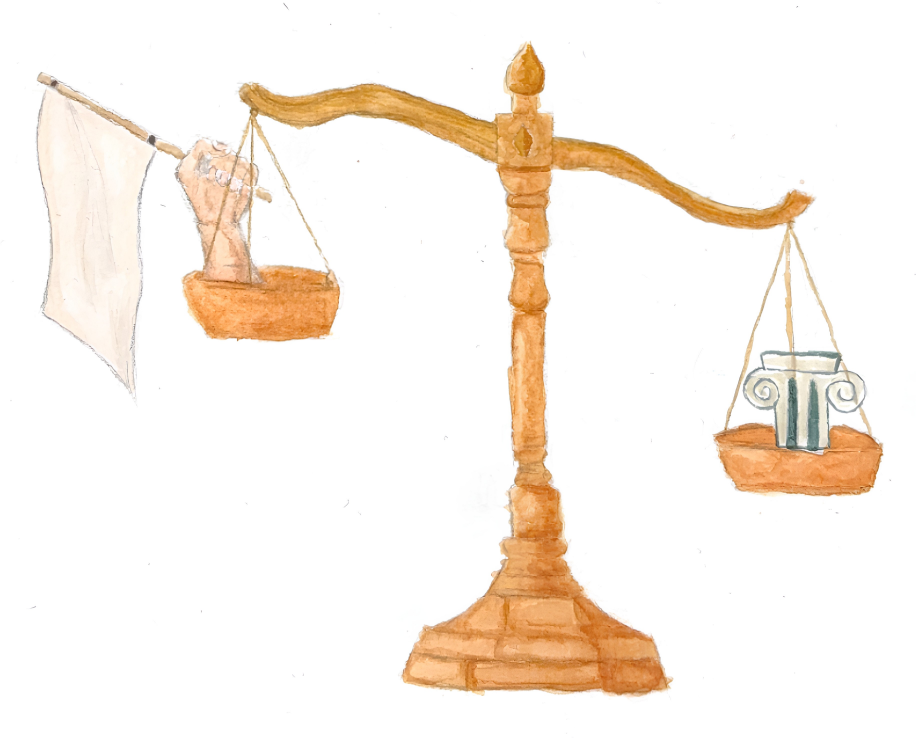
Since every political banner which criticises the Chinese government is illegal, they instead were just holding a piece of paper, which gives name to this movement. Some believe the white paper represented the white masks of the quarantine enforcers, personally I believe it is a sarcastic reflection of the censorship, like: “Hi, I can’t say it but we all know what I want to say”, and ironically, people got into trouble just for holding a piece of blank paper.
Under the Chinese Criminal law article 293, act of protest like this is considered as “Disrupting Public Order”, and will be punished by detention or imprisonment. Moreover, Chinese police force often oversteps the legal procedures before conviction, they can detain protesters for up to 48 hours in police stations for unofficial interrogation and torture, including forcing victims into dehydration and sleep deprivation.
Under the severe suppression, it was anticipated that the protest went out like a candle in the wind, the White Paper Movement lasted no more than a week. There are no official statistics about the names or the number of the participants, or what happened to these individuals. Rumours on the social media mentioned that, based on different degrees of participation, punishment ranged from expulsion to imprisonment. There are very few available sources of this movement that can be found on the internet, and zero information will be found if using the Chinese-approved search engine, Baidu.
Activists like Peng Lifa were voluntarily involved in these protests and were aware of the consequences of their actions. The protest didn’t have a unified chant and perhaps many protesters had different political demands. What they are speaking up for is the right to speak up. They wanted to tell the world that they believe people have a right to make decisions for their society they live in, and protesting under that amount of risk just proved how much they value that right.
Movements like The White Paper Movement are incredibly rare in the history of PRC. China has always been largely tolerant of political totalitarianism. Since the establishment of the PRC in 1949, the country has been through several catastrophes because of the CCP’s radical social reform. During the Great Leap Forward(1958–1962) and the Cultural Revolution (1966-1976), an estimated 20–45 million people died due to misallocation of food, street violence, and government-approved class violence. Not until the 1989 Tiananmen Massacre, the country witnessed a large social movement that challenged the monopoly of power of the CCP, and failed tragically.
And the oppression of Tiananmen Square Massacre marked the end of democratisation of the nation for 33 years, until The White Paper Movement. The three years of COVID lockdown, during which the Chinese government attempted to implement an unrealistic zero-COVID policy, suggest that the same systemic flaws seen in the Cultural Revolution still exist today in this one-party state. The efficiency of actions in the Chinese regime is prioritized over civil rights and legal procedures, and the grassroots government blindly follows—if not radicalises—the orders from the central government.
The Chinese government does not recognise this systematic flaw under the single leadership. The official response on the communist website to the CCP’s most infamous political episode, the Cultural Revolution, is: “The party members had the wrong focus on the class conflict and neglected the objective fact of economic development”. When the system fails, the government always blames the people who run it instead of the system itself, does not allow any objections, and constantly neglects voices outside the party.
Moreover, the regime has been actively punishing the people who speak out about the social issues. During the Cultural Revolution the regime was prosecuting intellectuals; the same happened during the Tiananmen massacre, the students were being slaughtered. Eventually history repeated in the White Paper Movement. The government has been prevailing every time when social actors tried to change the system. The main reason is, each time when there were voices speaking out against the government, they were not supported either by the western government or the local community.
In 2022, I was only a first-semester student when the protest broke out in China, so I contacted the SU and Chinese Society. In the unofficial meeting with the SU president at that time, she happily mentioned that SU could make an announcement, organise a protest and even set up a committee. I don’t recall anything that has happened since. I texted Trinity Chinese Society about organising events to support the protest and commemorate the fire victims. I received the following response, “We can’t host activities outside the campus. We understand how you feel but there is no precedent of such activities being hosted by the school society, commemoration activities are normally hosted in the chapel.”
Trinity was like a reflection to the general pattern of the responses to the Chinese human right abuses. Western governments are verbally active but quickly shift the attention away. While the Chinese community mostly stands aside as long as it does not directly affect their life.
The Chinese community in foreign generally shows little initiative to support such movements, despite the cultural reason, it’s also partly because the Chinese government has an invisible agency abroad that keeps surveillance on its citizens. In 2022, an illegal Chinese police station was found in Dublin Capel Street, persuading 230,000 emigrants to return to China or face criminal charges. In 2025 Irish Times again reported about the Capel Street police station. In 2023, another police station was reported in Belfast.
There are also many Chinese party members abroad. The Confucius Institute, including the branch in UCD, is the official government educational institution abroad directly from the Chinese government; most of the staff are party members with internal channels of the report system connected to the central government. Even among the international students’ community, there are a number of students who have backgrounds as party members. The threat of surveillance by the party continues to intimidate people and enforce censorship abroad.
The reason that the totalitarian state like CCP are burying this history is because they are trying to portray an illusion that Chinese are fully satisfied with one party leadership thereby legitimising the monopoly of power. This illusion is not true, if there is suppression, there is resentment. Dictatorship hides that resentment because once people hear the resentment, they realise they are not alone, and they are more likely to unify their voices, revealing the legitimacy of this dictatorship is in fact questionable.
This historical erasure has been even intensified in the last three years in China. Not only is the White Paper Movement completely wiped out from the Chinese search engine or any media recording, but even the memory of COVID lockdown or Cultural Revolution as such are being censored online. Chinese officials have continued promoting the term “positive energy” (正能量) on social media, so the negative content, even as small as criticising the school policy will be removed. The goal is that internet users in China shall learn about nothing but good things happening in the country.
Censorship exists because dictators are unable to argue against the truth, and the only way to combat it is by collectively acknowledging the truth. There are many reasons why individuals, no matter what country they are from, choose not to make sacrifices for the social movement. It’s not a noble decision, but a reasonable one. However the least thing people can do is to remember those who participated in the sacrifice. If we don’t let our history be manipulated, there will always be hope in our memory, and perhaps history will have its justice.
On 27th November 2022, the world witnessed this White Paper Movement in China.