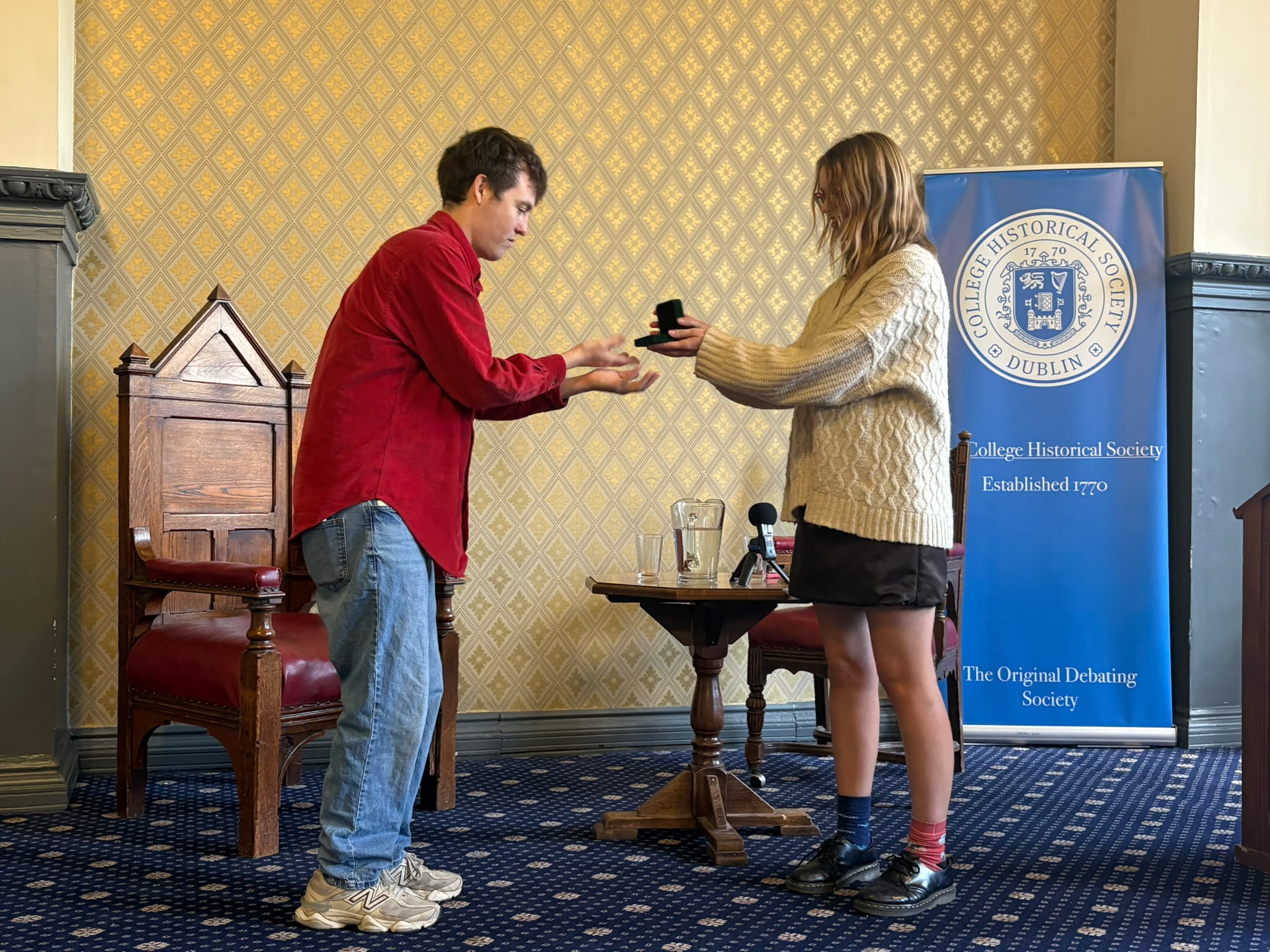
The Comhairle Hustings took place on February 17th, at 6pm in the Edmund Burke Theatre. The event was led by Chair of Council Bailey Armstrong alongside the current sabbatical team and replaced the Welfare & Equality Hustings of last year’s election as the first question-based hustings of the year. The hustings gave the Trinity College Dublin Students’ Union (TCDSU/AMLCT) candidates an opportunity to respond to both general questions and inquiries regarding their respective manifestos. Each candidate was given one minute to answer each question. The venue was only at around one quarter capacity.
Editor of the University Times (UT)
Harper Alderson, the only candidate for the post of UT Editor, was asked whether she feels students should continue to pay for both the University Times and Trinity News. She answered “yes!” further stating that both newspapers should exist because they both make each other better. She also mentioned that the student contribution and UT budget is not that high. Afterwards, she addressed concerns about UT’s journalistic objectivity, given that its editorial integrity could be compromised by UT’s status as a TCDSU subsidiary. She stated that “when the union tries to impede with the content, it must be struck down”, referencing TCDSU. The second question posed was about what level of oversight non-journalists should have. Alderson answered that anybody can be a journalist at Trinity — “That’s true now and that’s true next year if I’m elected” — and that there are multiple ways of having your voice heard. She also stated that non-journalists are able to engage in mechanisms of accountability by engaging with the University Times.

Graduate Officer
The first question posed to both candidates asked how they would go around promoting engagement in Class Rep elections. Ava Tuohy stated that she will want to “go to every postgrad induction and speak to the classes and talk to them about what it is and what it means just so they know what it means to be a Class Rep” and “So they can see my face and who I am as a Graduate Officer”. Féith Ní Chléirigh stated they want to “show how fun events can be” and stated that they will ask the people what they think they should do about that, as she needs “a lot of advice”. Ava Tuohy was then asked about representing both taught and research postgraduates, and she acknowledged the existence of both challenges and similarities, stating that she is “aware [she] has never been a researcher” but she will “talk to as many [postgrads] as she can”.Ní Chléirigh was then asked about their goals if elected, as their manifesto does not contain any campaign promises. They answered that they were “unsure” on what to write, but that they provided more information to Trinity News. Further, they stated that they will “see where I can help everyone fit in”.
Oifigeach na Gaeilge
The questions for the Oifigeach na Gaeilge (Irish Officer) race was chaired by the Chair of the Oversight Commission, Aaron Groome, and the questions and answers were all conducted in Irish. The general question posed to both candidates was in regards to conducting student services in Irish. When both candidates were asked after the event to provide clarification on their answers in English, Hugh Ó Ríordáin, was first to answer and stated how “College needs to provide more modules in Irish, there’s already demand for this, and there are already lecturers who can provide this. They just need the system and the funding to facilitate it. They already do this in Wales with over 900 courses”. Mary Kate Ní Artáin would call student services in Irish, “not an invisible problem. There is demand for these services”, continuing to say how she would pressure College to “start giving students the choice of submitting work in Irish or English”. Ó Ríordáin was asked about the presence of more general training outside the usual remit of the Oifigeach na Gaeilge, present in his manifesto, “[Oifigeach na Gaelige] should have basic training so they can direct students to the right places”, additionally, “other sabbatical officers should be able to provide basic services in Irish”. Ní Artáin was asked about the incorporation of Irish in student societies. Ní Artáin responded “I would love to meet up” with the Irish officers of and the receptive committees for societies and sabbatical committees “to discuss different options to incorporate Irish for everyone in these societies”. Ní Artáin continued, “I would incorporate Irish in them, to come up with something for all students to enjoy while still using their cúpla focal”.
Entertainments Officer
The questions were posed by the second guest chair, the current Ents Officer Orla Norton. She asked about what the candidates plan to do differently in the role, “step by step”. Danila Kitaev stated that it is “very important to keep finger on the pulse” when it comes to what students want. Further, he referred to his experience on the Ents OCM subcommittee: “We expected a lot of club nights, what turned out to happen was that people were not engaged in club nights, they didn’t want to go to club nights…but we have to try to keep a finger on the pulse.” Finn Hallwood primarily referenced his plans for live music showcases on campus, and Trinity Ball’s (TBall) “rolling bar”. He plans to work heavily with DU Alternative Music Society and DU Music, as well as labels and different bands within the Dublin area. Hallwood was then asked what incentives would promoters have for his live music showcases and this would translate to bargaining power. He stated that this would give smaller bands a platform, stating, “It’s not something that will be feasible for my generation of Trinity students but for students who come in the next year”. Kitaev was then asked about his plans for the Ents loyalty scheme, stating that he “want[s] Ents to be as affordable as possible for students”. “We should be able to have a … some sort of incentive to do that … that’s why I think it would be great.”
Communications and Marketing Officer
The questions were asked by the current Comms Officer Channing Kehoe. The general question asked about the biggest challenge to sustaining engagement. Promise Okafor answered: “definitely getting them to understand content”, which she wants to make more “creative and engaging”, through different transitions and edits. Alice Moran answered next, talking about “gaps in the platforms we put across”. She talked about refurbishing the website, as well as focusing on Facebook. Matthew Kurt talked about “giving people a chance to engage in a way they want to engage”, saying he plans to boost online engagement through video content, and in-person engagement by talking to people. Jacob Barron stated that it’s a “shame that only Class Reps know what’s going on in council”, and stated that he plans to advertise that content. He also talked about translating communication into multiple languages.
For the individual round of questioning, Jacob Barron was asked about how he plans to make the weekly email an opt-in feature, he answered “I don’t think that will be very difficult”, cited the idea of creating a form for this purpose and stated that “it is a shame to bombard people with emails who don’t want them”. Matthew Kurt was then asked to address the fact that two manifesto points (WhatsApp being one) have already been implemented. He stated he plans to draw on WhatsApp communities for campaigns as inspiration as well as a gauge for what students want from the Communications & Marketing Team. And that he plans on “expanding the system that is already in place” and “making sure that the SU is present and visible for every person”. Alice Moran was then asked about potential funding opportunities competing with the values of the College, and answered “I would follow those until they’re … at Comhairle”. “For assessing ethical values vs affordability … I would prioritize affordability overall but ethical values would back that up.” Promise Okafor was then asked about her plans for reaching out to different committees and societies during different times of the year. She cited the simplicity of reposting events on TCDSU socials and said: “We see what they’re doing all the time … but it would be nice for the SU to engage more with them.”
Welfare and Equality Officer
The questions in this round were asked by the guest chair, current Officer Deirdre Leahy. Both candidates were asked whether they prioritised lobbying College to provide more student services, or whether they felt that TCDSU should step in directly where College falls short. Rossa Bolger stated that “there is so much this college can offer students and should” and addressed the importance of casework which is “central to the SU”. Lorenzo Cheasty answered “I think we need to take a multifaceted approach to make sure the college fulfills its obligations. Lobby the government, focus on direct welfare provision, our union has a great potential to help the lives of students”. He cited his idea of the social supermarket to “plug welfare gaps”. Bolger was then asked about his plan on enforcing PTO oversight and coordination without limiting their important work. He stated that managing who works with who can play a massive role in how successful the union is, and mentioned the importance of PTOs, who do “so much for the union”, specifically mentioning Housing Rights Officer, Lorenzo Cheasty. Cheasty was then asked why “several points of [his] manifesto repeat welfare officer current mandates”. After asking a question about the question, Cheasty stated that he plans to “achieve the maximum potential of what they’re mandated”, stating that a “large part of welfare officers job is fulfilling the mandate”. He mentioned the social supermarket yet again stating he is “very passionate” about them, as well as welfare, stating, “these are things I would like to personally fulfill but the other ones, need sustained support for”.
President
The questions in the final round were again asked by Bailey Armstrong, as the current TCDSU President, Grace McNally, is also running in the election. The general question asked the candidates about what they believe to be the place of direct action in the union. Jonathan Hoffman stated that it is a “really really important tool in the arsenal of the union” and “not something we should abandon and be scared of”; however, he acknowledged that “we need to use it right”. “If our last resort is also our first response, it is not effective.” Cathal Horgan acknowledged the role direct action has had in the College: “Without it, we wouldn’t be able to eat our own food in the Buttery”, also mentioning the ongoing ties to Israeli institutions. He also stated that “sometimes students only see the union when we are protesting”, and added: “We can all admit the government has failed students, but so has the Students’ Union.” Amy Kennedy stated that she believes that communication of actual goal of direct action, mentioning the lack of student knowledge about the port protests: “If they knew it was for Palestine, they would be more supportive. She stated that “That is how we need to go forward.” and that she believes “We have a strong role being the university the closest to the Dáil.” Tadhg Ó Neil stated that he believes in “direct action first and foremost for the students, rather than above the students”, and also mentioned the port blockade, specifcally that it delayed his commute and that “allowing these campaigns to be disruptive to student life is completely unacceptable”. He also stated he believes that many protests have pushed causes against the beliefs of the general student body. Grace McNally stated that she believes direct action to be “absolutely necessary” and mentioned her own experience with protests: “I know how to start a campaign … I know when it is necessary and when it isn’t necessary … “Sometimes it can be, to block the port … That was for an incredible cause. Sometimes you just know what and when it is necessary. We need to be loud and act fast [sic] for some issues.”
Jonathan Hoffman’s individual question addressed the new TCDSU positions that he plans to implement to “ tackle issues of coordination, direction and legislation” and asked how “how these bodies will differ from the already existing Sabbatical Board, Union Forum and Comhairle?” He stated that “Structurally, [the SU] is not as effective as it can be”. He mentioned class reps not showing up to Comhairles and that votes between the courses are not equally proportionate. He stated that he plans for the SU assembly to work aside Comhairle only on legislative issues, and to for roles to be elected on faculty basis. Cathal Horgan was asked about how he plans to represent Trinity’s policy of no confidence in the government as a member of Cumann Wolfe Tone, the Trinity branch of Fianna Fáil. He stated that the government has failed students and the SU has also failed students, stating “there’s students across campus who aren’t being listened to”. He also mentioned he plans to work more with unions across the country. Amy Kennedy was asked whether the RON campaign last year (for which she was campaign manager) weakened the trust in the SU. She answered: I firstly do not feel it increased any sense of division; if students don’t feel their voices aren’t heard, they are less likely to get involved” she also stated that the campaign was run by students within the SU, class reps and PTOs. Further, she admitted that “acknowledging external criticism of the union is important…to getting students involved”. Tadhg Ó Neil was asked about how he plans to tackle the “widespread bullying issue” within TCDSU, an issue he has mentioned previously. He mentioned an “unwillingness to call out your friends” within the union, and suggested that the fact that he’s “not very friendly with a lot of people within the union” puts him in a good position to “call people out”. He also said he didn’t particularly want to be friends with anyone on the SU. Current SU President, Grace McNally was asked whether she feels she had any role in the perception of the union as inaccessible. She answered that “[she] think[s] the SU can be very uninclusive sometimes…we have so many students living so many different lives….its impossible to find every single one of them”. She also mentioned that because of that “we didn’t have this aspect of health science students in the union … The first nursing president was a really big deal.”
The Hustings was brought to a close just after 7pm.
Additional reporting by Manasvini Naren, Amalia Madrid-Lilly, Henry Brown, and John Crofton