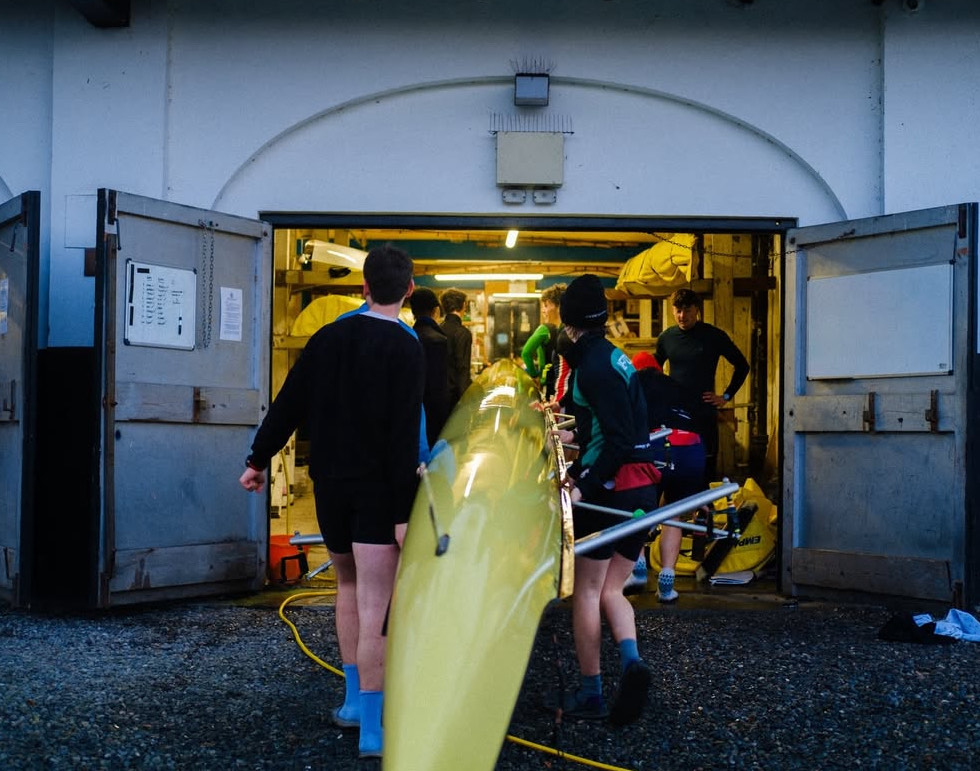

A unique opportunity presents itself when a student is first embarking on their college experience: the option to take up rowing at the university level. But what does being a rower entail? With the help of Sam Walker and Eliza Barrett-Cotter, captains of the Dublin University Boat Club (DUBC) and Dublin University Ladies Boat Club (DULBC), this article will attempt to give an overview of what life as a Trinity rower is like.
Both Sam and Eliza secured their position as captain of their squads having first involved themselves in rowing as first years at Trinity College Dublin. Sam emphasised the fact that rowing is “completely different to any other sport”, as “it’s something you can pick up late, when you enter college, and still get to quite a high level”. This makes rowing an ideal opportunity for those who wish to involve themselves in competitive sport, despite not having had much athletic experience prior to entering college.
DUBC and DULBC are separated into two “branches”: novices and seniors. While the novice team is open to all those wanting to try out rowing for the first time – whether you’re a first year in university or completing your PhD – the senior squad is reserved for those who are able to make it past the trials and tribulations of novice training. For this reason, the novice group tends to be substantially large at the beginning of the academic year (with over seventy novice sign-ups on the ladies team at the start of last semester), but gradually dwindles in size as the season progresses.

Though the difficulty of being a novice rower shouldn’t be underestimated, it’s important to note that training for novices is significantly lighter than for seniors. While novices might train an average of five sessions a week, “senior men train pretty much every day”, according to Sam. Eliza confirmed this, stating that “there’s a level of training that you hit when you’re a senior that’s just that much harder”. Sam conceded that the intensity of the training itself might not be as physically demanding as other sports, but clarified that, as it is an endurance-based sport, rowing is “one of the hardest, in terms of time commitment”. Considering the already substantial workload of completing an undergraduate degree, this aspect of the club can make the prospect of taking up rowing seem quite daunting. Eliza’s experience with rowing brings in another perspective, however: rather than monopolising her time, she argues that rowing has made her more productive in the way she spends it: “all the time I could be doom-scrolling, I spend on rowing instead”.
Both novices and seniors take part in rowing competitions in the second semester of the academic year. While the Newry head race is fast approaching on February 21st, the most eagerly anticipated of these competitions is set to take place on March 21st, on the River Liffey. On this date, Trinity College will go head-to-head with their long-standing rivals UCD in four separate races involving the novice and senior squads for both the male and female clubs.
As the rowers prepare for the impending racing season, maximising boat speed is increasingly becoming a priority. While Sam suggests that the most important aspect of rowing is a combination of both power and technique, Eliza argues that it isn’t necessarily power, but rhythm which can make the difference: “you might have the fastest crew on paper, but on the water it doesn’t work”. She develops this by stating that the best way to generate a sense of chemistry within the group is to ensure that everyone is committed to the training sessions, which she claims fuses people together through the “shared trauma” of vigorous exercise.
But rowing isn’t purely defined by the intensity of its training schedule. In fact, when asked what genre of music the sport could most accurately be likened to, Eliza opted for classical music, describing the feeling of rowing as “gliding” on the water. “When you’re on the boat, it can be quite peaceful”, she says, “and our winter camp trips to Blessington can be very picturesque”.
While there is much overlap in the activities of both clubs, when asked what the fundamental difference was between the DUBC and DULBC, Sam pointed out that the men’s team has a much stronger alumni base: “I have a lot of help with my job, whereas Eliza has to work in a harder environment”.
When Eliza was posed with the same question, she responded with the one quality she believed the women’s team had over the men: “Brains”.
This month’s rowing terminology:
“Catching a crab” – when a rower loses control of their oar, failing to properly extract it at the end of a stroke.