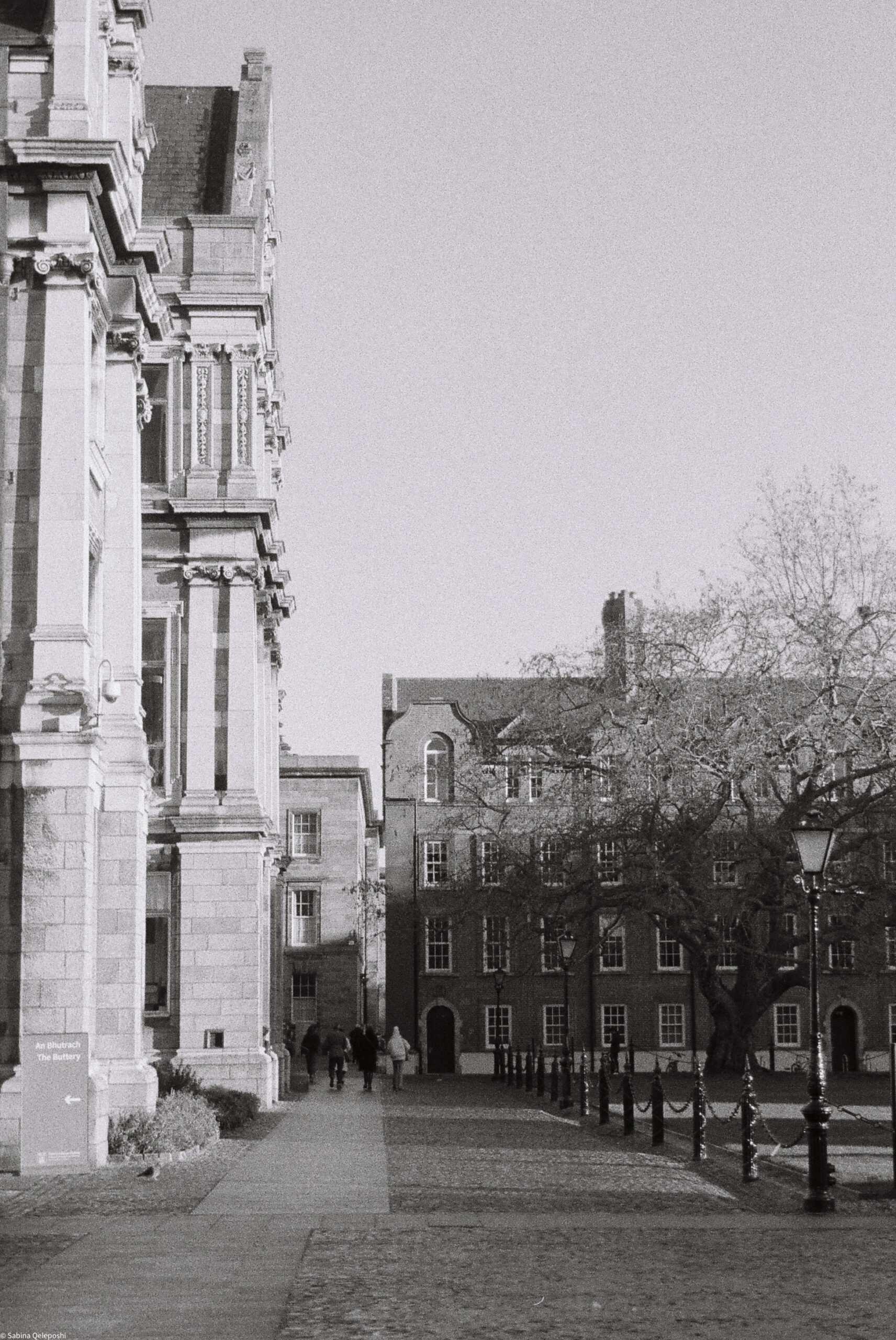

On Monday, March 23rd, the Cork poet and theologian Pádraig Ó Tuama very nearly delivered a speech on the stories of the Bible as fodder for poetry and wonder in the debating chamber of the Graduate Memorial Building (GMB) at Trinity College Dublin. A die-hard fan of Pádraig and his podcast Poetry Unbound — a show that wants to make great poems accessible and interesting even to people who profess to hate poetry — I was surprised that the 10am event was advertised with so little fanfare. The only promotion I’d seen on campus was a small, muted green poster, almost hidden among the hundreds of other colourful advertisements in the main entrance. It hung high up on the stone wall by the front gates, and when I happened upon Pádraig’s bright smile beaming down at me in the darkened passageway, I felt certain his visit to Trinity was a message from higher, unknowable forces.
I was on the phone with my mum back in Canada, subjecting her to another burst of my somewhat frantic, unfiltered thoughts. These calls had become increasingly frequent since my crossing of the pond. They could be provoked by discomforts big and small. I called her when I discovered, with indignation, that the fancier brand of baked beans I’d bought at Marks & Spencer was sweetened with stevia — who would do such a thing? — and when the poem I’d written for Icarus wasn’t accepted for publication. On this occasion, I had just gotten out of a Roman History lecture where I felt particularly out of my depth. My peers all seemed able to decipher inscriptions on Roman tablets and funerary altars with ease, could recite successions of emperors and dynasties as if by rote, and when our professor asked, “Who became emperor after Macrinus?”, they all shot up their arms: “Well, Elagabalus, of course.” “Elagabalus, of course? What do you mean, of course?” I asked my mum.
Three months ago, before my exchange, if you’d told me I’d be calling home for maternal reassurance almost daily, I would have been very surprised. Like many North Americans from countries with much younger literary traditions, I’d imagined I’d land in the Land of Writers and immediately start flying from ritzy poetry readings to invite-only launches of avant-garde magazines with only slightly nauseating names like Simulacra Review or Stimulus Mag, in rooms with cream-coloured walls and herringbone floors, gliding up to podiums in a sequined silver skirt under ornate vaulted ceilings. At Trinity, in the School of English, I’d fall in with the rising Dublin literati, be swiftly swept under the suave wings of little Bolands and Heaneys, who’d kindly give me the formula for finding my voice, who’d share the secret recipe for transforming the silent dread of sunless white afternoons — when the only thing it seems one can do is stuff the void with Lidl microwave popcorn — into clever, compact little poems instead.
But when I arrived in Dublin, although I did fall in love with The Country Girls — Cait and Baba — stare down the tall brown stacks of books and rows of marble busts in the Old Library in wonder, visit the cosy pub where James met Nora, I still gave entire hours to Instagram Reels, found that no witty limericks floated up in the foam of my Guinness, and my pen did not flash across my notebooks with any greater frenzy than it did back in snowy Montreal. I made lovely friends — some bookish and others who programmed computers — but at the start of my exchange I felt a new, tugging loneliness and a gnawing disillusionment.
I missed my cats in the slightly stark IKEA-white of my student accommodation and came close to plucking a seagull from off St Stephen’s Green for a little companionship. “I’m sure Seamus Heaney never shuffled awkwardly to Shakira’s ‘Hips Don’t Lie’ in a nightclub belting anthems stolen from my high school prom playlist”, I thought bitterly, not wanting to accept that this was the only way to meet people.
I tried writing about the preserved bodies I’d seen at the National Museum, but this felt phony. My language was not that of the bog, but of ice‑cracked roads and exhaust‑blackened snowbanks the size of small mountains, of steaming, salty poutines after nights out on St Laurent Boulevard rather than spice bags after too many beers in a club basement on Harcourt Street.
When I found out that Pádraig was coming to Trinity, I was still clinging to some of the illusions I’d brought to Dublin and felt sure this would be the event that would redeem my literary frustrations. I’d get there early and speak to him; he’d reassure me I was on the right path, agree to mentor me, help me pull from my depths the poems that had
mysteriously gotten blocked, or he’d deliver a line so brilliantly insightful that my notebooks would soon be bursting with observant prose. So, on the Sunday evening before his visit, I put myself to bed early and made sure to charge my earbuds. It had been a long time since I’d listened to Poetry Unbound, and it would be thrilling to listen to Pádraig on my way to seeing him in the flesh.
In the morning, I dressed quickly and swallowed a boiled egg, then put an old playlist of my favourite episodes on shuffle. The familiar, soothing piano theme trilled — it was an episode from the first season: Patrick Kavanagh’s “The One”. “A humble scene, in a backwards place, where no one important ever looked”, read Pádraig in his comforting timbre. I’d first heard this delicious line during the first weeks of the pandemic, when my mum had introduced me to the podcast. While my friends were breaking quarantine to try ketamine in the frozen park near my house, my addiction was to Poetry Unbound, which says something about the kind of teen I was. That line was a balm on the sharp loneliness I felt. My home often felt like a backwards place where no one important ever looked.
As I crossed the stone bridge over the lake on the Green, Pádraig delved into his interpretation: “Kavanagh is drawing everyone back to that bog where nobody’s looking, but it’s where you’re from. It’s what you see. That’s the source of self and home that you need to return to without hatred, without self-comparison.”
I hadn’t heard these words in a very long time, and in a strange moment of premonition, they made me think that even if the event were, for some reason, cancelled, Pádraig’s near visit might be enough to draw me out of my predicament. I had been busy looking in other people’s bogs for my own stories. I suppose I thought Irish suffering was somehow worthier or more poetic than my own Québécois suffering. I was also just looking for a quick fix. Maybe it’s the feeling created by Instagram that one must constantly justify one’s existence with a steady stream of creative output, or maybe it’s having a workaholic dad who can’t feel good about himself at rest, but I hold myself to sometimes militaristic standards in terms of the amount of work I think I should be putting out into the world. The idea that as soon as I stepped off the plane I’d have a neat little memoir to show for myself was certainly a comforting fantasy. I thought I’d come to Ireland and be so inspired that the chapters would write themselves.
I reached the GMB and found the room empty. A security guard informed me that the talk had been cancelled due to unforeseen events. Of course, I was disappointed not to see Pádraig and hoped he was in good health, but I kept my cool, put my earbuds back in, and unpaused my episode.
“And that is a deep and human anxiety”, continued Pádraig, “to figure out what does it mean to be me, from where I’m from? And this poem isn’t saying, ‘Do it now. Do it quickly. Answer the question, the exam, and get over it when you’re 15’. This is saying, ‘You’ll probably be asking this question for the rest of your life,’ and that there is the possibility of deepening your relationship with something that might once have been troubled.”
I walked down the steps of the GMB, resolving to let Ireland be Ireland, Erasmus be Erasmus. They could only offer themselves up to me in full if I released them from the weight of my impossible expectations — and if I finally stopped pretending that my own bog wasn’t worth looking at.