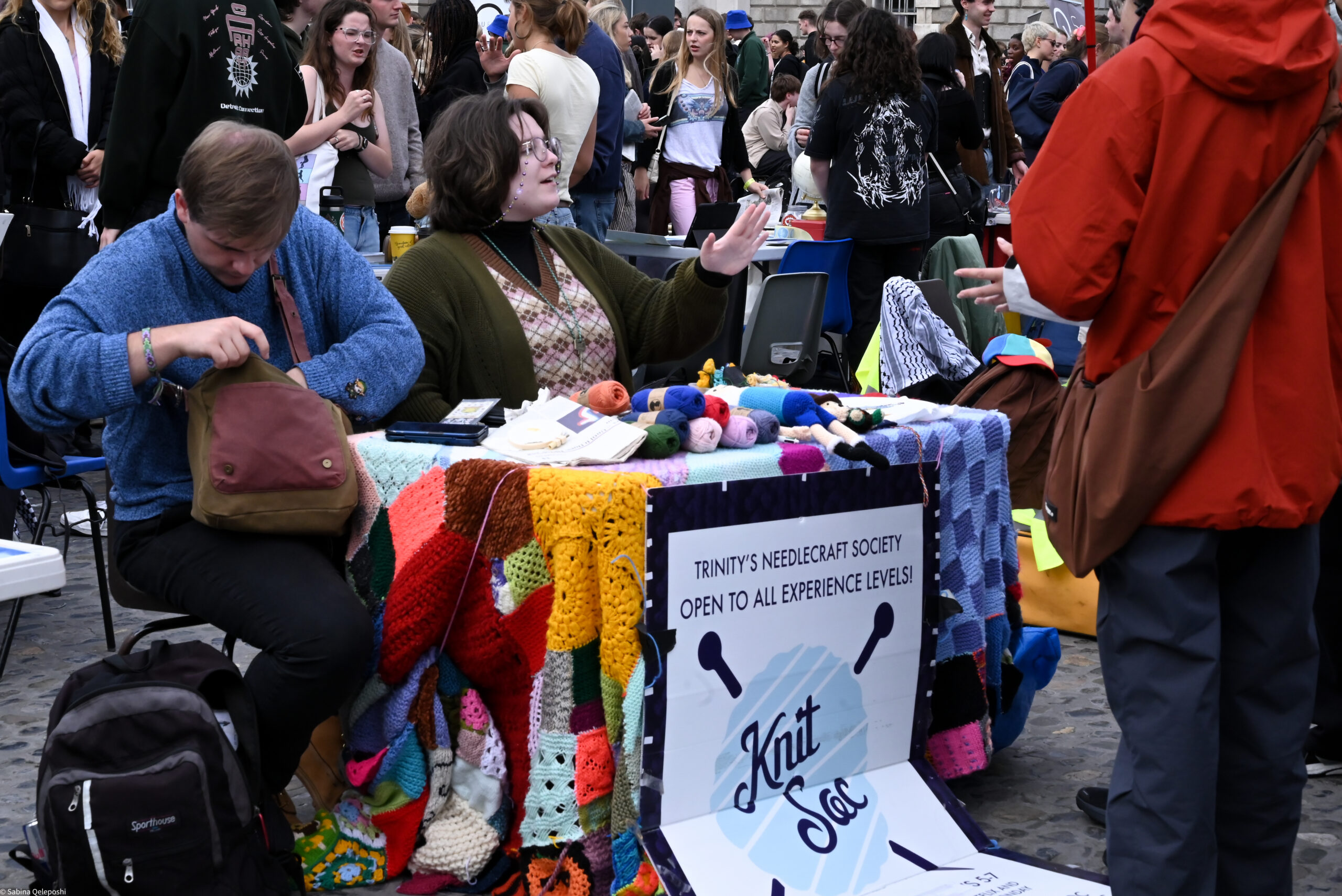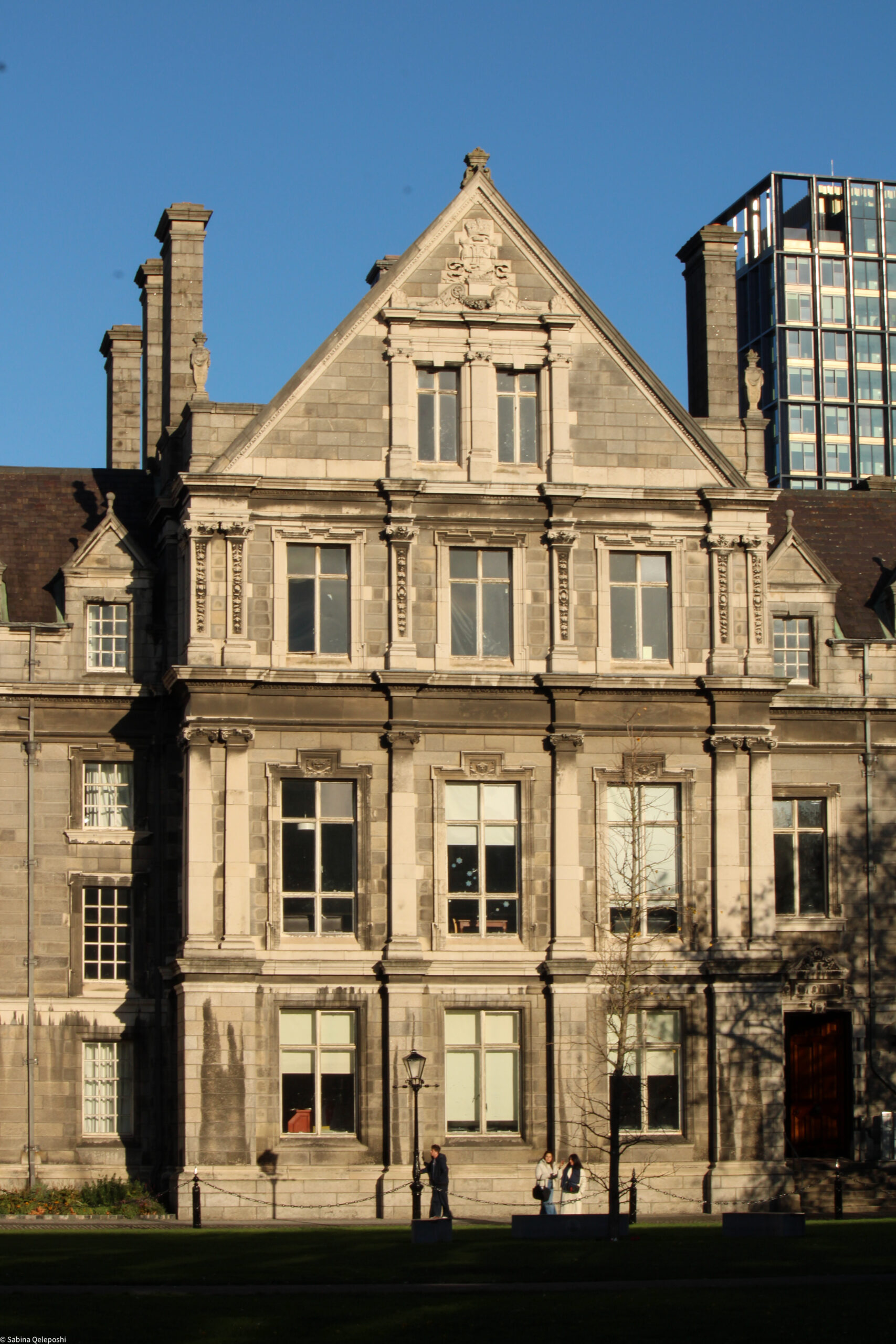

On April 2nd, the University Philosophical Society (the Phil) hosted its hustings for the election of its committee for next year in the Graduates Memorial Building (GMB) Chamber. The Phil is one of two debating societies on campus which have sabbatical positions on their committee, the other being the College Historical Society, whose election period just passed. The highest ranking position within the Phil is President, who is responsible for all aspects of the Phil, including convening regular meetings and setting the general aims of the Session. It is also an optionally sabbatical role.
The candidates running for the role are Aaliyah Mullen, the current Auteur, Fionn Graham, the Registrar, and Matilda Brewe, the Secretary for the 341st Session of the Phil. All the candidates have extensive prior experience in debating and being on Council.
Mullen is a Junior Sophister English and History student. She currently serves as the Auteur and was formerly the Pro-Auteur. Mullen outlined her initiatives to improve the quality of debates and widening schools competition. Mullen also hopes to champion Inaugural events, making the Beckys, the Hilary Term internal debating competition, just as engaging as Michaelmas Term Maidens. Some of Mullen’s passion projects are to secure a sponsorship for the Phil which would be a “top priority”, as well as making the Phil more sustainable and accessible.
Graham, a Senior Freshman Law student, is currently the Registrar but has also been the Pro-Treasurer of the Phil. As the Registrar, Graham opened most of the debates of this session and participated in Maidens in the 339th Session. Graham’s manifesto outlines a vision for securing individual sponsorships for Phil subcommittees and hopes to expand the roles of the Librarian and Auteur. He also wants to tap into the comedic and bilingual potential of the Phil. Additionally, Graham wants to improve participation with the Trinity College Dublin Students’ Union (TCDSU/AMLCT), other societies and social initiatives like football teams and the Philcast.
Brewe is a Junior Sophister History student. In her first year, she won Maidens and later served as Pro-Secretary and Secretary. She has also represented the Phil in the Grand Final of the Irish Times Debating Competition twice. Some of Brewe’s plans for the Phil are to secure a sponsorship for the Phil and a diverse range of guests for Honorary Patronages. She also wants to leverage relations with publications on campus, as well as Facilities and Estates to ensure the smooth functioning of the GMB. Moreover, Brewe wants to get the Phil more involved in the Irish debating circuit as well as involving subcommittees and other societies in chamber debates. Finally, she wants to champion the growth of Phil subcommittees and make competitions more accessible.
At the hustings, candidates had four minutes for a speech followed by two general questions and individual questions from the Phil’s Election Oversight Commission (EOC), and subsequently, two questions from the floor.
Brewe was the first to speak, opening her speech by saying that the €6 membership paid to the Phil was the “best money I have ever spent” and argued that “the Phil has something for every student in this college”. Brewe then went over her achievements while on Phil Council, notably breaking the record for chamber attendance as Secretary, and hoped to break her own record by working with the Secretary again if elected President. Her other missions outlined in her speech were to partner with two types of sponsors, a corporate sponsor and a food and drink sponsor; the money saved from these sponsorships would be channelled toward underfunded areas like schools debates. She also had a vision for “getting people excited about the Phil” and improving schools, reinstating a relationship with the Trinity Access Program. Brewe said she wanted to realise all her goals in “a space that feels supportive, kind, and creative”. She also added that she would be willing to take on a role as a member of council (MC) and work hands on with all the committee members, filling in wherever necessary.
Graham spoke next, also outlining his successes with the Phil. While Registrar and Pro-Treasurer, he “had a hand in administration” and spent the past summer chronologising the Phil’s past records, creating the first-ever Irish language translation. He said he had “a very good work ethic”, as evidenced by his work as Registrar while also being in his second year of Law and studying for Schols. As Registrar, Graham also organised the first successful Irish language debate in the history of the society, getting KNEECAP to advertise it, having live music and free Guinness. Graham promised that a hallmark of his presidency would be to “listen”. As president, he had a three-fold plan for the Phil to make it the “very centre of media on campus”. First, Graham described entertainment through improving the quality of comedy, live music, expansion of TikTok and reels, revival of a five-a-side team and other ways of centring the Phil in campus life. The second prong of Graham’s approach to the Phil would be through initiatives like individual sponsorships, Irish language officers, expanding schools competitions to Gaelscoileanna and giving hard powers to MCs and officers. Finally, Graham addressed discourse, wanting to make a third of the debates centred around “contemporary, national, and global issues”. He also hopes to add an audition based five-versus-one debate against experts in fields like economics and politics on “issues that deserve direct clashes and time for nuanced discussion”. A final point on discourse was the hope to add a Philcast or a podcast.
Mullen was the final candidate to give a speech, beginning by declaring her love for the Phil, saying, “I love this place”. Her list of achievements being on council included her roles as Auteur, Pro-Auteur, launching the website, recording and editing Youtube videos, filming reels and TikToks, all of which reached an audience of around three million people. Mullen noted that “the Phil has historically built on the back of exclusion”, and although it may not be the case anymore, Mullen does not believe “everyone knows that”. Her vision for the Phil is “a Phil for all”, which would include prioritising subcommittees beyond giving them a single chamber debate per semester. Mullen does not want this initiative to be a token measure but a sincere effort to champion the interests of gender minorities and people of colour. With regards to fresher engagement with the Phil across its subcommittees, Mullen wants to “get them early, keep them keen,” highlighting every single entry point such that everyone can “find themselves within debating”. Other initiatives Mullen highlighted were the expansion of schools outside of Dublin and even outside Leinster, improving the opportunities for freshers in Hilary Term to a similar degree as Michaelmas, more charity events, sober officers and options, and sustainability. Throughout her speech, Mullen noted the necessity of cross-departmental collaboration within the Phil.
Following the speeches, the first general question addressed the candidates’ ability to manage stress and ensure it does not spill into their work environment. For Brewe, the answer lay in having support outside the Phil and taking breaks from the role within the Phil. She added “the success of the Phil is not worth creating a bad environment amongst friends”. Mullen noted the importance of a work–life balance and treating fellow council members with empathy as well as taking up a hobby. Graham noted that his role as Registrar alongside school work already made him prepared for the intensity of the role of President and during his time as Registrar, he never expressed his frustrations against others on council. The EOC’s second general question asked the candidates about their greatest weakness in the past year and what they learned. Graham noted the necessity for preparation, especially in the Irish language debate where the script included major mistakes, and could be addressed by taking help from those more qualified. Mullen’s one mistake that she “regretted very much” was not trusting her Pro-Auteur quickly and with more responsibilities since she herself had a difficult experience as Pro-Auteur and vowed to “delegate a bit more”. Finally, Brewe wished she had “taken on more feedback for the term card” from council, her Pros, and the secretaries of the Elizabethan Society (Eliz) and Udoma. She considered this in the term card for Hilary Term which she believes is “reflected in the quality of the term card”.
Brewe was asked the first direct question regarding the decrease in the number of guests and collaborations in chamber debates over the past Session. Brewe said she had “taken on board the criticism that my chamber has had fewer guests” but defended herself, arguing that most of it was “stylistic”, enjoying student speakers over guests. She added that this would continue to be her approach in seeking guests: “looking for quality over quantity.”
Mullen was questioned on her ability to take on a broader range of tasks. She too, defended herself with regards to the quality and quantity of work completed during her reign as Auteur, saying “I have proven that I can take on more things and expand.” However she recognised “this as a shortcoming” and her solution is to “be honest and open” and “keep lines of communication open.”
Finally, Graham was asked about the work he did as Registrar, suggesting that he failed to provide all minutes of meetings, giving 40 per cent of his speeches to his Pro-Registrar and MC, and was generally absent from meetings of the the Udoma and Eliz Subcommittees, and questioned his commitment to the role. In response, Graham challenged the validity of these claims, asking for the origin of the statistics. With regards to providing council minutes, he said the claim leveraged against him was “genuinely not true”. As Registrar of chamber debates, he did agree that at times, his Pro opened but the statistic of 60 per cent was “absolutely not true”.
Update: The EOC has since clarified that Graham gave away 40 per cent of his speeches, rather than 60 per cent, and the EOC was mistaken. Moreover, they noted that Graham was absent from 19 per cent of council meetings, not 46 per cent, as was previously suggested. Furthermore, the original version of this article suggested that Graham failed to fulfill his role as Registrar of the Eliz and Udoma subcommittees, however, he is not the Registrar of either subcommittee and thus did not fail to carry out his role. The University Times apologises for this error.
The first question asked from the floor of the audience was from the current Debates Convener, Adrianna Mazur, suggesting that the Phil treated British Parliamentary (BP) competitive debaters “like a joke”. Her question was regarding the candidates’ commitment to competitive debate and BP debate within the Phil. Brewe found two ways to address this issue, saying she would be a president who would “crack down” on the cultural rhetoric within the Phil against BP. Secondly, she would foster engagement with BP within the council via judging workshops and schools’ mace competitions, “giving people the knowledge and comfort to engage in BP”. Mullen viewed BP as “a lifeline of the Phil” and suggested that the style of debating in Maidens and Beckys compelled speakers to be funnier. She suggested “people should give it a shot”. Graham diagnosed the lack of engagement with BP as an issue where the style did not get “as much of an audience”. He reiterated the point made in his speech about five-versus-one debates against experts in a BP format as it would “lend itself better” to debates in that context. He also hoped to expand the competitive teams with an Irish language team.
The candidates were then asked about what their plans for the subcommittees of the Phil were going to be under each of their presidencies. Brewe said she planned to address the Eliz and Udoma differently, given that the former is already a big committee and required focusing on equity while the latter is a smaller committee whose focus must be growth. Mullen identified the subcommittees as being “one of the lifebloods of the Phil”. Her solution is to continue to collaborate with the subcommittees outside of traditional chamber debates and “experience subcommittees and the Phil at the same time”. Graham wants to include the leaders of the Udoma and Eliz on the term card and “deciding the overall culture” of the term card and the review of guest speakers. For the Bram, he wanted to improve their online presence.
The hustings ended at around 5.20pm. Elections will be held on April 7th from 11am to 5pm. Franchised members will be allowed to vote with a link sent to their email. Results will be announced at the steps of the GMB on the same day.