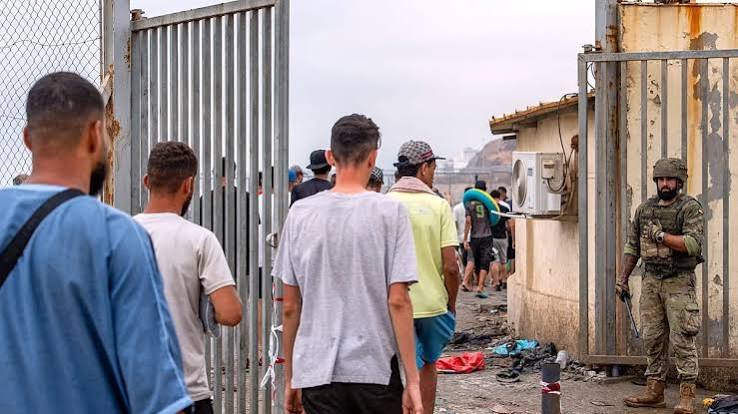

Many might have only heard the name “Ceuta” for the first time recently on the news. Perhaps, to give a better geographic pinpoint, one might recognise better the strand of sea it borders with: the Strait of Gibraltar. While Gibraltar is under British jurisdiction, Ceuta is an exclave in Africa under Spanish governance. As of the last few days, Ceuta has become a key word in many broadcast news, because, as BBC reports, around 78,000 people have flooded Ceuta from a neighbouring country, Morocco; at the moment, there are between 3,000 and 5,000 people remaining in Ceuta. Fatally, a hundred people have already died in this humanitarian crisis.
This exodus has sparked much discussion from Mediterranean right-wing governments, perhaps reminiscent of the lasting impacts of the 2015 so-called immigration crisis, when almost a million migrants (according to the UN Refugee Agency, UNHCR) reached Europe by sea or by land. While the migrants stranded in Ceuta have not yet reached continental Europe, it is crucial to remember that Ceuta is an exclave of Spain in Africa: its handling and development falls under Spanish management, which has also decided to deploy armed forces in the area.
But this situation is not only causing a headache for Spain. One the one hand, it is provoking discussions within the European Union on the management of migratory fluxes; on the other, more pressingly, it is causing clashes between Spain and Italy, which has decided to suspend the open borders Schengen agreement ‘to prevent any of the migrants who had entered Ceuta from travelling on to Italy’, according to BBC news, and will not relent on their decision at least until August 15th, despite Spanish President Pedro Sánchez’s intimations to do so. Italy’s decision has been backed by Denmark and Finland.

This closure of a Schengen border between two countries supposedly friendly with each other is a much bigger deal than it might seem like. Italy and Spain do not even share a border; they are divided by the French Côte d’Azur and the Tyrrenian Sea. Spain also does not border with either Denmark or Finland, which backed Italy’s decision, nor with the Czech Republic, who called for the temporary suspension of Spain’s membership. In a moment when the European Union, darkened by the US’ unpredictable foreign policy from West, while always having to look over its shoulder for any Russian sudden movement at East, should be showing a united stance, sunny and commonly friendly open countries like Italy and Spain are closing doors on each other’s faces.
But this recent flashpoint is part of a much older story. Ceuta is a residue of a Portuguese conquest of Africa, which was subsequently given over to the Spanish government. As Tunisian clinical psychologist Wael Garnaoui also explained to Italian outlet Il Manifesto, the demand (by countries who do not even confine with Spain) to control or suspend Schengen borders in this situation is a reflection of how European countries still pretend to be in control of people from North Africa through their freedom of movement. It is a residue of colonialist mentality and a modern reproduction of colonialist actions: it does not matter if the migrants arriving to Ceuta moved inside their own continent (perhaps their own country). They reached a bastion of a European government in African land: they are now a source of fear for all of Europe. So, despite the fact that this is all still happening in African territory, the reason why these people being treated as a threat, rather than either a hopeless humanitarian crisis, or worse, as a nuisance of no importance (as many other African humanitarian crises are treated) is that this flux, while not having crossed the Mediterranean yet, has already reached a European country.
In the year 2026, Mediterranean countries have to face the consequences of their own colonialism. Continental Europe seemingly has forgotten that ‘colonialism’ is not only a word we remember for school tests and forget the class right after: it is well alive in the chaotic remains that European countries scrambled around other continents, half ashamed of their history, still half unwilling to give them up just yet. Ceuta and its migratory flux scattering discord among European countries is the perfect example of how colonialism returns, claiming its price to pay: for as long as Europe manages some countries as colonised, the toll of colonialists deaths will never really cease to be counted. And as Europe is refusing to acknowledge this, it is becoming its Achilles’ heel: a vulnerable bare spot everyone would rather keep suffering from, causing clashes between countries, rather than owning up to its history.