Hannah Ryan | Senior Staff Writer
The University Times has learned that college authorities intend on relocating a portion of the Scholar accommodation allotment to Trinity Halls from the next academic year. The move comes following the publication of recommendations of the Working Group on Residential Accommodation (WGRA), established in September 2012 to deal with the shortage of rooms available in college as a whole.
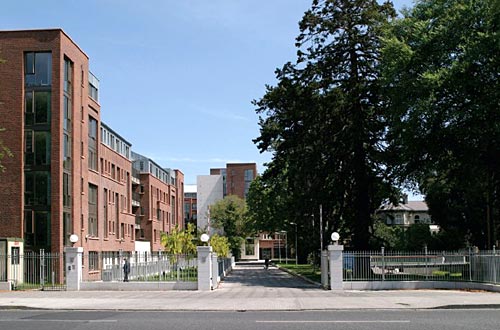
Trinity Halls in Darty, set to be the new home for a number of Scholars in their first year of scholarship. Photo: Trinity Halls JCR
A sustained increase in the number of Scholars, allied with a number of factors unrelated to the scholarship programme, have placed a heightened degree of pressure on accommodation allotments on-campus in recent years. One such factor is the recently launched Global Relations Strategy, tasked with building on “Trinity’s strong international reputation for research, teaching and innovation”, and under the initiative, greater focus is to be placed on accommodation for international students – a demographic whose occupation of campus rooms has augmented from 173 students in 2011 to 230 at present. As well as this, Trinity is now attracting an increased number of Masters and PhD students, and Houses 38 and 40 (close to the Health Centre and built circa mid-1800s) are set to be closed for renovations next year, which will result in the loss of 68 rooms.

The working group to tackle the accommodation question was chaired by Dean of Students Amanda Piesse and attended by the then-Secretary to the Scholars Tony O’Connor and the Secretary to the Fellows, Donal MacDonaill. The suggestion of moving some Scholars to rooms in Dartry was originally made by Brendan Tangney, Warden of Trinity Halls who pointed out that as Scholars make up the biggest proportion of students living on campus, and as such, freeing up some of the rooms which they occupy would make space to help resolve other issues.
Traditionally, the scholars’ campus accommodation allotment has been seen as an integral element of the scholarship programme with the college statutes stating that “each Scholar shall be entitled to reside in College (italics supplied) free of rent.” However at a meeting of the working group in February, Registrar of Chambers Emma Stokes pointed out that “in college” does not necessarily mean “on campus”, and that even such areas as the Trinity centre in St. James’ Hospital would qualify as ‘in college’.
In response to this O’Connor employed the Scholars’ self-titled “old defence”, the argument moving scholars off campus would damage the scholastic community and risk the advancement to fourth level study within Trinity by the Scholar group. In response to the assertion that a move to Trinity Halls would harm the “collegial” element of Schols, Stokes responded that scholars can simply commute to college to eat together in Commons.
A meeting of the Scholars’ Committee was held recently to discuss the decisions. It was announced that the Working Group on Residential Accommodation (WGRA) had made several proposals to the Provost, all of which were rejected in favour of an alternative solution. New Secretary to the Scholars, Amy Worrall, was informed of this development on Monday 29th April, over a month after the WGRA’s proposals were initially submitted.
Within the Scholar community there is growing fear that unlike previous attempts at reforming the entitlements of Scholars, this year College authorities are determined to push through reform. In that context, Worrall has put forward proposals to compromise on the issue, requesting (i) that newly-elected Scholars who are entering their final year in September still be housed on-campus, and (ii) that, if newly-elected Scholars do spend their first year in Trinity Hall, they should be guaranteed rooms on-campus for subsequent years, rather than in Goldsmith Hall. Worrall has not yet received a direct reply from the Provost, but was told by his secretary that the Provost has “considered [their] request.” The final report on the subject was issued on Wednesday 8th May, but was only circulated to the Provost and the Dean of Students. Speaking to The University Times, Worrall said that “while [the Scholars] are sensitive to the strain College is under, the Scholars’ Committee remains in contact with various bodies in College in the hope that this measure [accommodation relocation] is temporary.”
In addition to this accommodation reform, the College Treasurer’s Office has also appointed Senior Lecturer Patrick Geoghegan to devise strategies for cutting the College Central Funds by 10%, the funding pool from which the scholarship programme is funded. Worrall has said that “whatever approach we adopt towards this issue is inextricable from the approach we will take towards the accommodation issue; they are not separable concerns.” The Committee intends to challenge any cut to the entitlements of Scholars, rights which have traditionally included the remission of academic fees, free meals in the Commons and an annual stipend now valued at €253.95. They argue that many students will choose not to accept the rooms in Halls, instead receiving €2068.76 in cash, thus saving the college on the cost of accommodating students. Furthermore, from next year onwards only Senior Freshman students will be allowed to sit the Scholarship exams, which will further reduce numbers and costs.
A letter was also produced at the Scholars meeting, sent from Patrick Prendergast to former Provost John Hegarty in 2011 when similar propositions to reform college accommodation had been made, stating that Scholars should not be affected by any cost-cutting measures. On that occasion, the College Fellows collectively announced their opposition to such a plan and it was scrapped. Current Chairman of the Fellows, David McConnell, has offered support to the Scholar community, advising them to act “in a manner that appears gracious, understanding and flexible” as the new financial policies affect all of college, but also declaring his willingness to step in and “rally the Fellows” should any moves be made to cut Scholar entitlements.