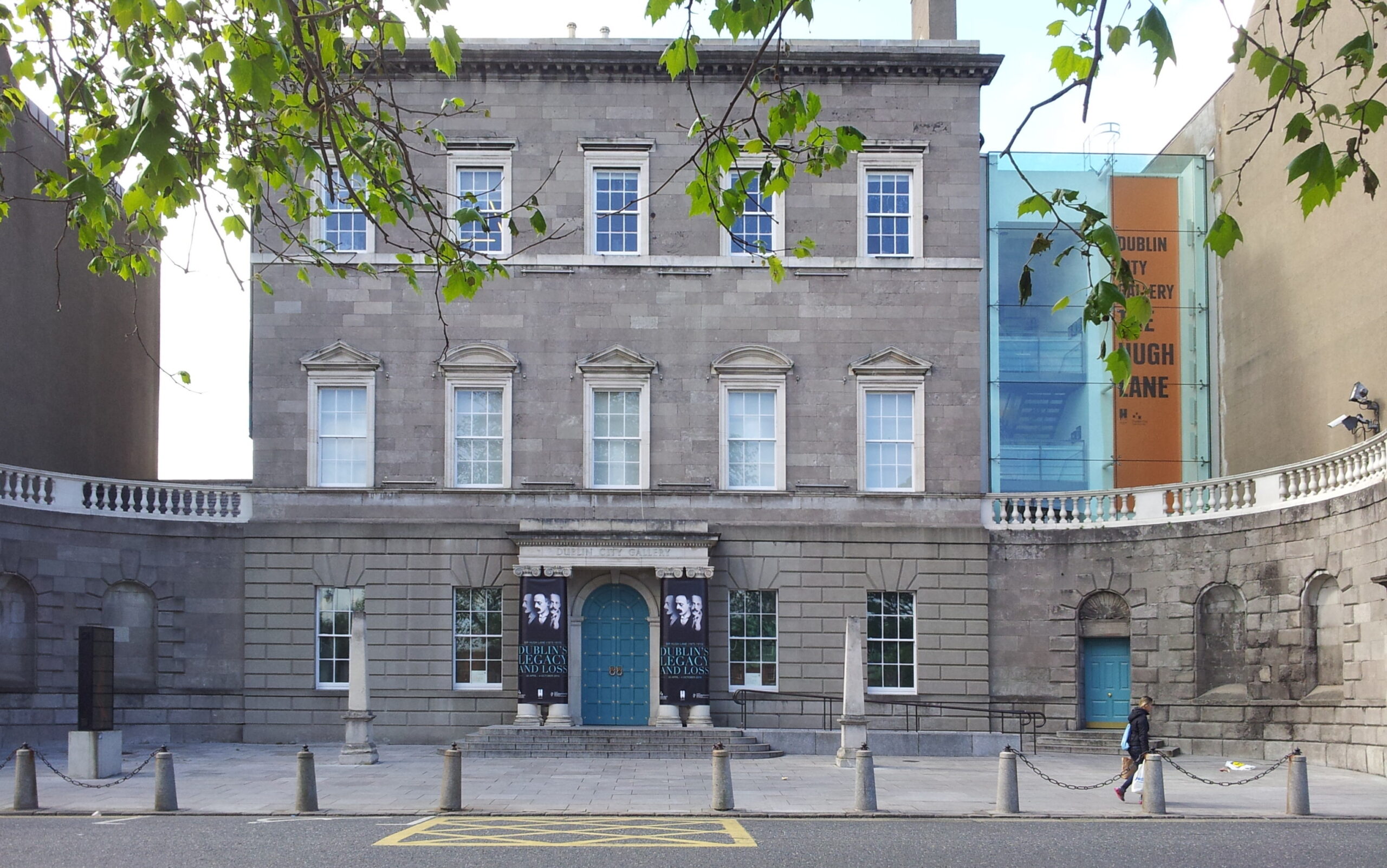

Nestled in the heart of Dublin on Parnell Square N., the Hugh Lane Gallery stands as a major landmark in Ireland’s artistic and cultural landscape. Opening its doors in 1908, the height of the Celtic Revival Movement and Irish Literary Renaissance, the Hugh Lane Gallery—originally named the Municipal Gallery of Modern Art—was founded by Irish art collector Sir Hugh Lane with the aspiration of creating a gallery of modern art for Ireland in a time when Irish identity and culture was being redefined and reshaped in artistic spaces throughout Dublin. 117 years later, the Hugh Lane is closing its doors on September 28th for at least three years while it undergoes major refurbishment works which are set to transform Parnell Square N. into a bustling cultural hub in the heart of Dublin. With only a limited amount of time left to enjoy the Gallery, there has never been a better excuse to visit.
The Gallery’s collection is a fusion of both Irish and European art. In addition to being the home of numerous masterpieces of French Impressionism by renowned artists such as Monet, Degas, Renoir, Pissarro and Marisot, the gallery’s permanent collection boasts a large number of works by both modern and contemporary Irish artists such as Jack B. Yeats, Mary Swanzy, William Orpen, Lily Williams and Seán Scully. Walking around the gallery, the visitor witnesses a striking vision of Irish identity at the turn of the 20th century.
Whilst Irish artists and subjects are foregrounded, they are presented alongside works of European masters, establishing a sense of “Irishness” that is coequal within the international canon. However, the most unique feature of the Hugh Lane Gallery is undeniably Francis Bacon’s studio, transported and meticulously reconstructed based on photographs of his studio in London, where he worked from 1961 until his death 30 years later. The space is chaotic, full of cans of paint, old newspapers and rags, among paintings frozen in progress; an intimate glimpse into the mind and artistic process of one of the most famous artists of the North Atlantic.

The current highlight of the Gallery, as it moves towards its closure, is the temporary exhibition The Dream Pool Intervals by Cork-based artist Ailbhe Ní Bhriain. This haunting exhibition is centred around five large-scale jacquard tapestries which take the viewer on a journey through a fractured, “multi-layered and disorientating world, where everything is connected but fixed narratives no longer hold”, as Ní Bhriain describes. The exhibition is composed of collages of carefully posed, archival Victorian-era family portraits, contemporary photographs of buildings destroyed by war and climate disaster, and imagery of caves and tunnels symbolising the deep-time of geology. Presented between a set of theatrical curtains, images of ruins and rubble atop a sea of limbs in Interval VIII bring to mind the destruction of Gaza and Ukraine. In Interval II and Interval VII, masks appropriated from the Nigerian and Congolese collections at the British Museum appear like golems amidst group portraits full of shadows. These masks are the closest thing to a human face to be found within the tapestries—through the collage technique, all faces of the stiff figures have been erased, either rendered as voids or giving way to images of destruction. A scene of death and deterioration is thoroughly painted, yet organic life can be found throughout the exhibition in the form of animals. Snakes, leopards, wolves, birds of prey and even the extinct thylacine appear unfragmented alongside the human figures, suggesting a reclamation of their dominion, but in the pallid landscapes of Ní Bhriain’s tapestries, one has to wonder if we will even leave anything behind to reclaim.
Entering Gallery 14 on the first floor of the Gallery, the visitor is met with the death mask of a rhesus monkey, laid atop of a bright white plinth in the centre of a bare, dark room. There is nowhere else to look but at the body of the creature, cast out of desmonite and marble dust with a coat of embroidered silk—its death must be confronted. In a way, it is reminiscent of a wake. This piece is the Hugh Lane’s newest acquisition, Primate by Irish artist Daphne Wright. The sculpture, created from the mould of a recently dead monkey, which had been involved in life-saving AIDS research at Wisconsin National Primate Research Centre, explores the relationship between humans, animals and medicine. Despite the surface-level subject matter of an animal dying for human gain, this piece is not a protest against animal cruelty. Rather, Wright has created something of a monument immortalising the primate, claiming it as “our ancestor, our antecedent past and passed away, an object of reverie, honour, compassion and mourning”.
The closure of the gallery is undoubtedly a loss to Dublin’s cultural scene. However, there is a light at the end of the three-year-long tunnel. The refurbishment of the gallery is set to bring the 1930s wing of the gallery to 21st century standards of environmental controls and security, preserving the collection for future generations, and opening the door to significant international loans of art for temporary exhibitions. The project also involves the construction of a new city library, which will be directly linked to the gallery, creating a space where art and literature are connected. With a first-class café, regular workshops, and concerts every Sunday afternoon, the Hugh Lane Gallery already has something for everyone, and so it is with great sorrow that I will say ‘goodbye for now’ to the Hugh Lane Gallery, but with great excitement for what the future holds.
The Hugh Lane Gallery will close its doors to the public on September 28th. Admission is free to all exhibitions which remain open.