
Jonathan Anderson works at a tempo that feels barely terrestrial, a metronome set between studio lights and departure gates. He has been called fashion’s busiest man, an epithet that reads less like a complaint than a diagnosis. The hours have multiplied since this summer, when he stepped onto the Dior runway in Paris for his first men’s collection for the house. This debut recast him from a two-brand polymath (JW Anderson and Loewe) into the new steward of a French institution. Reviews spoke of aughts sleaze and cargo pragmatism; of a curatorial eye riffling the archive while keeping its pulse modern. The Guardian framed it as “preppy and eccentric,” a Dior with shades of Anderson’s hands, and GQ called the show the year’s most anticipated. Vogue Business had already charted how his menswear began in 2008 by prodding the fault lines of gender and silhouette, an origin story that remains legible in his every role.
Yet if the appointment crowned a cosmopolitan ascent, the coordinates of his work still triangulate back to Northern Ireland. Magherafelt is not a mood board so much as a weather system with low stone walls, club jerseys drying on radiators, the clatter of newsprint at the local shop. Anderson has been explicit about the formative charge of growing up there: a place whose absence of certain cultural narratives (queer histories among them) sent him to the archive with evangelist zeal, to build a counter-canon and, someday, “put it in an institution in Ireland so they have to deal with it.”
If you trace the line from his student years to that Dior runway, it snakes through Dublin as well. After abandoning drama and discovering costume, he worked at Brown Thomas, absorbing the pragmatics of luxury from the shop floor. In interviews, he still mentions a grandfather who printed textiles the old way—screen, pigment, repetition—as if the cadence of the squeegee taught him a designer’s gait. These aren’t romantic anecdotes tacked on after the fact; they are the bone structure of his method, the insistence that craft is culture before it is commerce.

Early JW Anderson collections, shown with fledgling grit around 2009 and 2010, were studiously contrary. Men in ruffled shorts; sailors drawn like doodles on knits; a palette that could turn prim then perverse between exits. That contrariness felt Irish in a way that had nothing to do with shamrocks. It was the stubbornness of someone arguing with a room’s assumptions, insisting on both/and over either/or. As Vogue Business reminded, the redefinition of menswear is the foundation of his practice, the willingness to let two truths rub until they spark.
Over the last two years, the Irishness has surfaced more literally, and with a wink. There was the bow at Milan in the fresh Ireland rugby jersey—timed to Father’s Day, a quiet salute to Willie Anderson, the former national captain. There were knitwear gestures that read like domestic archaeology: jumpers mapped to Georgian brick, to two-up two-down terraces, to the iconography of childhood on this island. And then the collaboration that needed no Rosetta stone: Guinness, its creamy head rendered in pearl-effect embroidery, stout turned to cashmere and rhyme. None of it felt like a costume. It felt like someone walking through rooms he already knows, finding new light on old tables.
Is it homage, or merchandising? The question would matter more if the materials didn’t argue back. Anderson’s Irish references rarely stop at symbols. Even when the motif is blunt, like a pint on the chest, he grounds it in handwork and tactility. That Guinness knit reads as camp until you clock the yarn and gauge, and the joke becomes a keepsake. And elsewhere, he returns to textures that precede logos: Aran densities, the pepper of Donegal tweed, linens that crease like short grass in the wind. He is not alone among contemporary Irish designers in reasserting those fibers, but with him, the point is not nostalgia. It is access. If you put a child’s terrace into a sweater, you are saying the house can follow them anywhere.
Sometimes the reference is worn, not woven. The rugby bow is a case study in authenticity, a single gesture that calls up a backstory—Sundays on pitches, ferry crossings, a father’s hands—and refuses to cash it out as sentiment. GQ’s dry explanation of the moment (“because his dad played for the Irish national team”) reads almost comic in its simplicity, but its spareness is the tell. Anderson doesn’t need to annotate these homages. He has already credentialed them with time.
There are deeper, quieter ties. In conversation, he returns to the idea of Northern Ireland as a place where you learn to read codes, to live inside contradiction. If queer culture wasn’t in the curriculum, you built your own curriculum through images, books, bootlegs, and the everything store of the internet. That habit of assembling a museum out of what’s to hand became his working grammar at Loewe, where he curated craft into celebrity, treating baskets and puffers, pottery and pumps with the same reverence. It is hard to miss the Irishness in that curatorial impulse, the conviction that the vernacular is holy if you look long enough.
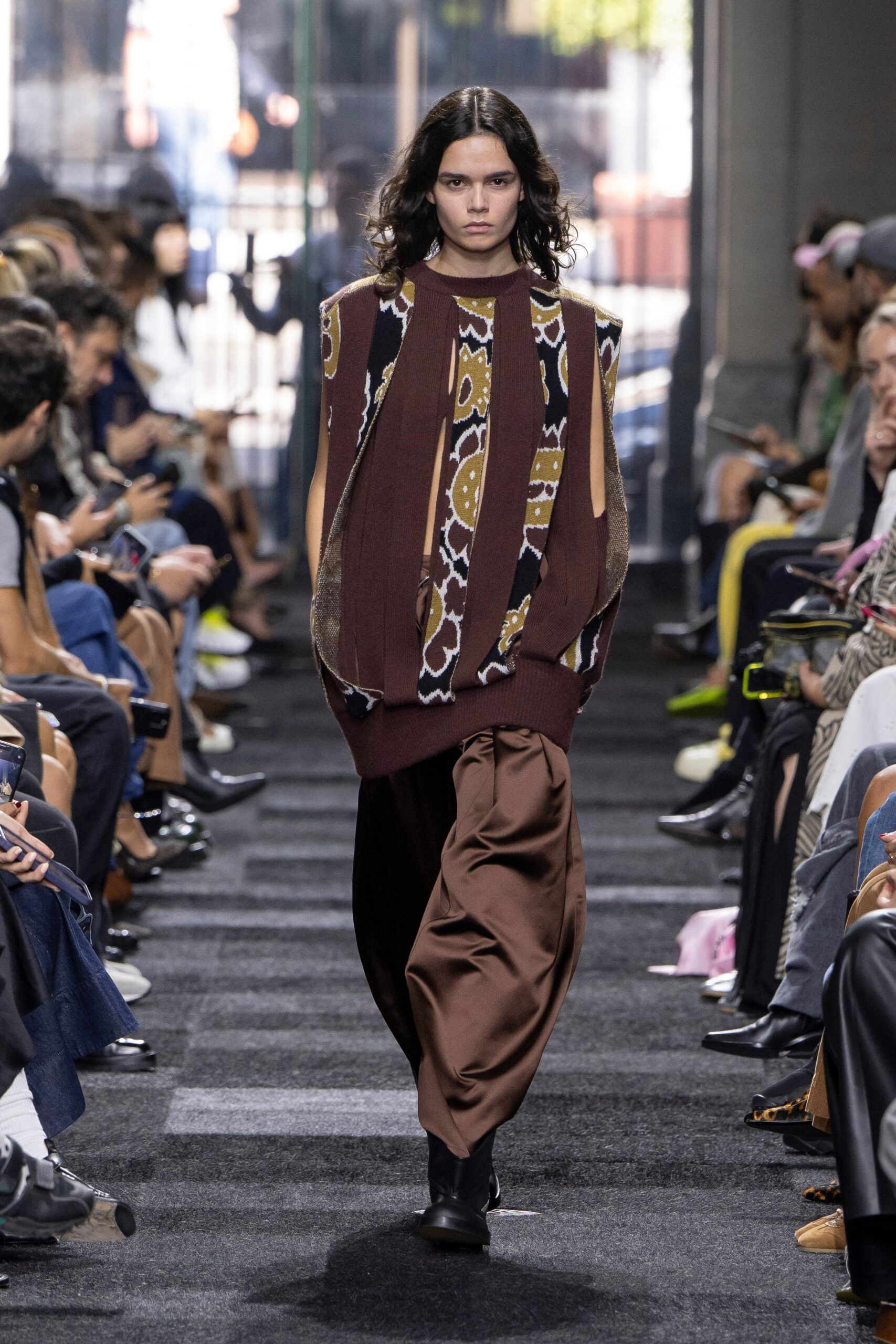
All of which returns us to Paris in late June. Dior’s spring/summer 2026 men’s show was read (in English, Spanish, and the international patois of fashion comment) through Anderson’s preoccupations: elongation, utility, eccentric polish, and a writerly relationship to the archive. The Guardian found “sweet relief” in the cool, museum-adjacent recoding; El País heard a designer celebrating “a thousand and one contrasts” rather than enforcing a single silhouette. GQ called the thesis “The Idea of Style,” a title that could sit on his entire oeuvre. And Vogue Business, weeks earlier, staged the logic of his appointment: a menswear radical whose grammar is now couture’s problem to solve.
Does it come off as authentic? That word is skittish in fashion, where sincerity and strategy are roommates divided by a thin wall. Anderson is strategic. How could he not be, given the scale of his responsibilities? But the Irishness reads less like branding than ballast. The motifs recur not because they trend, but because they’re furniture. He moves house; the furniture comes with him. When he says the show is the store, as he did around his Resort 2026 JW Anderson presentation, what he seems to mean is that the private museum is an invitation to come inside and see how the rooms connect.
If you track the arc from the first off-calendar shows to Dior’s glass box, it’s easy to read inevitability. But the Irish thread complicates that smoothness in productive ways. It keeps the work anchored in places where inevitability is not the rule, where ambition had to slip in sideways. Brown Thomas was not just a job; it was a vocabulary lesson in how clothes travel through space, how a shoulder seam persuades a passerby. The grandfather’s screens were not just family lore; they were proof that images can be made the hard way, and that the hard way matters. The rugby shirt is a dial tone, a call you can always make home.
Even the Guinness capsule, so easy to cheapen, carries that attitude. The pint is cheeky, yes, but it is also a vernacular reliquary, an object that holds the weather of a city on a Friday. Anderson knows that Dubliners perform their own fashion shows between the bar and the bus stop, that Belfast teenagers learn silhouette from the geometry of school uniforms and shed it in alleys, that the island’s textiles are less heritage than infrastructure. So he insists on craft even in a punch line. Cashmere gives the jokes a second life.
What about the beginnings—just out of fashion school, trying to make something stick? The early JW Anderson accessory line that opened the door in 2008, the Fashion East platforming, the off-kilter menswear that made critics squint before they smiled. Those chapters already had the stubborn headwind of an Irish upbringing in them. He has said, more than once, that predictability is the death of a brand. You can hear the rural Northern instruction in that: don’t get above your station, but also don’t get stuck in it. The instruction becomes an engine.
If authenticity is a test, the grade is earned not by reference but by repetition with care.
Anderson repeats with care. He returns to Irishness the way good writers return to a neighbourhood: not to romanticise the old corners, but to notice what’s changed. When he puts a terrace into a sweater, or walks out in a jersey, or renders stout as knit, he is doing what his best collections always do—making the familiar strange enough to see, then intimate enough to keep. That is why the homages land. They aren’t postcards. They’re house keys.