Less than a month after his re-election, Donald Trump was appointed as Chair of the John F. Kennedy Centre for Performing Arts. This is a peculiar, yet unsurprising target as this position grants him full control over the financial and artistic strategies of this cultural powerhouse. In her article published for the Guardian on February 22nd, journalist Adrian Horton positioned this act as “part of the authoritarian playbook to suppress dissent”. The centre hosts many performances that boast the diversity of the United States, but this has since been threatened by this overturn in leadership and the Trump administration’s proposal to implement the “Make Entertainment Great Again” act. Trump, like many other political leaders, understands the power of theatre and is perfectly willing to censor and mould a nation’s theatrical voice in order to direct the circulation of ideas and to prevent public resistance.
Good theatre is impossible to ignore, and therefore it is no wonder that it has been used to capture the attention of politicians and citizens alike to solicit political change. Theatre can be used as a form of protest, but is the inverse true? What happens when theatre is taken from the comfort of the stage and is placed on the streets? Theatre that commands the attention of all passers-by, theatre that denies authorisation, theatre built solely on the political sensitivity of a community: is this the answer to breaking through to decision-makers amidst recent efforts to censor the arts?
On April 16th 2025, journalists held a ‘die-in’ in Paris where they lay on the steps of the Opéra Bastille wearing vests splattered with fake blood to protest the mass killing of journalists in Gaza. On June 15th 2025, around 75 women in Texas marched in red cloaks with white hoods, a direct reference to Margaret Atwood’s piercing novel The Handmaid’s Tale, on ‘No Kings day’ to protest the Trump administration. On August 15th 2025, healthcare workers carried a stretcher through the streets of Dublin carrying baby dolls and a broken CPR mannequin in solidarity with their colleagues in Gaza.

It is no accident that the phrase “staging a protest” is used when it comes to organising a demonstration. In all of the above instances, the props, the costumes, the so-called “actors”, all become representative of something greater – something bigger than themselves that goes beyond words and enters the realm of the symbolic. If words fail to speak, then we must resort to visual methods in order to appeal to the empathy of an unknowing audience and incentivise action. To achieve results, a “weighted silence”, so to speak, can be effective, but we must simultaneously recognise our privilege in being able to do so.
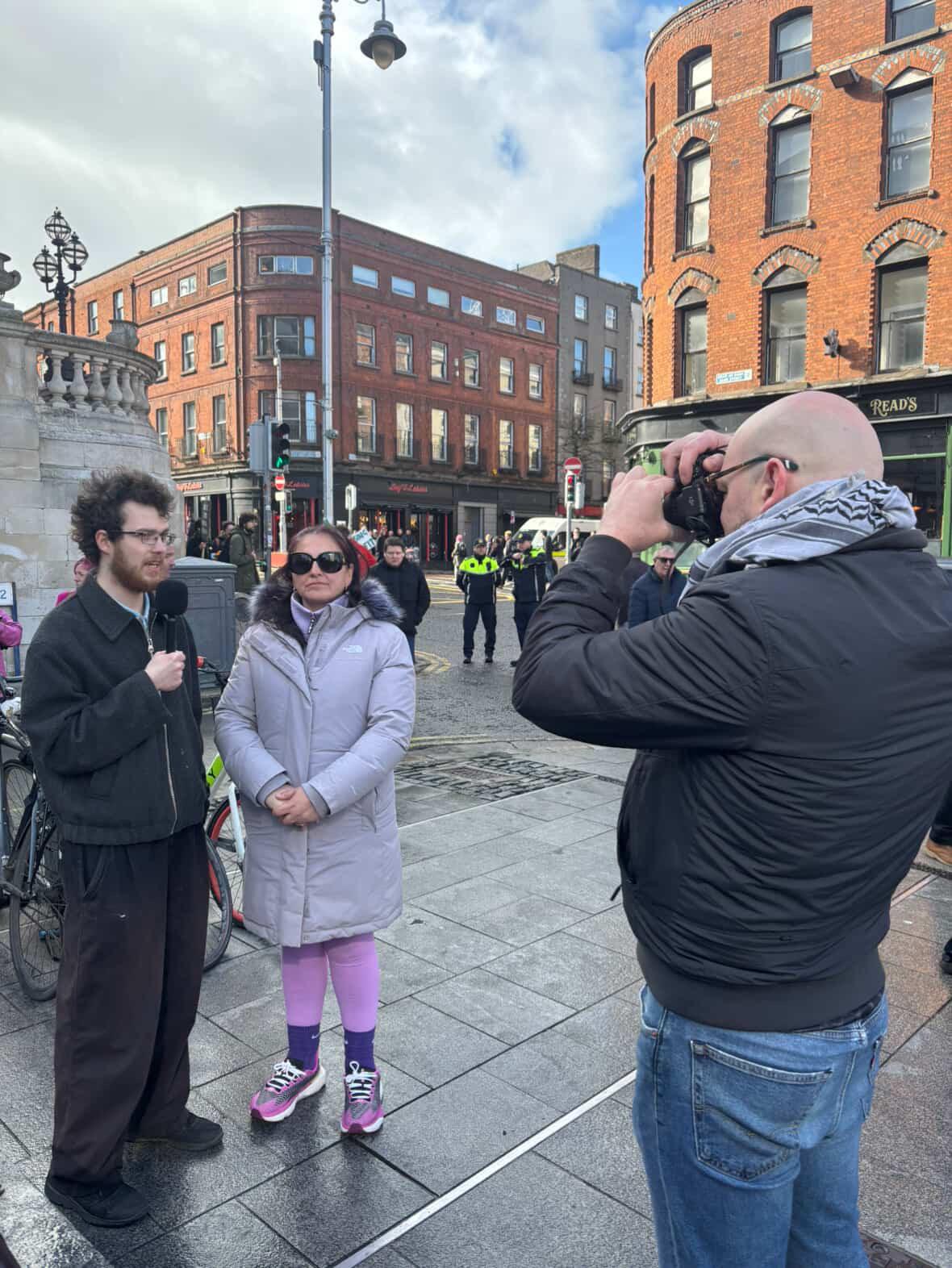
Kassie O’Mahony, a third-year theatre student in South East Technological University (SETU), who has been actively involved with the “Gather for Palestine” group suggests that “people struggle to be affected by something if it is not within their landscape. I think with theatre it brings it into our homes, and it brings it into our lives … it makes it personal instead of aimlessly consuming it through a screen which creates a certain desensitisation”. One thing that she highlights is the fact that theatre is the pinnacle of solidarity. When you have people coming together to orchestrate a performance, it builds community and a site of resistance, which is a disruptive act in itself. This however prompts dialogue around our ability to empathise. Why does an injustice have to be made ‘visible’ to us before we decide to act? When posed this question, Kassie answered that “it is negative that we’ve gone so far as a society that horrific media doesn’t concern us anymore, but that is exactly why theatre is so important. Especially in today’s world, we need to be maximising the impact that storytelling can have”.
Jules Nati, a third-year English student from Rome offers an alternative perspective. Commenting on the Irish activist scene, she states, “you do a lot of this performative stuff, that’s because you have most of your rights. We have nothing. We have to make the statement clear, and the way to make the statement clear is not through a performative scene. It’s through sayings and slogans…”. She commends the Irish instinct to turn to art and theatre, but nonetheless one’s geographical, cultural and political position will always dictate this method’s potency. When asked if art plays any role in her activism, she answered, “we sing a lot…that’s the main form of art, because it’s loud, because you can hear us and we can bother you with that. You can close the windows and you can turn around but you will still hear us”. Jules further recalls attending a pride protest in Rome, seeing the theatrics and dance, she states that “it was very much useless. I, as a lesbian, have no rights in Italy. Here performativity does not work. It is counterproductive”.
Ultimately, we need to recognise our privilege and learn to use theatre to confront, and to destabilise the status quo. This style of activism must be accompanied by a strict message that ushers in a call to action, direct action at that. Ireland has a rich history of storytelling, and it is wholly understandable that we as a nation seek to arm ourselves with symbols and performance where our words can no longer be heard. In spite of this, there needs to be a direct relationship between the performance and mobilisation for the piece of theatre to be considered effective. The moment that the art begins to overshadow the politics, is the moment where the question of ethics needs to be raised. This is where the philosophy “art for art’s sake” ultimately fails.