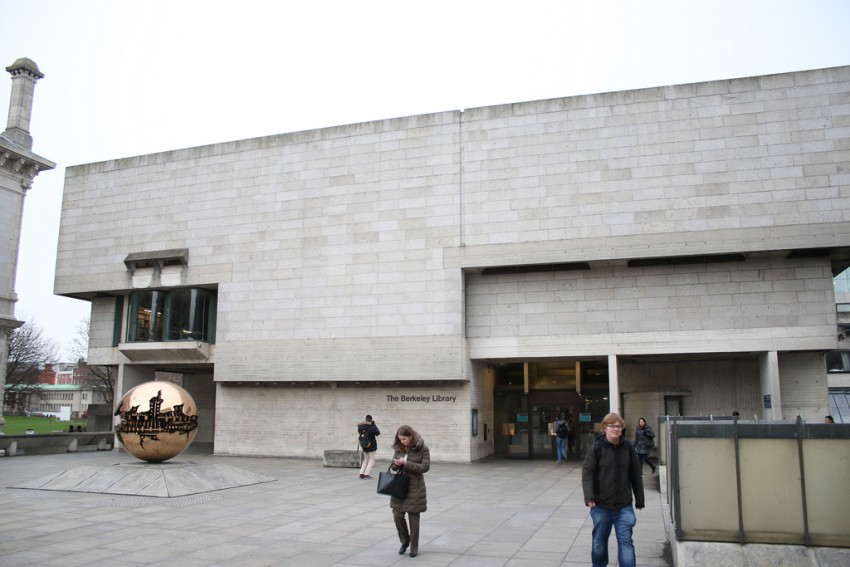

The freshly re-christened Eavan Boland Library sits like a mooring stone at the edge of Trinity’s green, its surfaces pale and pitted, its geometry lucid as a theorem. The new name is a soft vowel against an intricate façade. To understand why this library is Brutalist is to return to the early 1960s; when Trinity wanted a building that spoke to sensibilities of the twentieth century as confidently as the Old Library spoke the eighteenth. The answer arrived through an international competition won by 28-year-old Paul Koralek of the London-based firm Ahrends, Burton and Koralek. His proposal promised a consciously modern monument that would hold its ground beside neoclassical neighbors; a library that was both structure and statement.
Brutalism, here, was less a posture than a method. Koralek’s team chose reinforced concrete and Wicklow granite. The concrete was poured into Douglas fir moulds so that the wood grain ghosted onto the cured surface, proof of a hand-made process inside an industrial material. The result is a building that reads at two scales: austere from a distance, tactile when your palm meets the wall. Contemporary and later accounts catch this double register, unusually “hand-crafted” for modernism’s machine age.
While Brutalism often gets caricatured as severity, the Eavan Boland Library complicates the picture. Daylight is husbanded with care, diffused downward into the stacks. The National Inventory of Architectural Heritage speaks of the jury’s confidence in the design’s “magnificent natural internal lighting” and its poised relationship to the Museum Building and the Old Library. It is this balancing act that continues to persuade, even as the commemorative plaque changes and new layers of meaning are invited in.

In October, 2024, Trinity decided to replace the Berkeley association and in March, 2025 honoured Eavan Boland, the first woman to have a building named for her on the city-center campus. The act was framed as a public reckoning with a colonialist legacy and a reorientation toward a different register of cultural contribution. Architecture did not change, but context did, and context is part of what a Brutalist building asks us to read.
To reflect on Dublin’s wider Brutalist heritage is to walk through a city that learned concrete in phases. In the 1950s and 60s, new materials and methods entered the city’s bloodstream. Busáras and Liberty Hall signaled a modern metropolis. By the late 1960s and 70s, the idiom hardened into a more muscular vocabulary. The architect Sam Stephenson became the lightning rod for Brutalist critiques through his work on the Central Bank on Dame Street and the Dublin Corporation Civic Offices at Wood Quay, buildings that answered Georgian grain with granite and concrete, and ignited debates about scale, heritage, and power that still echo through the modern city landscape.
Wood Quay, in particular, revealed how architecture could become a stage for public conscience. Excavations unearthed a Viking town, protests tried to halt the municipal complex, and the city pressed on. RTÉ’s archival record and later reporting revisit the drama: a contested Brutalist civic set piece rising from a site dense with archaeology and emotion. The quarrel was never just about concrete. It was about the kind of modernity that Dublin wanted, and what pasts could be displaced to make room for it.
University campuses became laboratories for the same language. Trinity’s Arts Building, designed by the same Ahrends, Burton and Koralek office, stretched a low, gridded mass along Fellows’ Square and has spent decades absorbing love and criticism in equal measure. Across the river at Belfield, UCD’s 1960s-70s expansion set concrete against landscape in a campus-scale essay on Irish modernity, its water tower and early faculties speaking the infrastructural dialect of the period. These were not simply stylistic choices; they were claims about utility and economy, and a belief that clarity of structure could serve clarity of purpose.
Why, then, was Trinity’s central library designed as a Brutalist object? Because the college asked for a building that could hold a century’s knowledge with a century’s form. Because concrete offered a way to make mass honest and detail eloquent. Because the 1960s thought that a university should look like the future. The Eavan Boland Library embodies that wager. Its materials tell you how they were made. Its volume tells you what it is for. Its surfaces carry the memory of timber, the imprint of a craft that resists anonymity.
And Dublin’s Brutalism more broadly? It grew where public institutions needed new rooms quickly, where budgets met ambition, and where architects believed in legibility—structure expressed rather than hidden. At its best, as in Trinity’s library, the language is lucid and humane. At its worst, it becomes a mask for bureaucratic will. The city still negotiates these legacies: questions raised about adaptive reuse at Central Plaza, arguments around conservation, and a public that reads concrete as both weight and history. The Boland renaming folds poetry into this conversation, reminding us that names and buildings alike are instruments for remembering.