I had ruined the mood. All the Erasmus students – even those new to learning German – knew exactly what it was that I was asking due to the similarity of its English translation. Silence befell the moments-before-carefree table and all eyes were on the startled Berliner I had directed my seemingly brazen question at. I had clearly learned absolutely nothing from my German class on stereotypes earlier that day because from his beanie hat and septum piercing alone, I had profiled this local as left-leaning enough to ask this question. It was a question that had been racking my brain since moving here for Erasmus four weeks ago, and despite studying German as a minor back where I was from, I was still lost for an answer. No number of hours spent learning and writing about this country’s memory culture and guilt had answered this question for me back home and moving here hadn’t changed that. The most common attempt at its justification I had come across was the measly two-word answer of “it’s complicated”, and it would be left at that. No need of course to explain any further, for when something is “complicated”, it’s not comprehensible to the average person, so how could the average person possibly form an opinion on something if they wouldn’t be able to understand it? I really did want to understand though, so I would read history books on the matter, opinion pieces from both sides, and make people uncomfortable by asking uncomfortable questions in some sort of investigative effort to crack the code. All to no avail, because nowhere I looked could tell me how exactly it was “complicated”, or why, in this country especially, any critique of a certain country’s actions must be unequivocally conflated with a hatred of their religion.
So that was my question for the Berliner: were these two things truly inseparable? Yes, if you’ve grown up with guilt, he said. Guilt from terrible crimes that neither myself nor my parents were alive for but that all of us still must bear, and have to bear, in order to not forget. I thought about that, what it must be like to be born with that guilt attached to you, what that must feel like, how that could change, or could be used to change, your relationship with things. In a loose sense it reminded me of the original sin, how it gets branded on the unluckier sex of a particular religious persuasion at birth, despite us having nothing to do with it personally, and from that, people pick and choose the lessons we learn from it depending on the agenda. Having grown up in this persuasion, I am well acquainted with the many lessons it has sought to teach me through this guilt, many of which I have deemed too sexist to pay any heed to. The guilt the Berliner was referring to however, is different. It is not based on a story but instead a very serious, very recent crime in our world’s history. I didn’t have trouble understanding the guilt felt by this country for its crime, but what I still didn’t get is how a country can have so much guilt for past crimes against a people yet in good conscience continue to facilitate the suffering against another? What I found even harder to understand was how the guilt felt for the first crime was being used to justify this one. The Berliner did let up that it wouldn’t be in the best interest of the country’s economy to stop to selling of weapons and sending of people to this other country that was causing so much suffering, but made no correlation between that and guilt as an instrument of justification, nor did I draw that conclusion in his presence. I knew this Berliner was not going to say any more – except remind me of the fact that it was a “complicated” matter – and that I would have to look elsewhere for my answer.
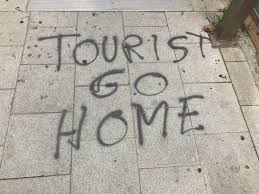
I knew that I was not the only person living here that felt this way. In fact, despite its eerie absence from everyday conversation, that feeling is very much alive here. Scribbled, sprayed and scratched onto the walls of buildings, doors of public bathrooms and seats of trains and buses are the clues that this sentiment is felt by people here in the same moral way that it is back at home. I know that some of these messages were written by people from home because they were written in Irish, which made me feel proud but also anguished to see because the same troops that were once created to be used to terrorise us were later sent to be used to terrorise them. What I also saw was that many of the graffiti with this message was written in this country’s own native tongue. Over the last four weeks I have noticed that other students here from other places also share this feeling. One even recalled his experience protesting a match between his country and that country, in which they tried to denounce the normalisation of what was happening –and is still happening–by trying to prevent the match from taking place and were met with pepper spray from the police. In this city, attendance at these protests and the use of “banned slogans” has led to deportation charges against people from my country. In a group we have also spoken about the unsettling dissonance between the horrors we so casually witness every time we open our phones and yet so few people speak out about it in public here because it isn’t entirely safe to do so. It is still a truth for so many here that criticism of the actions of a certain state and hatred of its religion can not–or must not–be independent from one another. I have decided to stop wasting time searching for an answer on something that to me is too morally bankrupt and unfounded to deserve one. Instead I have spent my time here surrounding myself with my conscientious and likeminded classmates, and on Saturday September 27th, at 14:30, we decided to show our support and join the other likeminded people in this city.

With 100,000 people in attendance, this was the biggest demonstration there had ever been for this cause in the history of this country. I emerged from the U-Bahn station onto the boulevard named after its linden trees that leads up to the famous gate. Under all the trees up the street, turning just before the gate were thousands upon thousands of people wearing red, many displaying proudly the flag of the state that this country is yet to recognise. Every now and then the group would stop, and people would make space for a much larger flag to be held above the ground and the colours green, black, white and red would replace the road. An armed police force in all-black guarded the crowd on either side, ushering the people in red to keep to their designated route whilst guarding a lady holding a sign saying “not until the last hostage is back”. The demonstrators had made signs of their own and holding them up high, chanted in unison to free the yet-to-be recognised state. As they did so, they crossed the cobble stone line marking where the divider of the city once stood. Written on one sign in the crowd were words that I found to be particularly evocative. They resonated with me not only because they answered the question the Berliner could not answer, but because of the fact that when you put it simply like that there is no question to begin with. What is happening to the Palestinian people in Gaza is a deliberate famine, and no text in any book, past actions of any people, or rhetoric of any nation is capable of justifying. It’s not complicated, it’s genocide.