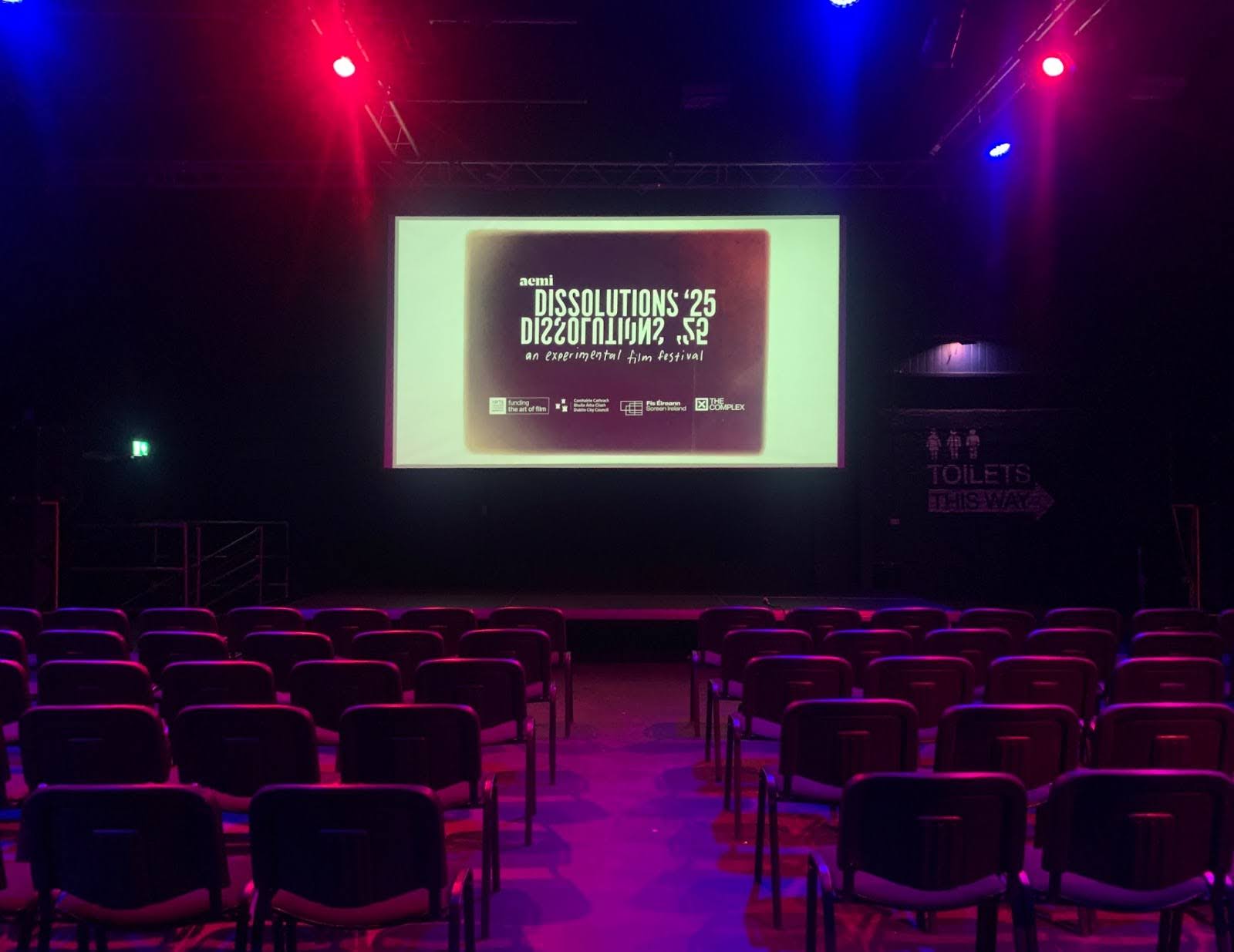

From September 26th to September 28th, Artists’ and Experimental Moving Image (aemi), presented the second edition of its annual film festival, DISSOLUTIONS ’25. aemi was formed back in 2016 by Alice Butler and Daniel Fitzpatrick with the objective of strategically supporting and contributing to the ecology of artist film practice in Ireland. DISSOLUTIONS ’25 featured screenings, workshops, and discussions showcasing the best of Irish and international experimental films. aemi was kind enough to let The University Times attend three of the festival’s events. This is how they went.
Kamal Aljafari’s A Fidai Film: Destruction and Reconstruction
Eva O’Donnell, Staff Writer
On September 26th, the festival opened with Palestinian filmmaker Kamal Aljafari’s A Fidai Film (2024) a relentless experience of destruction and reclamation. All festival events were hosted at The Complex Arts Centre in Dublin 7, a refreshing and exciting arts space, with a neon-lit bar and warehouse screening area. Myself, with an audience of mixed ages and attitudes, settled down in stark rows of individual office chairs to watch the Irish premiere of Aljafari’s film.
Created from archival footage seized by the Israel Defence Forces (IDF) from the Palestine Research Center in Beirut in 1982, the experimental montage film reconstructs Aljafari’s now-unrecognisable homeland. It becomes a monument to the enduring nature of cultural memory, reclaiming a place and a people from a looted archive, while reckoning with what has been permanently altered or lost.

The film opens with footage of the 1982 looting, where the archive was car bombed before its contents were later removed by Israeli forces. Aljafari called the archive seizure an effort to “destroy any attempt at building a historical record, a collective memory”. The contents of the library, gathered over decades, comprised some 25,000 volumes and over 100 documentaries, as well as an extensive microfilm collection. To deny a population access to their own history, (the archives are still held under security in Israel) is an act of cultural violence, one that Aljafari tries to counter through his filmmaking process. “I’m speaking about a country that we have lost, a homeland that we have lost and I’m not trying to escape from that loss”, Aljafari said in an interview with Untold magazine. “Every film I’ve made – and every film I will make – starts from that condition, from trying to find a way to relate to it.”
Aljafari uses filmmaking as a way of sabotaging the colonial gaze in A Fidai Film. The scars of occupation are seen through the distorted and sometimes written-over reclaimed images, stamped with the Israeli Defence Force Archive (IDFA) logo. The text as well as the footage of IDF soldiers has been painted over in dripping, confronting red, having an effect of both condemnation and retaliation. Watching the film was an intense, almost disorienting experience. There was no guiding dialogue, no dates or locations given to the archival footage, dating from the early 1960s to the occupational clashes of the 1980s. The result was a dizzying barrage of faces, landscapes and fires led by a haunting score from Simon Fisher Turner, culminating in a profound sense of grief for the sheer amount of destruction witnessed.
It was a powerful and unrelenting viewing experience, and effective in a way unique to its form. It was not an easy film to watch, and not just for its upsetting subject matter. The experimental format can be isolating, but where a documentary can convey facts and dates, A Fidai Film informs on an affective level.
Peter, Paul and Mary (or crazy films on a Saturday night)
Khushi Jain, Film & TV Editor
I am not sure if I have written this article well. I am not sure if I could have written this article at all. Because I have tried to write about that which uses a different language, a language which is no language. I have tried to write about ‘Peter, Paul and Mary’, a collection of crazy, hallucinatory films playing at DISSOLUTIONS ’25 on September 27th at 10pm following last year’s festival screening of psychedelic experimental shorts (titled ‘This is my happening and it freaks me out’). This nocturnal programme was introduced by aemi co-founder Daniel Fitzpatrick as perfect for ‘drunk people late at night’. It highlighted three key figures from three different generations – Peter Tscherkassky (1958-), Paul Sharits (1943-93) and Mary Helena Clark (1983-) – all with innovative approaches to the materiality of film.
The six films that I saw that night cannot and should not be put into words. The only way to understand and explain them (if that is to be done at all) is through experience. The first in the order was Paul’s Ray Gun Virus (1966), a film with no images and no narrative but a film with a lot of film. This was a flicker movie bursting with colour and the abstract. For the full 14 minutes, I found myself trying not to blink, lest I miss that which was happening by not happening. Fitzpatrick rightly described this as ‘a film you can’t not watch’. The other Paul film was PIECE MANDALA/END WAR (1966), wherein an act of heterosexual lovemaking was seen from all the two sides. The second and last films were Mary’s; Sound Over Water (2009) and The Dragon is the Frame (2014) were trance-like investigations into two very different mediums, liquid and fabric. And finally there were the two scrapbooked films by Peter. The three-minute-long L’Arrivée (1998), using footage from L’Arrivée d’un train en gare de La Ciotat (1896) by the Lumiere Brothers and Mayerling (1968) by Terence Young, was a menagerie of movement, movement of the physical film itself. Outer Space (1999), made out of Sidney J Furie’s The Entity (1982), replaced the spectral presence of the original with the ghost of film itself. It was the most disorienting piece of cinema I have ever had the privilege of witnessing.
Peter, Paul and Mary made apparent the very body of film in their own bodies of work, overlapping, distorting and cutting material, physical film. Some of their shorts were in dialogue with mainstream cinema and others, exclusive darkroom projects. The materiality of the films was reflected in the materiality of the experience of watching them; they were shown on a projector screen hanging from the ceiling and with each film, I was becoming more and more conscious of the muscles in my craning neck. Then there were the sounds of the semi-industrial venue and the smell of popcorn. The design of the programme was extremely intelligent, chaotic but with an invitation to create meaning of my own. With Paul’s Ray Gun Virus I was immediately drowned in a world of strange images and Mary’s The Dragon is the Frame helped ease my transition from there back to the real world of Dublin city at 11pm on a September Saturday. The films still haunt me, but in all the best ways (especially Peter’s Outer Space). In a runtime of less than an hour, ‘Peter, Paul and Mary’ hypnotized, fascinated and absorbed. When I walked out of The Complex that night, I had so much to say and no words to say it.
Lunar Stones: Past, Place and Pattern
Marianne Dubois, Staff Writer
On the third and last day of the festival, aemi presented ‘Lunar Stones’, a programme composed of three Irish premiers, Full out (2025) by Sarah Ballard, E-minor (2024) by Callum Hill and Siticulosa (2025) by Maeve Brennan. The films dealt with patterns, attention and spectatorship, but also history and the human experience.
Sarah Ballard’s Full out addressed the subject of mental illness and the role of the body and the individual. During the 19th century, at the Salpêtrière Hospital in Paris, patients were hypnotized on stage in order to demonstrate to the audience the symptoms of different physical and mental diseases. Years later, a group of cheerleaders start to faint and hurt themselves. The two separate events seem to be linked through the reaction of the body and the madness of the individual. The film created an ominous atmosphere through gloomy cinematography with old black and white pictures, sinister music, and shots with unclear framing and close ups.
E minor by Callum Hill, comprising both 35mm and 16mm film, took the audience on a hallucinatory journey between documentary and fiction. It depicted the human experience, starting with a clown, Lou Jacobs, famous for his grinning expression. The film moved from place to place, between the United States, the United Kingdom, Ireland and even Italy. Between family homes and natural landscapes, representing a kaleidoscopic vision of reality.
Finally, Siticulosa by Maeve Brennan, was a poetic and artistic documentary about historical objects in Puglia, Italy, a region built on tombs and artefacts. Interviewing experts, archaeologists and tombarolis (tomb robbers), the film addressed issues of nature and history, while also dealing with questions of ethics, illicit forms of knowledge and tomb robbery, geology, and sustainability. There was a strong emphasis on the place, Puglia, with its beautiful scenery presented through poetic shots. In a conference after the screening, Maeve Brennan talked about the relationship archaeologists and tomb robbers have with the past. Indeed, timelines seem to collapse and individuals meet with the past, feeling nearly eternal. As she explained, they “move between the world of the living and the world of the dead”.
‘Lunar Stones’ was an original programme connected in interesting ways and forms. First of all, there was the highlighting of settings. Whether it be the US, the UK, France or Italy, particular locales and environments were the source material for all three films. And so places became as important as the characters, sometimes even more. Furthermore, the films seemed to “look underneath”, inside tombs, in basements and into the human psyche, studying that which is hidden and difficult to discover. Finally, the theme of patterns was crucial to the three pieces in the programme: events seemed to happen again and again, linking the past, the present and the individual across time. This made ‘Lunar Stones’, as one of the final screenings of DISSOLUTIONS ’25, self-referential, colouring an end with shades of recurrence.