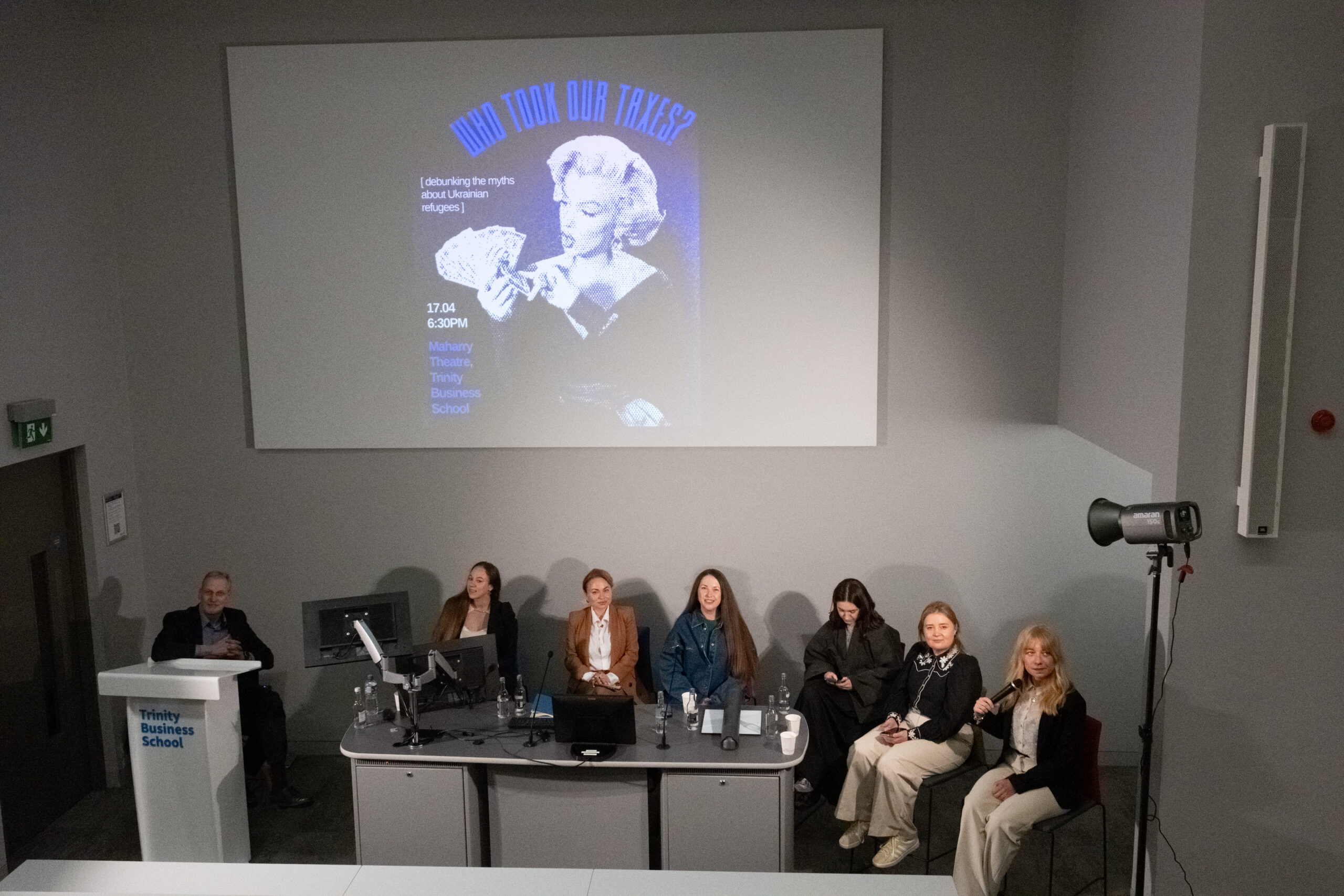
On October 21st, the Trinity Politics Society in collaboration with the College Historical Society (The Hist) screened the Presidential debate, which was broadcasted on RTÉ. I cleared my schedule to attend it – “presidential debate, as a treat”, as one of my friends mocked me.
Ireland is not even my own country, but my thought was: I am going to live under this president for at least the next year and a half. I might not be able to vote, but I might as well make myself aware of what awaits the country that has been – and will be – my home during these college years.
I had heard – from the news, my Irish friends, social media, and whatnot – that Catherine Connolly was leading the opinion polls, but I wanted to make my own opinion on the presidential candidates. What better way to do so than watch the Presidential debate?
By the end of the screening, I realised that if I could, I would definitely cast my vote for Catherine Connolly. Not just because she made a better impression than Heather Humphreys, and not just because I agreed with her on what she said. I noticed a difference in her from other European politicians, a good breath of fresh air.
Back in Italy, our politics have seen better times in the past, although there still are a couple of politicians worth following. But Catherine Connolly made me realise that those that I consider ‘good politicians’ really are just the bottom line of what a leader of any political belief should be – and I believe this comparison works not only with Italian politics, but with those of many other European countries.
Oftentimes I have heard young people from EU countries looking for an alternative to the current politicians in our countries. Connolly could be the alternative voice that many young people have been looking for in politicians, and her election would make Ireland a leading voice that young people from all over Europe would follow.
Firstly, she has the qualities of a leader and she showed them during the debate. While Humphreys rarely managed to change her replies when pressed by the debate moderators, Connolly was much more agile and firm in her replies, and managed to get to the end of her speeches clearly. This gives a feeling of trust and confidence in those who watch and listen to her.
Moreover, during the debate, she took a proper stance on the European Union and its ties to the United States, a stance that I have never seen another politician take before – at least not with this certainty and bravery.
One of the debate moderators called her out on her comments on the European Union: “Europe has lost any moral compass if it ever had one. There are countries we certainly cannot trust. America is one of those.” The moderator then asked her how she thought these comments might affect Ireland’s relations with those countries, above all, given that Ireland is a small country.
Her reply struck me: “I think it’s very important as a small country that we speak truth to power. […] I think as a small country, a postcolonial country, a history of famine and resolution of the conflict […] if we do not use our voice to call out genocide and allow the normalisation of genocide we’re in serious trouble.” She then went on: “I have no difficulty looking forward to serving as President of Ireland and using my voice in different ways as diplomatically as possible in compliance with the Constitution. […] But [anybody witnessing the genocide] would have to be concerned at the increasing money going into the militarisation of Europe. And that is the direction we are going.” With just a few words, she demonstrated that one can stay true to their own beliefs while diplomatically working with the rest of the European Union.
She gave a lecture of independent thinking to the rest of the European politicians, who instead still struggle with admitting even the existence of the genocide in Gaza, afraid of America’s retorsions against their countries. At the same time, she demonstrated that all this can be done by an institutional role. She reminded that it is the role of the President to hold onto their own beliefs – which is what brought people to vote – while compromising with the diplomatic duties of the role of representative of the State. I am tired of seeing politicians afraid to speak their minds, hiding behind the shield of diplomacy, and I breathed a sigh of relief listening to Catherine Connolly on this topic.
Another feature that impressed was her use of Irish. As an international student in Ireland with a political conscience, I have often pondered on how I myself, who came to Ireland because it is an English speaking country, affect the revival of the Irish language – in principle, I support it, but practically, I do nothing to help the cause – if I don’t even make it worse, and that inevitably makes me feel at odds with a country that I consider my home now. But Connolly speaks honestly about learning or relearning Irish. She makes it feel like Irish is a language of inclusion rather than a nationalist weapon, encouraging people to brush it up or learn it from the beginning. Irish is the language of the people who live in Ireland, and it is accessible to all that are willing to learn.
By the end of the debate, my thought was that Catherine Connolly makes me want to stay in Ireland for longer than my college years. This is because she is one of the few politicians I see actually caring for the people of her country, and the first politician I feel I can trust the transparency of. I can say that, on many levels, I feel represented by her more than I feel represented by the politicians of my own country.