
October 7th 2023, 6:30 a.m. Hamas – considered a terrorist group by the EU, Canada, the United States, Israel, and Egypt – announces the launch of Operation Al-Aqsa Flood, beginning with the firing of thousands of rockets from the Gaza Strip. The offensive continues by land, sea and air, and proves to be the deadliest day in Israel’s history. More than 1,200 people – mostly civilians – are killed, and around 240 people are kidnapped. “We are at war,” Israeli Prime Minister Benjamin Netanyahu declares.
Two years later, this conflict continues to have a profound impact on Israeli and Palestinian societies, as well as on the international community. This assessment of a major and still unresolved conflict is intended to be factual, based on verified data and multiple sources.
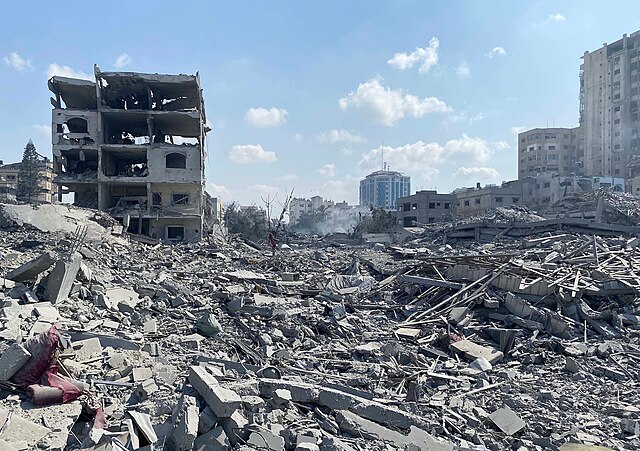
According to the Gaza Ministry of Health (whose data is used by the UN and humanitarian non-governmental organisations (NGOs) as a rough estimate), more than 55,000 Palestinians have been killed since October 7th 2023, the majority of whom are women and children. The United Nations Office for the Coordination of Humanitarian Affairs (OCHA) estimates that more than 90 per cent of the population in Gaza has been displaced and warns of “a high risk of widespread famine”. The bombings have destroyed or severely damaged nearly two-thirds of the homes in the Gaza Strip, as well as hospitals, medical centres and schools, according to the United Nations Relief and Works Agency for Palestine Refugees in the Near East. Israel is blocking the entry of humanitarian aid, and access to water, electricity and healthcare remains extremely limited. A Commission of Inquiry mandated by the UN Human Rights Council (HRC) accuses Israel of ‘genocidal acts’ due to its ‘systematic’ attacks on sexual and reproductive health in Gaza.

In Israel, The Israeli Defence Forces (IDF) report that approximately 1,200 people died in the initial attack and more than 300 Israeli soldiers in subsequent fighting. The families’ anger remains strong, especially among those who are still waiting for the return of hostages. Around 100 of them are believed to still be being held in 2025 according to the Times of Israel and the International Committee of the Red Cross (ICRC) regrets not having had access to the captives.
In Israel, the national unity born out of the shock of October 7th quickly fell apart. Benjamin Netanyahu’s government, already weakened by corruption scandals (‘Qatargate’) and controversial judicial reforms, is facing a political, institutional and constitutional crisis: an authoritarian shift, hostage management, lack of an exit strategy, dismissal of the last figures of the opposition in a country where the executive and legislative branches are intertwined, opposition from ultra-Orthodox allies, Israeli settlements and mass demonstrations as noted by The Times of Israel.
Hamas still controls the Gaza Strip, while the Palestinian Authority – based in the occupied West Bank (Ramallah) due to the annexation of East Jerusalem – exercises partial civil control and remains marginalised. At the UN, President Mahmoud Abbas advocates for the Palestinian cause and rejects Hamas. The divide between these two entities makes any political solution (such as a two-state solution) more complex.
International reactions range from strong condemnation of Palestinian terrorism to calls for de-escalation for fear of regional contagion. The conflict has led to heightened tensions in Lebanon (Hezbollah), Syria and the Red Sea (Houthi attacks), while the Islamic Republic of Iran – accused of seeking to develop nuclear weapons under the guise of a civilian programme – remains a key player]. The United States has been providing military support to Israel, amounting to $174 billion in bilateral aid and funding for the “multi-layered” anti-aircraft system known as the Missile Defence Organisation (IMDO) – from the Iron Dome to the David’s Sling – since October 7th 2023 according to figures from Le Monde, while the European Union and several Arab countries attempt mediation.
Organisations such as Human Rights Watch (HRW) and Amnesty International accuse Hamas (attacks on civilians, hostage-taking) and Israel (indiscriminate bombing, siege of Gaza) of violations of international humanitarian law. The International Criminal Court (ICC) has opened investigations and issued arrest warrants for war crimes and crimes against humanity against Israeli Prime Minister Benjamin Netanyahu, former Defence Minister Yoav Gallant and former Hamas military leader Mohammed Deif. No judgement has yet been handed down.
In Israel, October 7th is commemorated as Iron Sword War Remembrance Day. For Palestinians, this date is part of a longer memory of dispossession and occupation. These conflicting narratives clash, exclude each other and complicate the construction of a shared narrative.
Two years later, no lasting military solution has emerged. Ceasefires and hostage agreements are temporary and fragile. The UN insists on the need for a return to political negotiations that integrate security for Israel, Palestinian rights and humanitarian guarantees. Transnational civil society – hostage families, Israeli and Palestinian human rights associations, humanitarian flotillas, international NGOs – plays a key role in advocating for peace based on recognition of the suffering of all victims.
France, Belgium and several other Western countries – following in the footsteps of the United Kingdom and Canada – officially recognised the State of Palestine at the UN summit on the future of the two-state solution. US President Donald Trump said that recognising Palestine was a “reward” for the “atrocities” committed by Hamas. For its part, the Israeli army announced that it had struck “more than 140 targets” in the last 24 hours as reported by France Info. The Palestinian news agency WAFA reported the deaths of 10 people who were waiting for humanitarian aid.
October 7th 2023 has become a powerful symbol: that of an Israel taken by surprise by the suddenness and scale of an unprecedented attack, of a Palestinian population severely affected by a siege, and of the impasse of a conflict that has lasted more than a century. Two years later, the toll remains one of devastated lives, wounded societies, and an extremely uncertain path to peace.
But this date also carries a collective responsibility: to transform memory into a lever for building a stable political, legal and humanitarian future. For while the present remains dominated by pain, division and uncertainty, history continues to be written.