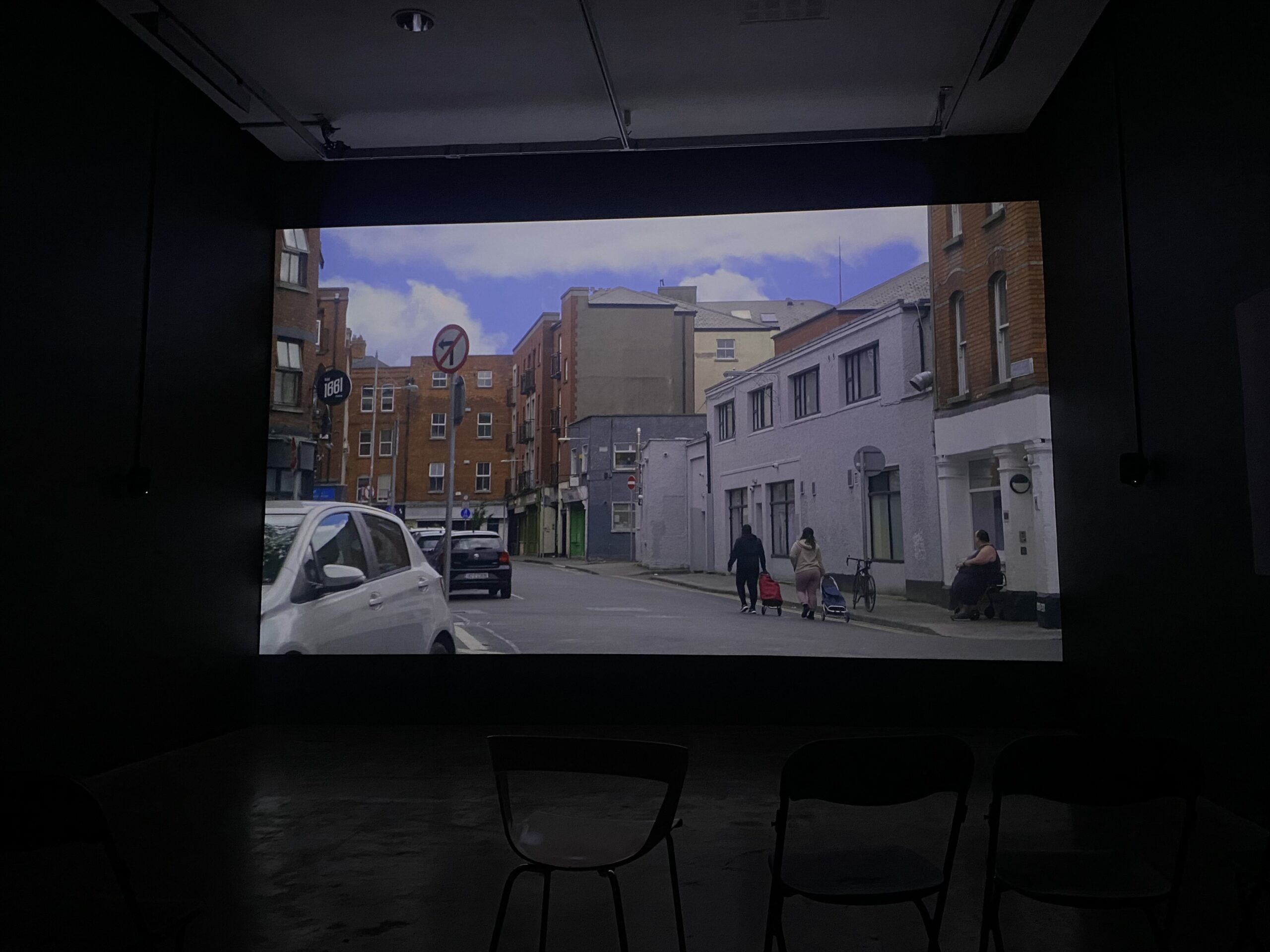

Is discontentment the mark of great art? I found myself grappling with this question when I walked out of the Project Arts Centre, having just seen Jenny Brady’s newest experimental short film The Glass Booth / An Both Gloine. The film screened in Dublin from July 25th to October 4th and required no tickets or reservations.
Brady, whose work is no stranger to exploring ideas around communication and the limitations of language, sought to study the intricacies of the work of language interpreters in The Glass Booth. Bringing them forward from the margins (where they usually stand) to the centre, she examined the art of what they do in four different situations; Reagan and Gorbachev at the Geneva Summit in 1985, an asylum seeker’s interview, a Young Interpreters programme, and a European conference interpreter translating in real time.
What was most apparent was the indubitable humanity radiating from those who featured. Particularly touching were confessionals from several young children of a Dublin primary school participating in a Young Interpreters scheme. In this scheme, bilingual students were paired with incoming students without English to help with language learning and adapting to new school environments. It was eye-opening to witness children as young as eight years old having to be aware of the concept of ‘survival language’ and acting as translators to their parents in scenarios as ordinary as a visit to the bank. This is the harsh reality of our times, which while being unfamiliar to some, resonates too closely with many others.

All in all, Brady achieved her goal of revealing how and why the act of interpretation is crucial to human survival. But despite the serene slow-motion shots of Dublin coasting from story to story, the momentary awe was superseded by rasping and pulsating synths that sounded like nails on a chalkboard. They made it difficult to ruminate on the significant matter at hand; in fact, the disparate horror film soundtrack and choppy scenes triggered a sense of fight-or-flight. There seemed to be the sense of an eventual final negotiation; however, this set up for a “great” impending doom led to an unfortunate crescendo, not really landing itself anywhere. That being said, the haunting choral harmonies would have been right at home had the film stayed on the topic of Reagan and Gorbachev.
Looking at subject matter alone, the sentiment is important, emotional and something more people should absolutely be aware of. But there was much left to be desired upon exiting the dark screening room. The Glass Booth felt like it was trying a little too hard to slot into the ‘experimental’ category, and along the way, neglected the synthesis between sound and image. Still, it must be recognised that a bewildered and baffled reaction to the incredibly strange is usually the desired one – so if a perplexed ‘oh!’ as the credits rolled was the intention, then I say fair play.