
I remember when I found out the world was going to end. Presented as a “fun fact” in a kids’ science book was a description of how the Sun would eventually exhaust its nuclear fuel and expand to over 100 times its current size, before beginning to shrink, cool and fade away, ending its life as a white dwarf, a dead star.
This “fun fact” was my first moment of existential terror (there would be more). The fact that all of this wasn’t going to happen for 5 billion years or so didn’t dim my horror. As a child, I thought that I, the planet, and everyone I loved would live forever. It was deeply frightening to my child’s mind that the Earth could ever be damaged. Of course, not too long after this first moment of learning of the planet’s precarity came more pressing problems. It has been apparent for a long time that human industry is putting our planet in serious danger. Despite this, said human industry has continued largely unabated.
Living with this knowledge is scary and overwhelming for adults. So how does it feel to grapple with it as a child, a stage of life that often feels helpless to begin with? What should we say to kids about the climate crisis? And what are kids saying to us?

Maisie Lee and Jessica Wilson’s The Shape of Quiet Feelings is an attempt to try and answer these questions. Featured in the Dublin Fringe Festival this year, The Shape Of Quiet Feelings is a family-friendly piece, composed of a short atmospheric audio-visual experience, followed by a twenty-minute interactive workshop. The project is driven by a common concept in cognitive behavioural therapy for children – externalisation of feelings, coupled with the personification of those feelings. Children in Galway and Dublin were guided in creating and designing “creatures” representing how they felt about climate change. The whole show has been created from their ideas and designs, as well as their feelings about the climate crisis. The audio-visual experience begins as we journalist-types sit cross-legged on cushions in a dark room. Three impressive large-scale models of different climate change creatures loom in front of us. One resembles an ice golem, another a craggy volcano spirit, and the last is a pile of brown sludge with skinny arms that reminds me of the McDonald’s mascot Grimace, who I suppose is as good a representation of mass human overconsumption as any.
We’re given a blank paper card and a marker, and are instructed to write down the primary feeling we have towards climate change, the colour we associate with this feeling and so on. In between these instructions, we hear recorded soundbites from the schoolchildren being interviewed, while colourful lights and some slight mechanical movement animate the creatures (at one point, Not-Grimace’s arm jolts upwards, and I start).
While we’re thinking of what to write on our cards, we listen to how the children responded to the same prompts we’re wrestling with. Though the topic is undeniably grim, the kids’ innate, uncomplicated creativity is striking. Some create monsters representing climate change, malicious entities responsible for pollution and destruction, whereas others see their creature as a victim of climate change – wild creatures whose homes are under attack. There are also more hopeful creations in there, heroic figures who will save the Earth from climate catastrophe. These optimistic characters made me feel a bit ashamed at my weary pessimism (evident in my character being named “Henry the Hopeless Cloud”).
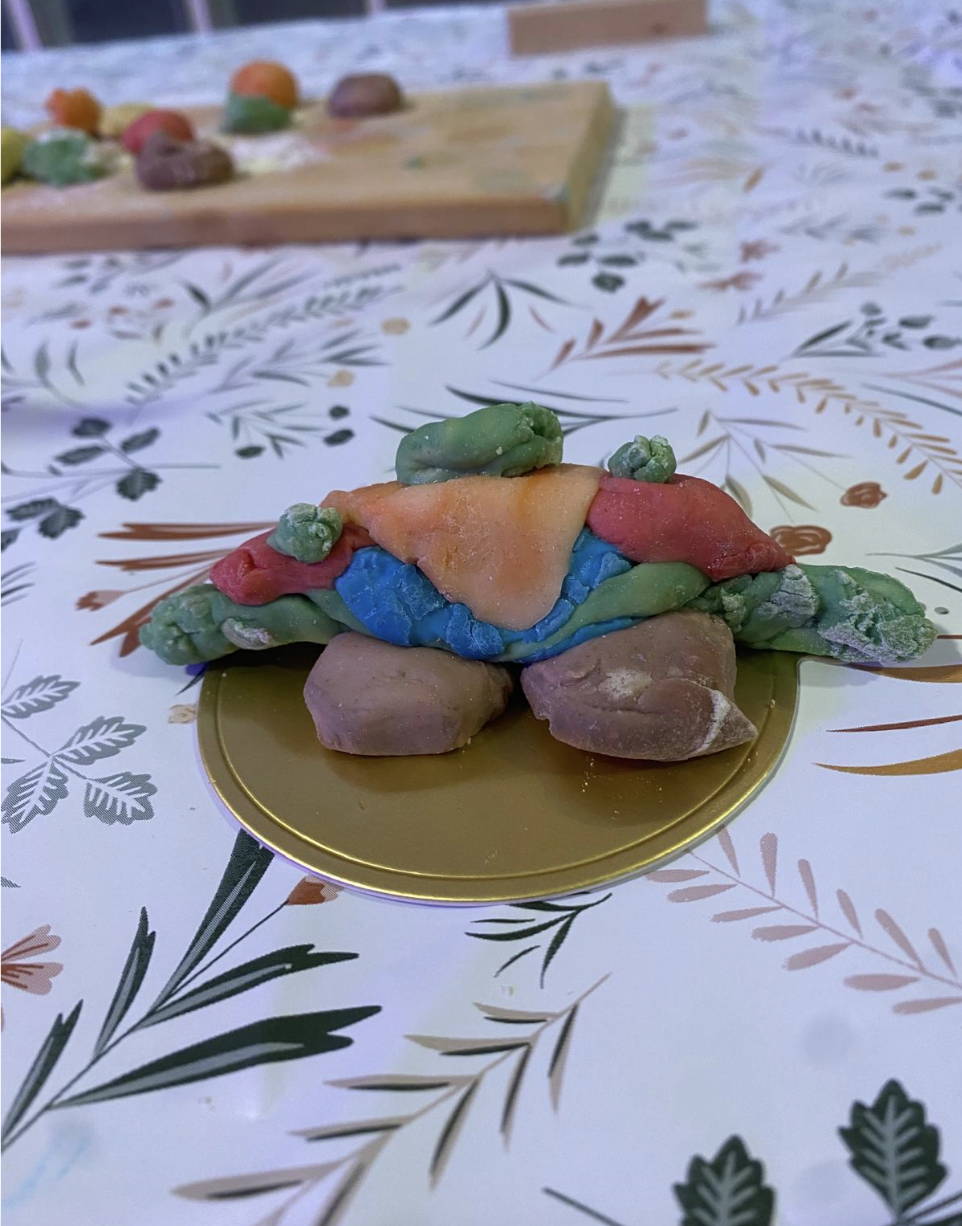
After the show is over, we’re escorted out and into the lights again to begin the workshop. We’re seated at a table laden with various coloured blobs, which we are told are biodegradable salt dough, made from flour, salt, water and food colouring. The aim of the workshop is to convert the critter we have described on our card into a clay model.
We’re initially a bit hesitant to get stuck in, dignified adults as we are, but as we start to experiment with the dough, we get into it. I labour over my creature, fine-tuning and tweaking Henry for as long as the workshop allows (though you wouldn’t know it to look at him). There is something satisfying about messing around with something tangible, physical, that you can mould with your hands. It’s something I haven’t done since I was much younger, something a lot of us don’t experience too often in an increasingly digital world. I’m glad that this workshop incorporated this tactile, artistic element; it’s something truly valuable for kids to experience.
At the end, we’re given the choice of taking our creation home or displaying it as part of the exhibition for others to gawk at. This is a means to say that I am now officially an exhibiting artist, my work featured alongside my nine-year-old peers. Until Henry is disposed of, no doubt in an eco-friendly, biodegradable way, he is my masterpiece.
The Shape of Quiet Feelings is a very short piece, but I did find it to be thought-provoking and worthwhile. It tackles a serious issue that gnaws at our psyche in a gentle, creative way. The show and workshop complement each other nicely, combining the emotional and the physical effectively. Families and groups of children could definitely get something out of attending The Shape Of Quiet Feelings, and I would definitely recommend it.
Thinking back on the various creatures now, I’m most taken with the optimistic ones, the heroes. They show that we haven’t entirely lost hope in our planet, that we haven’t all succumbed to hopelessness. There are still people who believe the Earth can be saved, and we should all strive to be more like them – even if some of them are in third class.