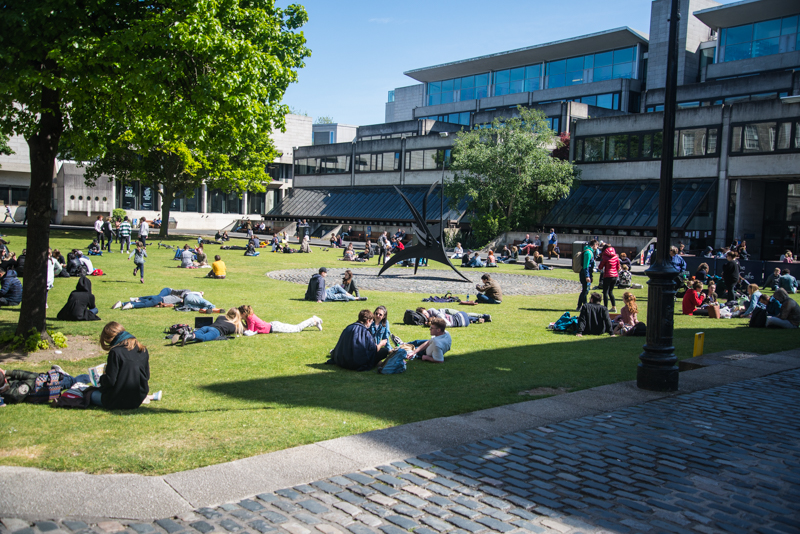

Walk into the Arts Block on a wet Tuesday and you’ll see the usual cast. Some people who sleep with sketchbooks under their pillows, others with their laptops logged into freelance platforms. Bands are advertising their first headline gig on faded cardboard, bathroom doors are packed with the half-peeled stickers of artists and writers, and there are fashion students whose garments look like performance art and cost more than a month’s rent. Some of this is practice. Some of it is labour. And some of it is a performance, a practised posture learned on Instagram and at late-night parties. The city hums with organised support and small, stubborn economies—national programs that promise everyone a chance to create and sell their creativity, and municipal plans that try to map what a creative life might look like in policy.
To call yourself a creative now is to hold a dual identity. It means you might be an artist making work in a studio, and it also means you might be an entrepreneur editing a portfolio to catch the eye of a client. Both are valid. Both are precarious. The studio practice depends on limited grants, intermittent residencies, or unpaid hours that rarely guarantee a livelihood. The entrepreneurial route requires constant self-promotion, competition in saturated markets, and the risk of reducing practice to what’s most marketable. In both cases, the work is unstable, tethered to cycles of funding, algorithmic visibility, and the ever-present possibility of burnout.
Dublin’s official cultural strategies and initiatives have pushed to make creativity visible and fundable in recent years. City and national programmes articulate a hope that creative life becomes infrastructure, not just an aesthetic. There are residency schemes like those supported by Dublin City Council, experimental festivals that showcase emerging talent, and even large-scale initiatives like the Basic Income for the Arts pilot scheme, which promises artists a measure of security. Yet that promise is fragile. Not every applicant is selected, and even successful artists often find themselves juggling side jobs or short-term gigs to cover rent. The art scene in Dublin remains volatile, and few creatives sustain a living wage purely through their practice. In this instability, performance becomes not just aesthetic but strategic: when stable structures fail, artists often have to define and perform their creativity on their own terms, cultivating visibility and identity as a means of survival as much as expression.

Performativity helps explain why the label matters. Judith Butler’s thesis—that identities are not a pre-existing essence but are produced through repeated acts—moves easily from gender into the economy of artistic selfhood. When people rehearse an image of themselves as “creative,” they are doing something that has effects in the world. It opens doors and closes others. It can spark a community. It can flatten complexity into a costume. We perform as artists in interviews, at openings, in bios and bios’ bios. Sometimes the performance amplifies genuine curiosity and craft. At other times, it becomes a mode of presentation that obscures labour, education, and obligation.
If you want evidence that the lines are blurring, look at the newest wave of designers and makers in the city. Young Dublin designers are explicitly mixing runway and installation, brand strategy and gallery practice. At this year’s Dublin Fringe Festival, for instance, several fashion graduates staged shows that doubled as immersive performance pieces, with garments presented as sculptural installations rather than in conventional catwalk format. Designers like those profiled in the Irish Times—emerging voices who treat fashion as both spectacle and commentary—are pitching their work simultaneously to buyers and curators. They stage shows that read like theatre. They pitch to buyers and to curators. The result is a fertile confusion. It yields work that is hybrid and audacious. It also poses a challenging question: Is the performative aspect of art a new language of creative freedom, or a necessary adaptation to a market that prizes spectacle? The answer, often, is both.
Being a Dublin creative, then, is rarely pure. It is a braided identity of study and hustle, of the kind of early-morning devotion that pays nothing and the after-hours networking that pays in gigs. It requires both fidelity to the work and fluency in presentation. If you are reading this on campus between lectures, take note of the way people carry themselves. Artistry and performativity live in the same bodies. They lift the city by filling its galleries, festivals, and streets with energy, but they also strain it by stretching limited resources, competing for scarce funding, and working under the constant pressure of visibility. To ask who a Dublin creative is, in the end, is to ask what we value when we walk by a gallery or like a photograph. The answer will not be tidy. It will be a room full of work, people handing out cards, and a small, battered hope.