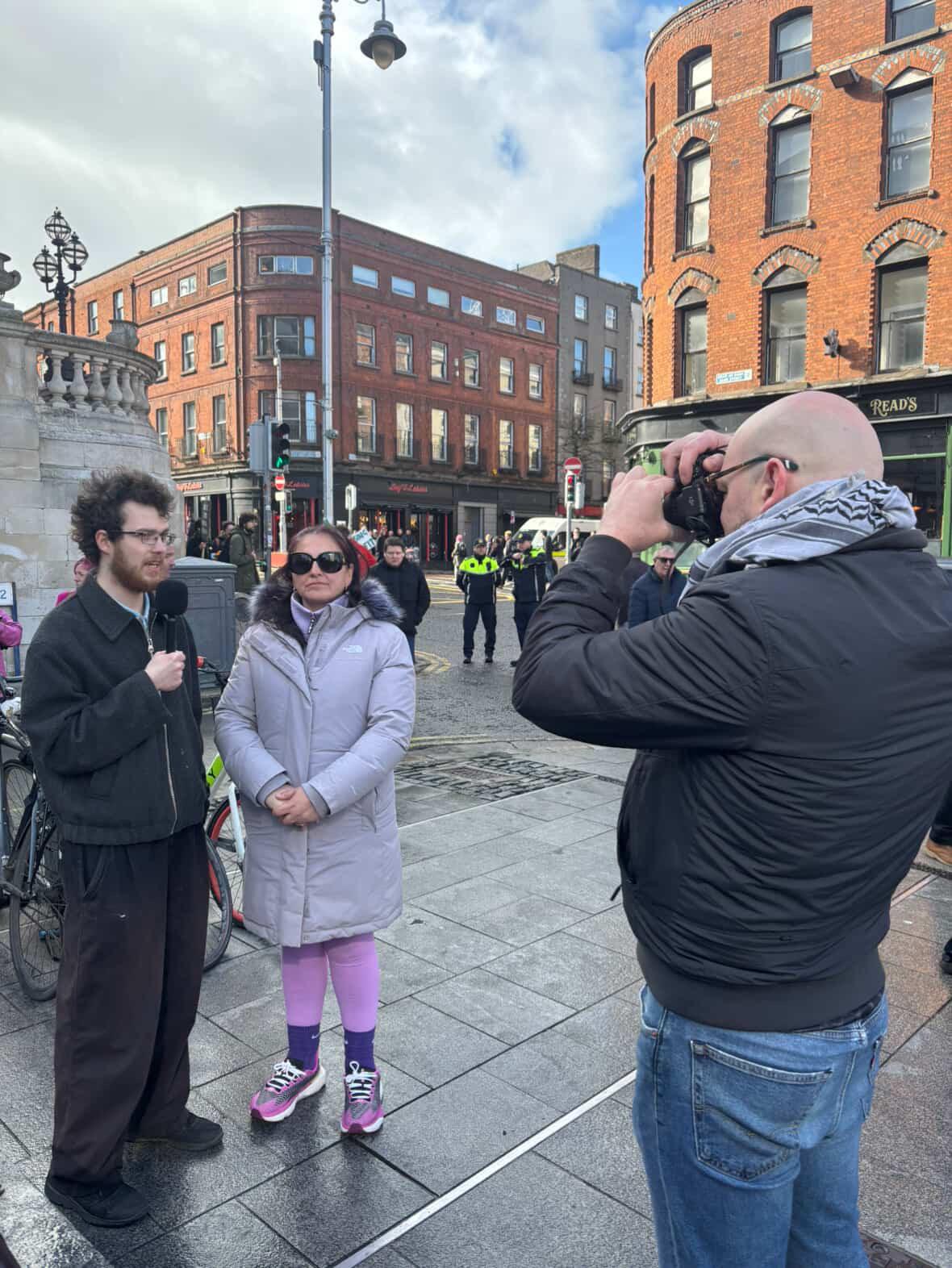
Irish historian, Cathrine Corless, received a medal of Honorary Patronage of the Elizabethan Society (Eliz) on Friday, November 7th. Corless is renowned for her role in uncovering essential information about the deaths and burial of children in the Bon Secours Mother and Baby Home in Tuam, Galway. Through her research, she brought the scale of the tragedy to light, discovering that 796 children died in the Home, and were buried in an adjacent “sewage system”.
Corless was introduced to applause and awarded the medal of Honorary Patronage, before giving a summary of her work, the challenges she faced, and the driving force behind her advocacy: “All I wanted was to get the truth out there and to do something.”
This was followed by an insightful Q&A session with the President of the Eliz, Marin Henley, whose questions led to discussion on her unconventional path to becoming a historian, as well as the challenges of her endeavour in the face of frustrating inaction from the Irish government and church, and her hopes for the ongoing exhumation of the site. Throughout it all, Corless placed the victims and survivors at the forefront of her discussion, emphasising the need for respect and dignity for those who suffered within Tuam and more broadly across Ireland.

Corless endured numerous obstacles in her fight for justice, yet praised the Irish media for keeping her mission “alive in the face of the government”. Despite being told to stop, she said that she could not ignore “the drive” in her to “unearth” what had happened to the children of Tuam, wanting above all to “give them a name”, and restore their dignity.
Henley moved to asking Corless about her path to becoming a historian, which was inspired by her own curiosity about her family history, particularly that of her mother. This led her to take courses on research and writing, guided by her tutor who encouraged her to “keep going, never give up, and find answers”. This project culminated in Corless’ 2012 article, The Home, published in a local historical journal, where she uncovered the harrowing deaths of 796 children and the absence of burial records.
In the wake of the final report from the Commission of Investigation into all Mother and Baby Homes in Ireland in 2021, Corless stated that it had not “gone far enough”.
Crucially, she lamented that the stories of survivors were only awarded limited attention in the report. She believes that in the search for “documented proof”, these testimonies were treated as “hearsay” and thus the explicit truth of suffering and abuse was not evident in the report.
Corless then spoke about the powerful experience of meeting with survivors in her community and helping them connect and, in some cases, share their stories with the media, many of whom had never previously discussed their memories of being in the Home. “It gave them back their dignity,” she said, with “survivors able to talk about their experience and demand their rights”.
She stated, “everybody deserves to know who they are.”
When asked if she could bring herself to find trust in the church again, Corless explicitly answered “No”. She criticised the church’s approach of ‘remembrance’ without taking responsibility for its role. Of those associated with the institution, she said, “they all told lies… they knew what happened… and they won’t take responsibility”. There was silence in the room as she asked the powerful question: “how can I have any faith in a church that still won’t do anything?”
The conversation turned to the current exhumation efforts in Tuam that began in the summer of 2025, which Corless called the “biggest relief” and the culmination of “what [she] worked for all those years”. Praising the team and the “excellent director”, and expressing the hope for the project, she said, “their heart and soul is in it and they want to do right by the babies”.
In Corless’ mind, the project is a symbol of “justice” and “truth”, giving a powerful “voice for the babies and the horrific life they had”, as well as to the “mothers” who “went to their graves with the shame” of the treatment they were subjected to within these institutions.
Corless also discussed the upcoming film, The Lost Children of Tuam, directed by Frank Berry and produced by Liam Neeson, set to be released next year. She is “delighted” to be involved in such an important piece of work, bringing the tragedy of Tuam and the fight for justice to a larger audience. The film itself is based on a 2017 New York Times piece on Corless, giving an account of her research and its explosive outcome.
Towards the end of the session, when answering a student question on the role of people and institutions in memorialising the widespread tragedy of mistreatment in Mother and Baby Homes across Ireland, Corless shared her poignant takeaway from the long process she endured towards justice for all who suffered under the scheme. She urged that “people have to keep talking… and raising the issue. You have to tell people not to walk away… because this could happen over and over again”.
Corless is an inspirational voice for those who were shamed and silenced, who continues to strive to restore their place and dignity in the history of this country.