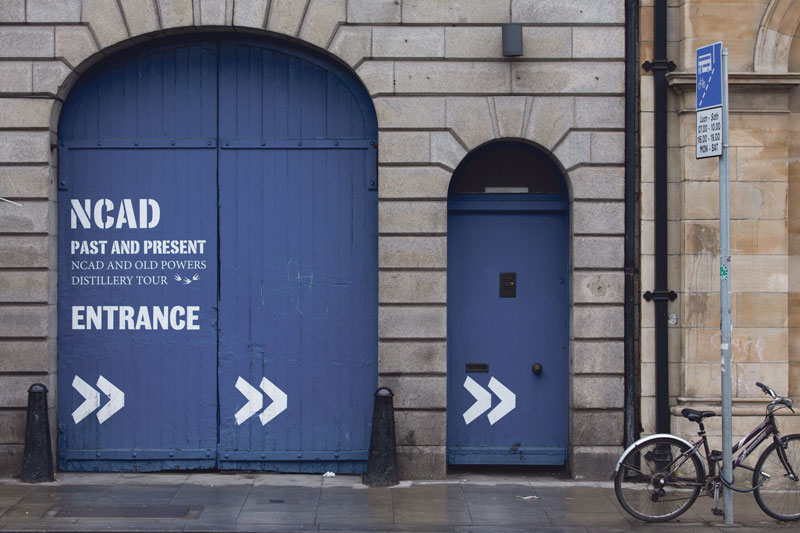
It’s not every day you walk into a free screening of an experimental film and out with a new understanding of religion, diaspora and memory. Set soon after the 2008 Irish banking crisis, Frank Sweeney’s Go Ye Afar, aims to take its viewers on a transcendent journey woven through Ireland and Nigeria’s intertwined pasts. The film is showing every thirty minutes at Dublin’s Temple Bar Gallery + Studios until 23rd November. Stepping off the hectic streets of Temple Bar, you are met with this safe haven of a theater, the vessel for Sweeney’s voyage. Each seat is a bus bench from a bygone era complete with a seatbelt, which, trust me, you’ll need.
We embark at twilight in the rolling hills high above Dublin, where our main character, an Irish-Nigerian taxi driver played by Stanley Aguzie, waits in his running car before starting his overnight shift. Throughout the night, each passenger that enters his car ties the thread connecting the two countries a little bit tighter. A preoccupied white couple are the first, setting the stage for what is to come.
“We were moved by what we saw,” the woman says from the backseat, detailing her missionary trip to Africa to someone on the phone. She proudly claims that she and her husband love to “give back to society” and here comes a taste of modern-day saviorism.

With the next passenger, an old priest, the years roll back to the times of rampant Irish humanitarianism and evangelicalism in Nigeria. The priest recalls the 1960s’ Nigerian-Biafran conflict, and his own experiences as a Catholic missionary. At this point, the film shifts from reality to fantasy, with the car transforming into a vehicle that can move through space and time. Submerging into Dublin’s Liffey and coming out to a rainy Calabar, the two characters continue to converse.
What really makes this short special is not what it says, but rather what it doesn’t. Religion looms in the background through shots of Catholic statues, mosaics of Mother Mary, and the Jesus prayer card tucked into the taxi’s flip-down mirror. The undertone of Christianity is omnipresent in the film, tellingly and intentionally. Sweeney’s focus remains on four key events: 20th century Irish missions into Africa, the Nigerian-Biafran War, Shell to Sea demonstrations, and the visit of the International Monetary Fund in 2010. History is deeply entrenched within the storyline and visuals, but, like religion, this only vaguely makes the cut into dialogue.
Sweeney also uses old footage to his advantage. A nun leading lines of Indigenous Nigerian women is a shot that really stands out. Such videos were extremely common in the West in the sixties due to their ability to appeal to a mass audience, who, for the most part, had never been outside their country of origin. Early Irish NGOs needed support, and this is how they gained the favor of the general public. Archival clips from Free Trade Zone instructional videos and Irish Shell to Sea protests are incorporated as well, impressively blurring the line between documentary and narrative filmmaking.
Go Ye Afar takes risks, but ultimately lands. While Hollywood these days feels like it’s just endlessly rewriting its old slop, small creators are putting in the work. Seeing films that cultivate inquiry into our past and collective memory through original storytelling genuinely fills me with such joy – I didn’t even mind walking out of the theater into the hordes of tourists scrambling to find their €17 Guinness.