Dublin’s rich scientific history is marked by groundbreaking scientific discoveries and pioneering research. While most of us are familiar with the Guinness Storehouse and the many esteemed alumni and researchers of Trinity, the city also holds many lesser-known sites of scientific discovery which deserve their own chance in the spotlight.
View or visit these landmarks here.
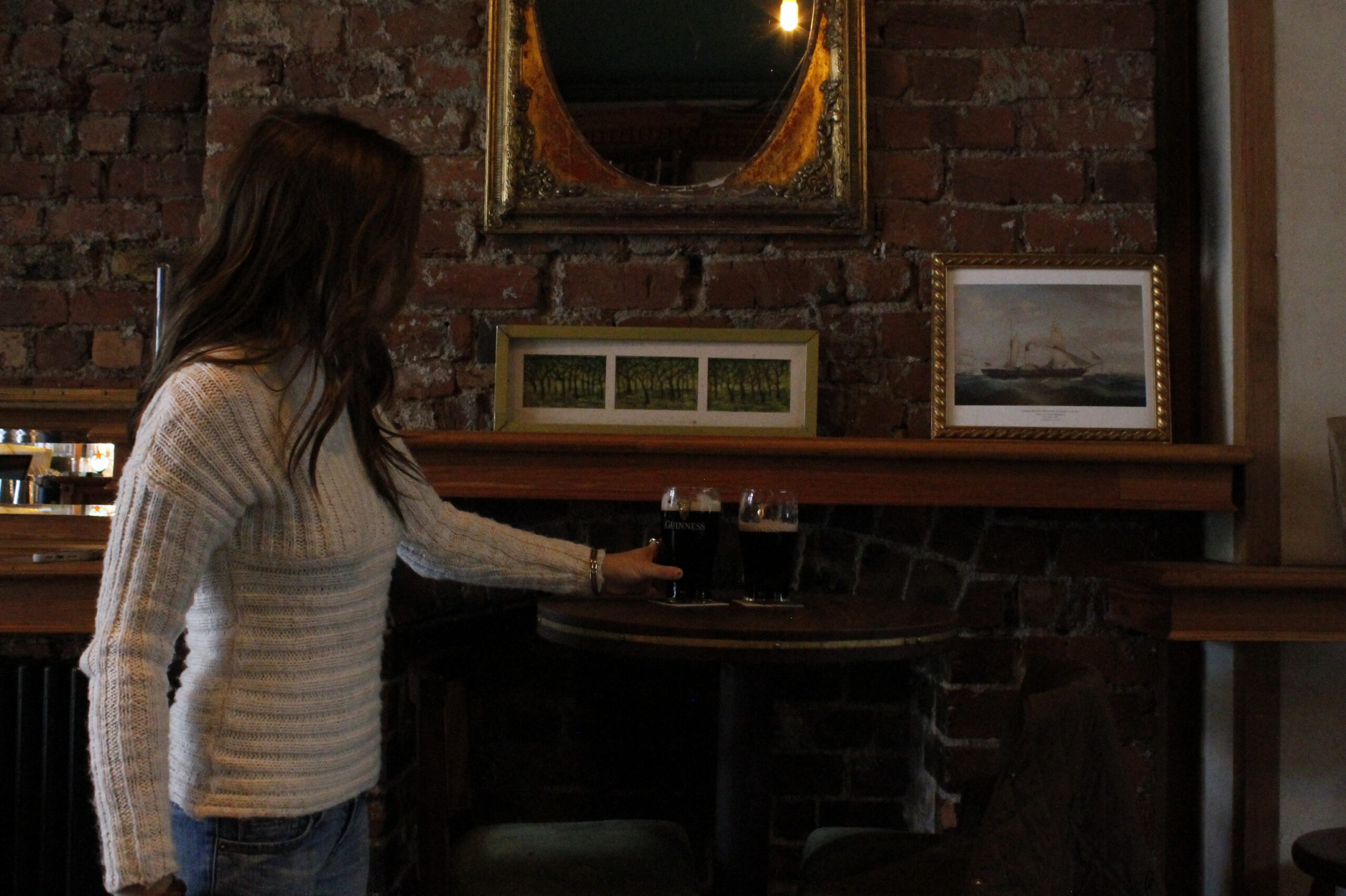
Guinness Brewery/Storehouse

St James’s Gate, Dublin 8
Any STEM student will be familiar with the t-test, arguably the most useful statistical tools in science. Fewer know that we have Guinness to thank for it.
Students t-test was developed by William Sealy Gosset, a chemist and statistician working in the Guinness Brewery at St James’s Gate. As international sales of the famous Irish stout were expanding, Gosset was working on a way to ensure rigorous quality control. In 1908, Gosset published the t-test under the pseudonym ‘Student’ to comply with Guinness’s strict publishing restrictions. Today, scientists use Student’s t-test to determine if there is a significant difference between the means of two groups. So, yes, whether you are sipping a cheeky post-lab pint or crunching data in the library, you have Guinness (and Gosset) to thank for it.
Trinity College Dublin
College Green, Dublin 2
Trinity has long been a powerhouse of scientific research and discovery. Today, we can thank Trinity’s world renowned researchers for countless innovations and discoveries which have shaped science and life as we know it.
In 1914, Trinity Geology professor John Joly (think the Joly Lecture Theatre in the Hamilton Building) developed the first cheap, effective and relatively safe radiotherapy for cancer. The discovery became internationally known as the ‘Dublin method’. Joly’s ‘Dublin method’ utilised cheap and controllable radioactive radon gas instead of highly reactive radium. Joly’s discovery laid the foundation for modern cancer treatment and saved countless lives.
In the 1950s, Dr Vincent Barry and his team were researching a cure for tuberculosis when they accidentally discovered a cure to another bacterial-caused disease: leprosy. Today, the anti-leprosy drug, called Clofazamine, is on the World Health Organization’s Essential Medicine List and remains part of a multidrug treatment to cure leprosy.
Trinity Genetics Professor Aoife McLysaght is one of the world’s leading geneticists. She was part of the international consortium that published the human genome project, a major international effort to sequence the entire human genome. In 2009, Mclysaght and her team at Trinity’s Smurfit Institute of Genomics were the first to discover novel human‑specific genes, providing insight into what makes us humans uniquely human.
Internationally acclaimed scientific discoveries such as these explain why Trinity is considered one of the best research-intensive universities in the world.
Ln.Na Réadlainne/Observatory Lane
Rathmines, Dublin 6
Just off Rathmines Road Lower, a small lane called Lane Na Réadlainne (Observatory Lane) leads to one of Dublin’s lesser known astronomical landmarks. An unassuming red oval plaque is the only clue that this quiet laneway once led to the Optical Works of Sir Howard Grubb, one of the best telescope engineers of the 19th century.
Grubb’s telescopes weren’t just famous locally, they were shipped to prestigious observatories across the world, from Vienna’s Royal Observatory to the Melbourne Observatory in Australia. Grubb also made significant contributions to the Carte du Ciel (Mapping of the Sky) project, an international effort to photograph and map every star in the sky starting in the late 19th century.
While the workshop is long gone and you can no longer order one of Grubb’s feats of engineering, this modest plaque in a small alleyway quietly honours one of Dublin’s forgotten pioneers in the science of astronomy.
Rotunda Hospital
Parnell Street East, Dublin 1
Rotunda Hospital, founded in 1745 by Dr Bartholomew Mossee, is the world’s oldest-surviving maternity hospital, but its significance extends far beyond its age.
In the 1790s and early 1800s Dr Joseph Clark and Dr Robert Collins were among the first doctors to understand the importance of hygiene in preventing the spread of disease.
The hospital was also the location of many techniques and device inventions. Late in the 20th century, Robert Collis developed the technique of feeding premature infants through a tube in the nose. Before this novel technique, infants were spoon fed by mouth, a method which was largely unsuccessful.
The Meath
Heytesbury Street, Dublin 8
In 1844, Dr Francis Rynd, a surgeon at the Dublin Meath Hospital on Heytesbury Street, was attempting to treat a patient suffering with chronic facial pain, but providing her with little relief. In an attempt to ease his patients suffering, Rynd invented a technique: a makeshift hypodermic syringe to inject medication directly under his patient’s skin. Today, hypodermic syringes are essential tools in medicine, used to administer medications and vaccines and to draw blood.
Baggot Street Hospital/City of Dublin Royal Hospital
Baggot Street Upper, Dublin 4
Though now closed, the Royal City of Dublin Hospital on Baggot Street Upper was once at the forefront of medical research in Ireland.
In the 1840s, Dr John Houstan pioneered the use of the microscope in diagnostic medicine, using it to reveal changes in diseased and cancerous cells. Today, the cancer research that began at the Baggot Street Hospital is now conducted at St James’s Hospital.
Over half a century later, Dr Dorothy Stopford Price, a Trinity medical school graduate, used the hospital’s radiological facilities to study tuberculosis in children. After observing the use of the BCG vaccine in other countries, Dr Price introduced the vaccine to Dublin’s St. Ultan’s Hospital in 1937, marking a turning point in Dublin’s fight against the deadly disease. Price’s efforts helped save countless lives in some of the city’s poorest communities during one of Ireland’s deadliest epidemics.
Broom Bridge
Cabra, Dublin 7
On October 16th, 1843, Irish mathematician Sir William Rowan Hamilton had a stroke of genius while walking along the canal in Cabra. In this moment of inspiration, he etched his famous quaternion equation into the stone of Broom Bridge, immortalising the small stone bridge.
i² = j² = k² = ijk = -1
This act marked the birth of the quaternion number system. Today, quaternions are fundamental in fields such as computer graphics, robotics, and virtual reality, and Broom Bridge is one of Dublin’s most famous bridges.
Dublin’s rich and diverse scientific legacy is immortalised in landmarks scattered throughout the city, e in scientific institutions and hospitals, but also in the most unexpected places. If you have a free Saturday, or even a couple of hours between classes, exploring these landmarks will offer you the inspiration you need to get through the busy months leading up to exams.