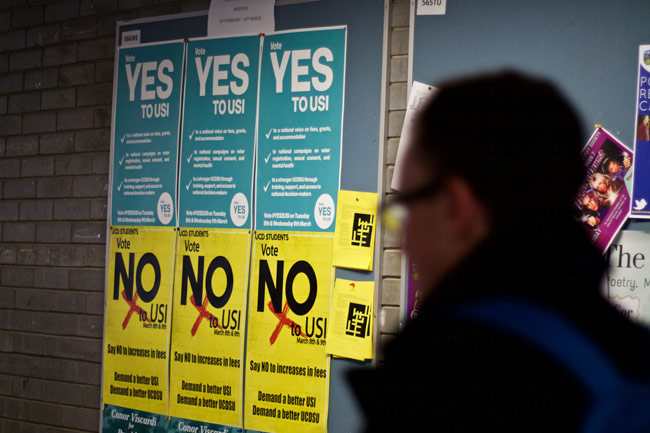

Trinity College Dublin Students’ Union (TCDSU/AMLCT) referendums offer a useful way to gauge public opinion within Trinity, and can significantly impact the direction of the Union. This article presents a sample of referendums in recent years, and the impact they have had on both TCDSU and the College.
Firstly, what is a TCDSU referendum? There are three types of referendums: constitutional, Long Term Policy (LTP), and Sabbatical officer impeachment. Referendums can be called either with a 2/3 majority vote at TCDSU comhairle, or through collecting signatures from Union members. If pursuing the route of collecting signatures, impeachment and constitutional referendums require 500 signatures, while LTP require 250.
Impeachment or constitutional require a simple majority to pass, while an LTP referendum requires a 60% majority to pass. All Union members are entitled to vote in referendums.
The following examples from recent years illustrate the recent referendums held by TCDSU, and their impacts.
2018 BDS LTP Referendum
One of the most notable referendums of recent years was the 2018 Boycott, Divestment, Sanctions (BDS) referendum, which passed with 64.5% of the vote among students. This referendum asked the question “Should TCDSU accept a long term policy on Palestine and in support of Boycott, Divestment and Sanctions (BDS)?”, and mandated TCDSU to, among other things, “Campaign and lobby College to adopt BDS; which should include a total boycott of the State of Israel (Cultural, Academic and Economic), divestment of college funds from Israeli companies and other companies listed on the BDS Divestment List.”
Following this referendum, the Trinity BDS Campaign was supported by TCDSU, culminating in the May 2024 encampment in Fellows Square.
Following the encampment, the college established the Taskforce on Academic and Institutional International Links and Related Matters. This culminated in Trinity fully cutting ties with Israel in June 2025, including investments, suppliers, commercial relationships, academic ties, and where possible, research collaborations. This decision made Trinity the first university in the Western World to comprehensively cut ties with Israel, truly showing the impact a TCDSU referendum can have.
2021 Failed LTP Referendum on Boycotting The Irish Times
In 2021, TCDSU held a referendum on boycotting The Irish Times. This came following an opinion article The Irish Times published titled “Bill to Ban Conversion Therapy Poses Problems for Therapists”, after which the Trans Writers Union called for a boycott of the paper.
This referendum received 58% of the vote, a majority. However, it fell short of the 60% required for a LTP referendum to pass. This shows that even though a majority may support a stance, it does not mean a LTP referendum will pass, because it requires more than a majority. As a result, TCDSU did not boycott The Irish Times.
2024 Irish Language Constitutional Referendum
In 2024, TCDSU held a referendum on fully integrating the Irish language into TCDSU, making it a bilingual union. This referendum passed with approximately 90% of the vote, and resulted in the Oifigeach na Gaeilge (Irish Language Officer) role becoming a full time Sabbatical role.
Since the passing of this referendum, TCDSU has worked towards integrating Irish into Union communications, which has included making all weekly emails and social media posts bilingual. Since the referendum, the Union has also protested the college on Irish language issues. This included a 2024 direct action where Union members put a sign saying “Cá bhfuil an Ghaeilge?” in front of the Campanile in protest of the fact that not all College signage is bilingual.
The referendum has had a large impact on the presence of the Irish language within the Union, helping to create a more bilingual culture across campus.
2025 Chapter 1.5 Constitutional Referendum
In 2025, TCDSU held a constitutional referendum to amend chapter 1.5 of the constitution, amending the constitution to read “The Union shall pursue these objectives independent of any political party or religious organisation”, changing it from the previous version which read “The Union shall pursue these objectives independent of any political, racial or religious ideology”. This referendum passed with 58% of the vote.
This referendum also shows how the different referendum types require different proportions of the vote, as the 2021 LTP referendum on boycotting The Irish Times also received 58% of the vote, but wasn’t carried because of the different requirements for LTP referendums when compared to constitutional referendums.
This referendum allows the Union to be more political than it had been allowed to previously, and it also allows the Union to adopt positions of no confidence in the Government of Ireland. This referendum also put the clause that “The Union may only adopt a position of no confidence in a government as a matter of long-term policy” into the constitution, which means that any position of no confidence must be passed through a LTP referendum.
2025 LTP Referendum of No Confidence in the 35th Government of Ireland
In November 2025, TCDSU held a referendum of no confidence in the 35th government of Ireland, which is composed of Fianna Fáil, Fine Gael, and Independent TDs. This referendum passed with 70.9% of the vote.
This referendum means that TCDSU will formally declare no confidence in the Government. This would potentially allow TCDSU to adopt a more hardline and general campaign against a government which has consistently failed students, such as with their recent €500 increase in student fees. Only time will tell what the impact of this referendum will be.
To conclude, these referendums show the varying impacts that referendums can have. Some referendums, such as the 2018 BDS referendum or 2024 Irish Language referendum have had lasting effects both on Union and College policy. Other referendums, such as the 2021 failed referendum on a boycott of the Irish Times, show the constraints of LTP referendums and the varying levels of support required for referendums to pass.
These referendums demonstrate that TCDSU referendums can in fact have an effect, both on internal Union policy and on external bodies, such as the College. From BDS to the Irish Language, referendums serve as a barometer to gauge student opinion on issues, and have a direct impact on policy. These referendums will continue to shape Trinity for years to come, and the question is, what will come next?