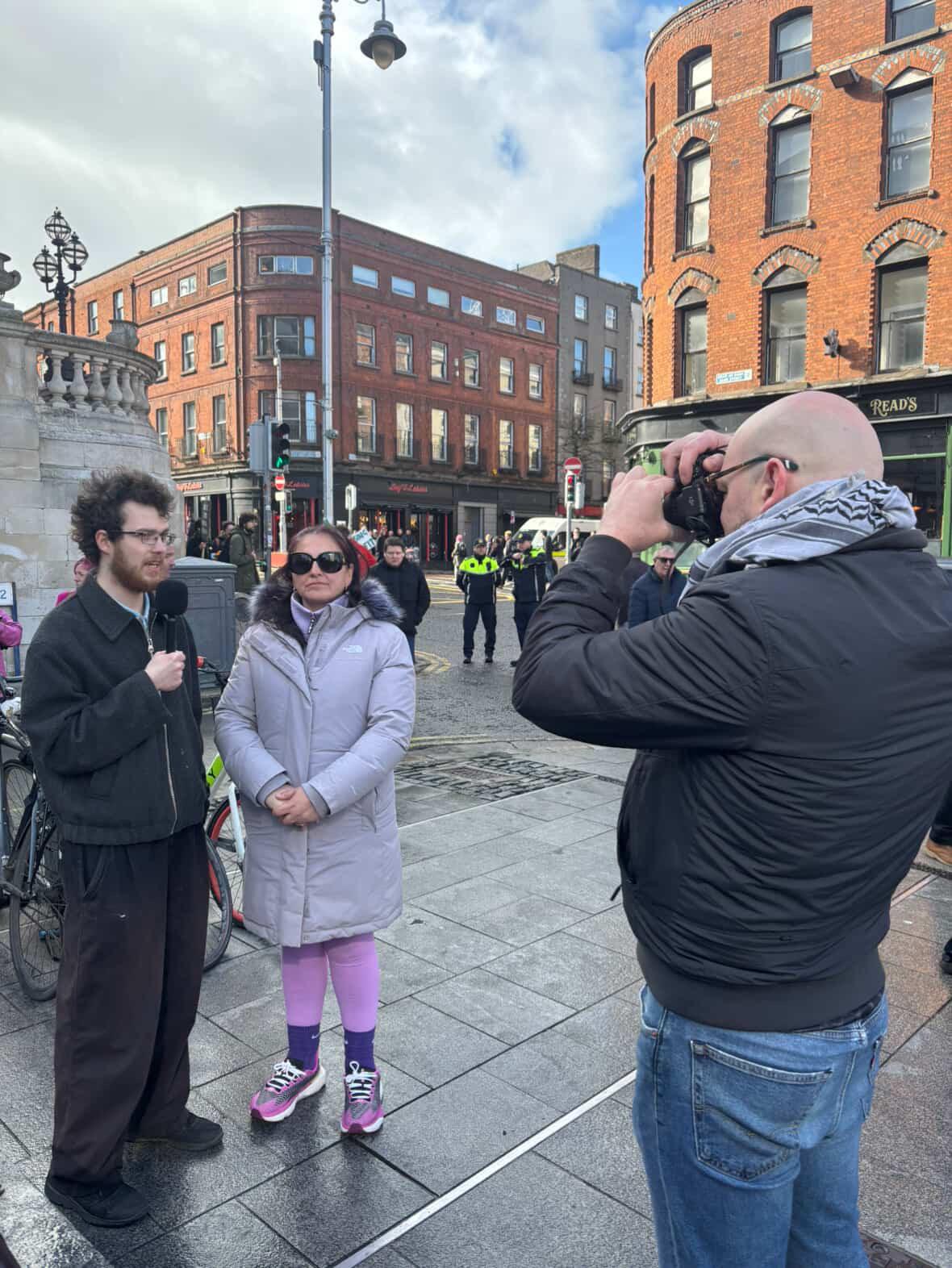
On Thursday, November 13th I sat down with Dr Jilan Abdalmajid, the Ambassador of the State of Palestine to Ireland to discuss her story as a diplomat, the political situation in the West Bank, and the state of the ceasefire in Gaza. The interview, which ended up lasting over an hour, is partially reproduced below.
Can you tell us about what your life looked like before coming to Ireland to work as a diplomat?
“I was the head of the mission in 2020, January 2020, and then the ambassador of the state of Palestine after the recognition in December ’24. I’ve been in this career for the past almost 30 years. I started in the Ministry of Foreign Affairs.

“I started my career back in 1995 as a junior diplomat. And then, gradually, I received my promotion over the years until I became the ambassador, I started this work back in 1995 in the ministry in Gaza. I worked for almost three years before I moved to Cyprus. I was a diplomat working with several ambassadors because I stayed there for more than 15 years. It’s unusual for any normal diplomats, but this is the situation for the Palestinian diplomatic service. It’s different from others. I think in 2005, the diplomatic law was adopted by the Palestinian government, and it’s supposed to have terms – we shouldn’t stay more than 10 years in any post. But, you know, the political and financial situations didn’t allow this.
“But I’m sure that within the next few years, if things will be settled down, I think this law will be implemented as any other diplomatic laws or rules by any independent state.”
So you went to Cyprus in 2005?
“No, no, no. 1997, end of 1997. Oh, wow, I was a junior diplomat. I worked with several ambassadors until I grew in my career and when I left Cyprus I was a first secretary. It’s a diplomatic status I got once I arrived here, there was an exam, usually with higher diplomatic status you have to go through exams. So, I took the exam and I was promoted to Counsellor, and then after a few years as well, I became first Counsellor and Head of Mission.”
How did it feel moving from one divided state in Gaza to another divided state in Cyprus and now Ireland, do you think working in these similar contexts has helped you?
“Similar, of course, but it’s not the same. No, listen I will tell you something because I was in Nicosia. So, this is an independent part. I mean, I don’t see any soldiers around. It’s independent and there is part of it, as the international law recognises, that is an occupied territory. But you don’t feel it. You don’t feel this. It’s not like the Israelis. The occupation is not demolishing, raiding, and putting people in prison. There are different issues between the Turkish Cypriots and the Greek Cypriots.
“And according to law also, they’re supposed to be ways to go from Gaza to the West Bank. It’s a different situation. So, Palestine: Gaza, the West Bank, and Israel, are completely colonised by the Israelis, whereas in Cyprus, I mean, the northern part, it’s an occupied territory, but not the same.”
Speaking of the West Bank, two years ago, polling data indicated that 48% of Palestinians in the West Bank said that they felt safe. Today, that number stands at around 15%. Can you tell us more about what’s changed in the past two years?
“Yes. While the whole world is focused on Gaza, Israel continued its colonisation policies in the West Bank silently and, you know, loudly, but the savagery and the genocide perpetrated by the Israelis in Gaza made the world focus only on Gaza. In the West Bank, Israel built in the past two years more checkpoints; more iron gates. If I wanted to take the figure that was published by the United Nations, OCHA, there’s about 890 checkpoints all over the West Bank. It’s 6,000 square kilometres and 60 per cent of this area. It’s occupied by Israel under what they call Area C, but it’s fully under Israeli administration and security control. Israel built almost 300 settlements and outposts, where almost 670,000 colonial Israelis live, but the control over the area, it’s 60 per cent Israeli. They cut off all the cities and towns in the West Bank and they planned these; confiscated the lands and built these settlements in between the areas of the Palestinians. The Jordan Valley is totally occupied and it’s the wealthiest area in Palestine with water and natural resources, and Israel completely controls this area. And it’s on the borders with Jordan. Area B (the jointly administered area) is 22 per cent. 18 per cent percent is Area A (the area completely administered by the Palestinian Authority). However, Israelis can raid anytime. Area B, administratively, it’s for the Palestinian Authority, but with security, it’s for the Israelis, even with building orders. Any building orders for the Palestinians are rejected by the Israelis. They have so many ways that they make this land totally under their control.”
So recently there was some news about the E1 settlement plan and expansion. What effect will this have on Palestinian sovereignty?
“That’s the most dangerous thing. And even the American administration and the European Union always put the veto over Israel to build this. This area will connect the big settlements in the West Bank, which is called Mali Adomim, with Jerusalem. Israel wanted to connect it together and they wanted to build this area, roads and buildings and houses. So, this will split the West Bank into a northern part and a southern part with Bethlehem, Hebron, Bejala, Bethzahur, and the northern part with Ramallah, Nablus, Tubas, Jenin. Israel approved building in Area E1 regardless of the objections from the Americans and from the European Union, because Israel knows that this will destroy any opportunities for the Palestinian state.”
As of Monday (November 11th), Israel has violated the ceasefire at least 282 times and has repeatedly broken its ceasefire with Hezbollah on an almost daily basis. It has also launched attacks in Tunisia, Qatar, and Syria. What do you think is the best response for both the Arab states and the international community more broadly to this sort of repeated aggression?
“You know, it’s a big, big question. We see that the Trump plan that brought the ceasefire, it’s fragile. There are three reasons why the Americans or why President Trump, I’m not denying that this – actually, I acknowledge that this was a very powerful step taken by Trump, and he was the only one he can take such a step and force Israel and Netanyahu to agree on the ceasefire.
“Yes, this might not be for the benefit of the Palestinians, except for stopping the killing, which we value. But on the other hand, the road’s still very long to peace and to stability in the Middle East. For Israel, this plan will let the international community just forget about accountability for Israel. Israel must be held accountable over all these violations and crimes that were committed against the Palestinian people. President Trump talked about the isolation of Israel and that he cannot defend Israel forever against the international community and by forcing this he’s really protecting Israel. Israel almost was isolated from the whole world, and this stopped the wave of sanctions that European countries started to place on Israel. So, I think the Trump plan will hold off all these things for a while. I’m not saying forever, because the Palestinians will never give up their rights and we will continue to call for accountability. When you stop the impunity of Israel, when you allow and respect the international law when it’s violated, then you will give some confidence for the whole world that this will not be repeated.”
Speaking of other Arab countries, there has been a growing feeling among youth in the diaspora, as well as in opinion surveys of people on the ground, that their countries are betraying the Palestinian people. This has been especially profound in states like Egypt and in Jordan, where they have had normalised relations with Israel and there’s a sense of nihilism that often permeates. Do you see a path forward for renewed pan-Arab solidarity with Palestine?
“It’s very complicated, but I need to emphasise that without the position of Egypt and Jordan, the Palestinians would definitely be forcibly displaced from Gaza. The position of Egypt and Jordan, when Trump said ‘go to the other countries, you look the same, you speak the same language, and you can host’, they took a stance to stop the displacement of the Palestinians. When it comes to the normalisation, there was no normalisation of the relations between the Egyptians as a people, and the Jordanians as a people. Since ’78, when they started the Camp David Accords, if you just mention Israel in front of any Egyptians – no. But there are certain measures within these countries over freedom of expression. I trust that every Arab who speaks this language and lives in these countries or in diaspora, they have the cause of Palestine as their own cause, and I know how they support the Palestinians. And they are totally against Israel. I know that they are with us, supporting us. And if they are given the opportunity, they will speak up, but there are so many problems around the Middle East that might prevent people from expressing this.”
How would you advise students here to help the Palestinian cause? Would you say that joining the BDS movement would be the best thing to do, donations or otherwise?
“I always encourage students to practice their freedom of speech. I always encourage the students to keep speaking about Palestine. The ceasefire is fragile, and Israel must be held accountable. There are so many issues that they can continue to call for their governments and for their universities to take a stand. Keep speaking about Palestine, if they want to engage with the BDS movement, this is very important. And you know what? I have something in my mind about this. You have new Palestinian students who arrive from Gaza, some of them undergrads, postgraduate, and maybe some very few who worked. It’s very important to support them. I mean, those students who left Gaza during this genocide, they are very strong. I know this. And they are resilient. But I’m sure that the trauma that they passed through, needs some time to heal. It’s no harm to engage the student unions to support these Palestinian students and I know that there are students who want to help. So, to help them to get their mental health back to normal, get them out of this by engaging them in more Palestinian or Arab events. This is very important. But keep talking about Palestine. This is the most important thing. I know that Trinity College is the first in the Western countries to take action and to boycott all ties with Israel. I met the provost, Linda Doyle, from the first weeks after the 7th of October, and I remember that she was really supportive and she didn’t say what she will do, but I trusted that there would be actions taken to support education for the Palestinian people, and I saw it over the years.”