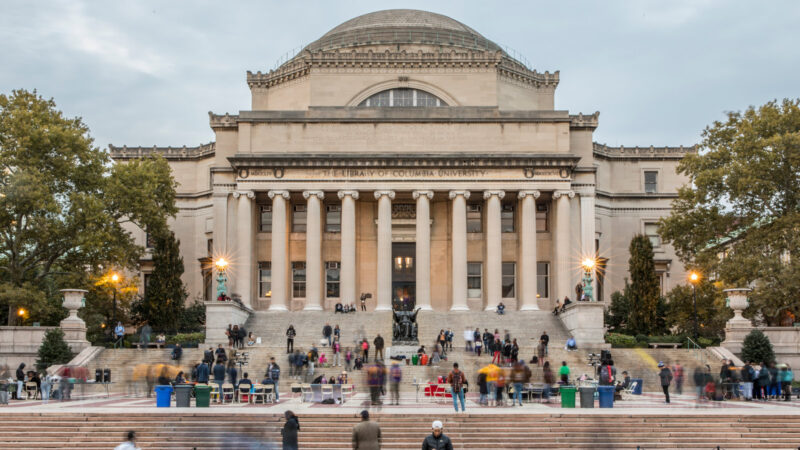
As a fellow student of the notorious Dual BA programme between Trinity and Columbia University, I’d arrived in New York last August with a naive optimism that Columbia might be at least intellectually rigorous, if not outright inspiring. I had been writing for the University Times back in Dublin, and I assumed I’d continue doing the same at the Columbia Daily Spectator. But my first encounter with the campus paper was… symbolic.
The open house took place in a room on the fourth floor of a church building on a Saturday afternoon. The broken mic was followed by slides that refused to load. The unforeseen technical difficulties were apologised for but inevitably required the section editors to take turns entering the room explaining their respective roles – something along the lines of, “I’m head of the video team, so, well, we make videos.” – while the eager applicants were quietly fighting for space on the floor and whatever oxygen that remained in the room.
I blame myself for gaslighting myself into thinking that an institution like Columbia must be revered for something more substantial than its Neoclassical and Beaux-Arts architecture. In a text I recovered recently from high school, I said to a friend, “well I will never apply to ivy league because ivy is poisonous.” A statement which, despite my confirmation bias assuring me yet again how prescient and intuitive I am at spotting “phoniness” as a young adult, unfortunately hits a little too close to home.
And nowhere is the poisoned ivy more vividly on display than in the Spectator’s Opinion section. Therefore, let us investigate the four most recent op-eds on their website for some enlightenment.
Yes, Columbia Needs More Conservative Professors
If there’s anything America does best, it’s creating artificial demand. The rhetoric here has played like a broken record across political debates in recent years: higher education needs a “revolution” to remain relevant or deserves to be dismantled altogether. A liberal college student calling for more conservative professors (a weird new form of Diversity, Equity, and Inclusion (DEI), I suppose) in an attempt to replicate “the real world” is exactly why the left keeps losing.
The so-called “issue” of Columbia’s lack of conservative professors overlooks the fact that Ivy League and university faculty as a whole tend to be left-leaning. It’s a pattern. And how far must college go in mimicking “the real world” before we start welcoming flat-earthers, cult followers, or those who justify the use of racial slurs into the classroom? Because if that’s the bar, then congratulations. That is the real world.
But not only is the logistics of hiring more conservative professors poorly conceived and the rationale unexamined, it’s also infuriating given the current political climate. The author is careful to say they are not advocating Trumpism, just the study of “traditional conservative intellectual values.” Fine, but if we were to recruit these professors, where are they coming from? How much money should we allocate to convince them to relocate from Texas, rather than paying student workers a fair wage or fixing student housing? That’s surely unaccounted for.
And to our duly preoccupied author – I can assure you that the university, if anything, has no shortage of conservatives. Your liberal beliefs can be challenged without making a DEI hire but by simply chatting to your peers. Just talk to the Chinese girl with the MAGA hat.
In Defence of the B
If you conduct a quick Google search “What is Columbia University?,” an intrusive AI summary will tell you that it is “a prestigious private Ivy League research university in New York City, founded in 1754, known for its rigorous academics, extensive Core Curriculum in liberal arts, strong research focus…” (While I usually find these summaries reductive, I do not take them cavalierly now that I know the feature alone could consume as much electricity annually as the entire country of Ireland.) Now, note how it says “a prestigious private university,” not “a playground for those who settle for mediocrity.”
I certainly do not object to the fact that a B is functionally comparative, or that grade inflation has rendered GPAs increasingly meaningless. But must we demand more from the students? Must we expect them to not feel like a B is life-altering, when employers and grad schools, despite what their statements may say, may still interpret it as a red flag?
Of course, we should value experiences and skills over a single letter grade. But when that single letter quietly writes the opening lines of most rejection letters – “Unfortunately, we cannot offer you…” – how can we expect any twenty-year-old to feel at ease, rather than spiral into imagining the chain reaction a single B might trigger?
So perhaps instead of defending the B, who surely would recognise its inferiority to the A, an educator should try to defend its students. And if the B were to speak again, it might ask why the system that created it now insists on disowning the consequences.
My Chinese Heritage Enriches My American Dream
Some kids dream of being astronauts. Others want to be ballerinas. I, apparently, should’ve dreamed of being Secretary of Defense – if only I had the foresight to memorise the Constitution and network with war criminals by the age of 20.
But alas, I grew up thinking democracy wasn’t cosplay, and that being called a “Chinese Trojan Horse” wasn’t just the natural price of entry into American politics. It is one thing to admire American constitutional principles. It is another to invoke them as a shield while refusing to interrogate the contradictions they contain. To praise “liberty” and “free expression” while ignoring how those very ideals have been weaponised to exclude, surveil, and criminalise immigrants and the marginalised is not patriotism but selective amnesia (I suppose appropriate for the unspoken age requirement of being president in this country).
To claim that your Chinese heritage enhances your appreciation of American exceptionalism is to flatten culture into ornamentation, using “multiculturalism” as a decorative badge on a fundamentally hegemonic worldview. What this op-ed reveals, perhaps unintentionally, is not the strength of a bicultural identity, but the desperation to be accepted by a political order that was never designed for you. This is not a dream. This is assimilation in its most self-congratulatory form.
But then again, this is the opinion section, where irony goes to die and resumés go to be born.
On the abuse of Faculty Immunity
It is widely known that a faculty member’s job, at least in theory, is to produce knowledge, challenge assumptions, and engage in moral thinking. To claim that they should then remain apolitical in the face of genocide is a rather convenient ask. It’s easier to reframe moral clarity as emotional manipulation, political courage as professional misconduct.
Here, our author casually celebrates that “dozens of students have rightly been suspended or expelled” after the pro-Palestinian encampments at Butler Library and Barnard. That such a sentence can be written without hesitation, in a student paper, at a university once considered a hub of activism, is beyond my wildest imagination. Having lived in Dublin, where weekly pro-Palestine demonstrations were normalised, this shift feels less like cultural difference and more like ideological whiplash.
“Faculty immunity” becomes a dirty word when the professors disagree with you. Never mind the fact that tenure exists precisely to protect academic freedom in controversial times. The same mechanism that once safeguarded scholars writing against slavery, apartheid, and war is now being recast as a loophole for misconduct when it no longer serves your politics. Precarity in the academy isn’t like a Silicon Valley layoff, sudden and impersonal. No, it often strikes because someone is doing their job too well. In this country, a professor might be put on administrative leave for giving a student a deserved zero for citing the Bible and personal religious beliefs, or accused of discrimination for upholding international law.
Maybe it is not the abuse of faculty immunity that’s the problem, but the abuse of language: “incitement” used in place of protest, “bias” used in place of ethics, “neutrality” weaponised to mean silence. If condemning civilian deaths offends your culture, maybe it’s time to be offended.
What the Spectator’s Opinion section lacks in argument, it makes up for in absolute, unshakable confidence – each piece more like a personal branding exercise than a genuine attempt at thought. Critical thinking? Optional. Self-awareness? Never heard of her. If this is the Columbia multiverse, then I’m reporting live from one of its dimmer timelines.