
1. Caravaggio (1571-1610)
Baroque violence and drama dominated both life and art for this 15th-century Italian artist. In his twenties, the intemperate Caravaggio killed a man in a brawl, resulting in the decree of a death sentence. Fleeing from Rome to Naples, Caravaggio found himself on the run for almost half a century, darting across the Mediterranean archipelago. Rumours of his death abounded in 1607, after his face was badly disfigured in another fight. He lived on for another two years, continuing to produce art, before dying under mysterious circumstances; it’s been suggested murdered or poisoned with lead. Caravaggio’s life has met with no absence of idealising romanticism; he was and remains, to some extent, the art world’s perennial celebrity badboy.

2. Leonora Carrington (1917-2011)
A Surrealist painter and founding member of the women’s liberation movement who lived most of her life in Mexico City, Carrinton lived a tumultuous life. Admitted to an asylum to “treat” a bout of paralysing anxiety in the wake of her husband Max Ernst’s Gestapo arrest, she endured shock therapy and sexual abuse. Later released to travel to a sanatorium in South Africa, she escaped en route in Portugal and fled to Mexico. Her focus undiminished, Carrington’s art flourished, its intense magical realism and symbolism a striking and uncompromising medium for her expression of feminine sexuality and creativity—a stark break-free from a masculine-controlled world that would no longer direct her life.
3. Francisco de Goya (1746-1828)
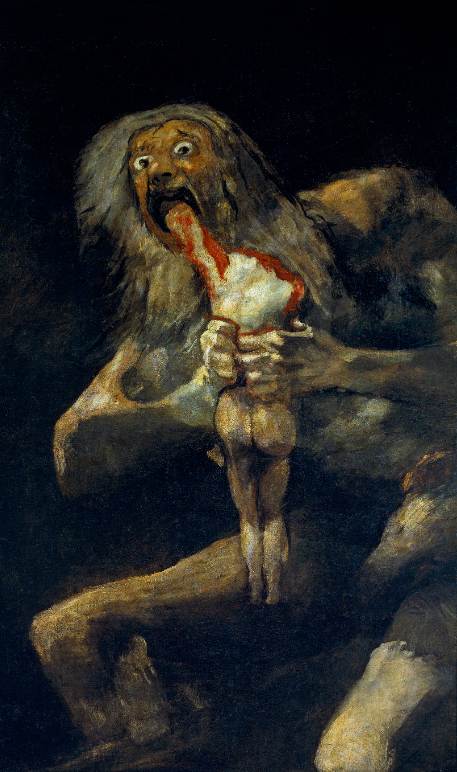
Spanish romantic artist Goya began his career rather conventionally, as a court painter. Nonetheless, within years, declining health roughened his outlook and a bleak pessimism forced itself onto his easel. Foregoing royal portraits and scenes, the now-deaf Goya turned to depictions of insanity, corruption, and the supernatural, a reflection on the health of himself and his nation. In the years before the stroke that caused his death, Goya produced the haunting Black Paintings, including the savage work Saturn Devouring His Son, painted directly on the walls of his country villa and now on display in Madrid’s Museo del Prado. Transformed from an intimate sketch to a reproduced public domain image now filling the page of a University Times broadsheet, it might be cause to question if some art is not meant to leave the confines of its maker’s easel.
4. Hildegard of Bingen (1098-1179)
“O fragile human, ashes of ashes, and filth of filth! Say and write what you see and hear.” So wrote St Hildegard, patron saint of musicians and writers, of the voice that spoke to her in the first of many divine visions that would inspire 35 mysterious and eccentric illustrations that accompanied the abbess’s prophetic and poetic writings. Hildegard’s experiences are on the cusp of pleasure and pain; she writes on tongues of heavenly fire invading her mind, a white cloud emerging from a mouth of fiery smoke spewing out human forms, the universe as a series of star-adorned spheres. Whether it was Hildegard herself, or a community of her religious sisters that produced this art, their style is consistently mystic, symbolic, and feminine. Above all else, these illustrations disrupt any notions that the medieval world gave artistic licence only to those pious monks scribing lanky bald-headed men into their copied gospels.
5. Egon Schiele (1890-1918)
Schiele’s Expressionist art gives voice to the essential rawness of a fragile human subject, one that is found in equal parts in his own life. Shy, reclusive, and strange from youth, he took on a bohemian lifestyle that roused a disapproval that would only grow as he established an artistic style that sought to depict sickly distorted bodies with perverse erotic touches. At one point, Schiele was arrested and found guilty of exhibiting erotic drawings in a place accessible to children; he later survived conscription in World War I because of his weak heart, taking a job as a clerk in a prisoner-of-war camp. Illness, something that had dogged his family throughout his life, struck him in 1918, and he died of Spanish flu three days after his pregnant wife. Schiele’s behaviour was artistically vulnerable at best, and disturbingly criminal at worst. Recent and upcoming exhibitions in Seoul, Vienna, London, and New York illustrate that his work has gained a public momentum; how loud should these exhibitions be about the life that accompanies his art?