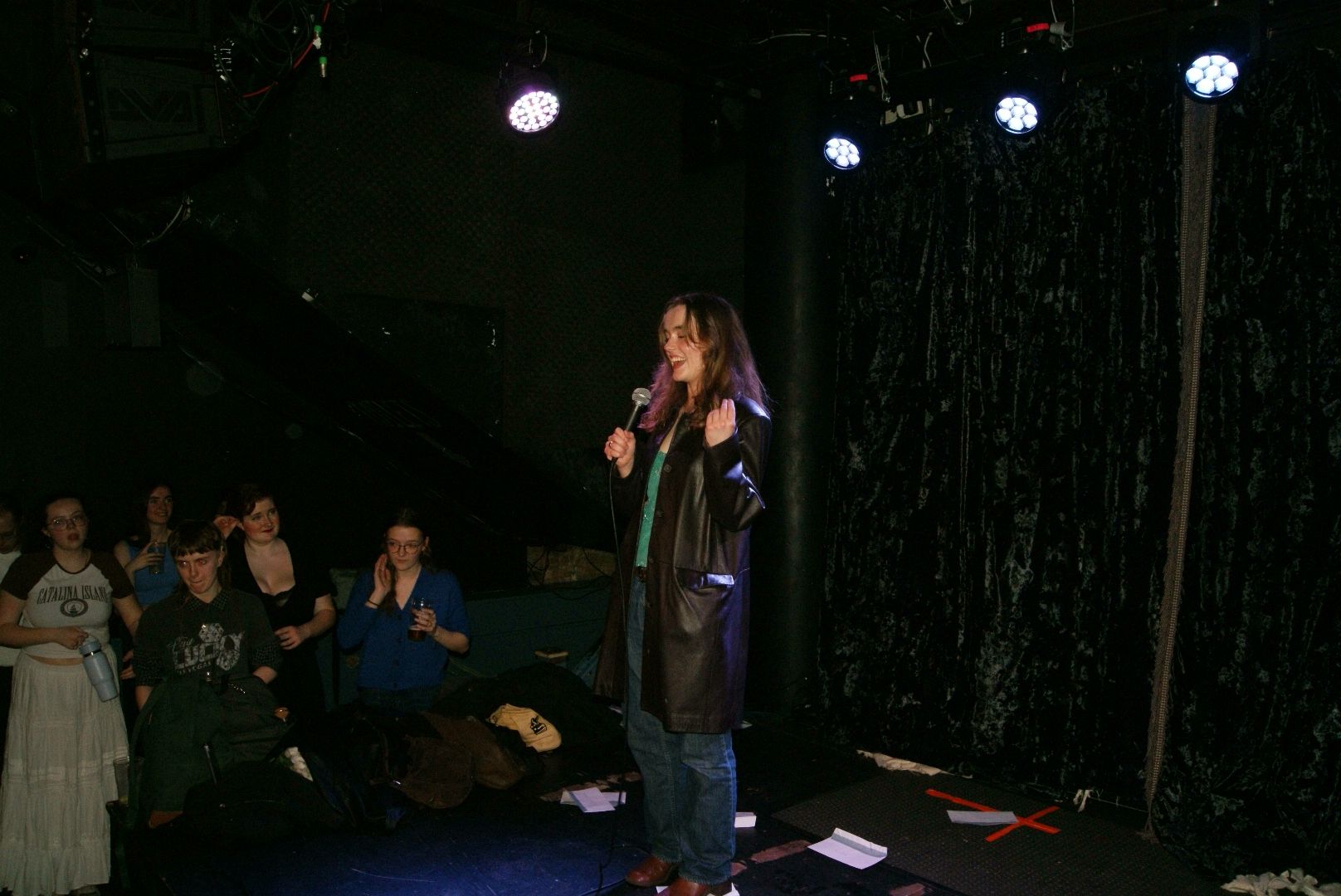
On February 20th at the Uí Chadhain lecture theatre in the arts block, the first ever Boycott, Divestment, Sanctions (BDS) and Citizenship Hustings for SU sabbatical elections began at 6pm. Harry Johnston, Chair of BDS, and Rose Gulden Sevim Bibinoglu, the Citizenship Officer of the Trinity College Dublin Students’ Union (TCDSU/AMLCT) chaired the hustings. Each candidate was asked two questions – one for all the candidates in the race and one based on each candidate’s individual manifesto – with one minute to answer each question and two minutes if answering in both English and Irish. All candidates were present apart from Promise Okafor and Jacob Barron, who are running for Communications & Marketing Officer. In an official statement posted on Instagram, Barron said, “I will regrettably not be at BDS and Citizenship hustings this evening. I will be at work where I am gainfully employed. I wish my fellow candidates and the crew at BDS (including its Chair) and Citizenship Inc the very best.”
Johnston led with a welcome speech in which he disclaimed that members who are both in the BDS committee and affiliated with one candidate’s campaign team, would not influence the integrity of the event or the questions posed. Following this, the hustings kicked off with the University Times (UT) Editor candidate Harper Alderson.
University Times Editor Race

The first question asked by Johnston was on whether UT sufficiently covered the voices and issues of marginalised groups on campus. Alderson responded that while there is always room for improvement, she mentioned the “Voices from Gaza” section in the new Corcra Magazine, expanding on Palestinian voices covered. Yet, she explained she couldn’t provide any specific number estimates. However, some things she planned to go ahead with was implementing the role of a Welfare & Equality Officer and continuing the role of Gaza Correspondent at the newspaper.
The second question asked was about the relationship between the Trinity College Dublin Students’ Union (TCDSU) and UT, and how UT would plan to maintain editorial independence under her editorship. Alderson emphasised that the University Times operates independently from the Union saying she felt like a “broken record” while explaining that “UT is an editorially independent newspaper. It is in the SU constitution.” While discussing the relationship between the Union and the newspaper, Alderson explained that she would hope to make a change to the impeachment procedure stating that, “Impeachment just doesn’t work under TCDSU and wouldn’t work for UT Editor.” Instead, Alderson wants to change the policy such that if half of the masthead asked her to resign, she would do so immediately.
Graduate Officer Race
Questions for the Graduate Officer candidates began with a question for Féith Ní Chléirigh, specifically about their experiences working with students of “all ages” and how that would help their ability to carry out the role. In response, Ní Chléirigh said that “people underestimate the intelligence of young students”. They further mentioned a student of theirs from Gaza, who they urged the audience to give donations to.
Ní Chléirigh’s second question segued nicely from their previous mentioning of the genocide in Gaza. They were asked about their plans to get postgraduate workers, stereotypically a busy group of people, involved in BDS. In response, they mentioned that they were “on several societies with postgrads”, in which recruitment for such a task would be possible. Furthermore, they cited their attempt at promoting postgraduate involvement in pro-Palestinian protesting with posters and signage, and that these were allegedly “taken down”.
Ava Tuohy was also asked about her claims that she wanted to help Palestinian students in Ireland, and how she would do this. In response, Tuohy brought up a “plan to lead a structured campaign” to increase funding for the sanctuary scholarship program currently in place, as well as her desire to increase emphasis on postgraduate students.
“I would organise direct action if necessary but would not limit myself to that”, added Tuohy.
For her next question, the chairs asked Tuohy about her own plan to get postgraduate students more involved in BDS. While she admitted that “most societies are dominated by undergraduates”, she detailed her plan to advertise “adequately” about BDS in postgraduate spaces and through postgraduate BDS inductions.
Rás Oifigeach na Gaeilge
Mary Kate Ní Artáin responded by recalling the Irish Language Rights protest, saying that she aims to achieve a similar turnout for BDS-affiliated protests once elected. To achieve this, she said she wants to work with different societies.
The question for Hugh Ó Ríordáin asked whether he saw the Irish language as a marker of culture, citizenship, or “something broader”. He responded saying that the Irish language “belongs to us all”, regardless of citizenship status or nationality. Therefore, he emphasised the inherent anti-colonial and inclusive nature of the Irish language movement.
The next question asked how he sought to ensure that Irish language rights would be on the political agenda of the country. He agreed with Ní Artáin, emphasising the importance of “keeping pressure on the government”. He also mentioned the importance of “day to day work” and holding the College accountable to keeping in line with legislation pertaining to Irish language rights.
Responding to the same question, Ní Artáin emphasised the importance of ensuring that Irish is made visible, saying that “there is a demand for the Irish language to be alive and spoken”. To ensure that students are “in the know about what’s happening”, she emphasised the importance of weekly Irish language emails.
Entertainments Officer Race
Next, the candidates for Entertainments Officer took the stage. The first question was directed at Finn Hallwood, and asked which causes he would prioritise in charity campaigns. Hallwood explained that he would emphasise those causes “most important to the student body”, including Breast Cancer Awareness Month, Movember, and women’s mental health.
The individual question for Danila Kitaev asked about his plans to ensure inclusivity for students with disabilities, and those from marginalised groups. Kitaev highlighted the importance of frequent, non-alcoholic, diverse, and cheap events. He said that he plans to organise “a broad range of events that suit a range of people”, highlighting the accessibility of venues as a key consideration.
Next, the question of whether candidates would be willing to “work with venues that stock products on the BDS lists”, and their plans for mitigating the cooperation with such venues was asked to both candidates.
Hallwood and Kitaev largely agreed, saying that “there is always space for compromise”. While both believe in boycotting certain firms, they highlighted that it was unrealistic to achieve for all events.
Communications & Marketing Officer Race
Two of the candidates for the Communications and Marketing Officer, Jacob Barron and Promise Okafor, were missing due to prior commitments.
The first question asked Matthew Kurt about the lack of mention of BDS in his manifesto. Kurt highlighted that he has spoken in favour of BDS in interviews and that its causes align with his personal values and beliefs. Moreover, he said that he believes that the Union “needs to work harder than ever” on the abolishment of Coca Cola on campus.
Next, Alice Moran was asked about her plans to engage students more with the Irish language. Moran responded by saying that she aims to establish a close co-operation with the Irish Language Officer, and wants to ensure that all SU publications would be available in Irish. Moreover, she emphasised the importance to incorporate the Irish language in audiovisual content as well, and to include student voices in the process.
The final question was asked to both candidates, regarding their plans to improve communications about union activities, such as BDS campaigns, once elected. Kurt mentioned the importance of increasing student involvement and highlighting Palestinian voices in particular. Moreover, he highlighted the success of the BDS movement’s Whatsapp community saying that this is an effective way of increasing student engagement.
Moran’s response to the question was that “a growing dissatisfaction with the Union” is at the cause of lacking engagement with Union activity. She identified a lack of communication as a key cause of this disengagement and emphasised the importance of efficiently communicating any upcoming or planned activity to the students in order to increase engagement.
Welfare & Equality Officer Race
Candidates in the race for Welfare & Equality Officer took the stage next. The first question was directed at Rossa Bolger and asked him to outline how he would facilitate the expansion of physical accessibility to campus buildings. While he acknowledged that there are other campaign goals that may appear more feasible, he emphasised that more lifts on campus would “have such a massive impact”. Therefore, he said, it is important to include these plans in his manifesto, as inaccessible buildings are “not the reality [he] wants to accept”, “even if it’s a big ask”.
The next question was directed at Lorenzo Cheasty and asked him about his plans to improve students’ food security, a big aspect of his manifesto. Highlighting his “commitment, passion, research, and enthusiasm”, Cheasty mentioned previous communication with Foodcloud, a charity that delivers surplus food goods to other charities. Therefore, he believes, establishing a social supermarket is a very feasible goal, and the “only real option to address food insecurity”.
The next question was aimed at both candidates, asking about how they plan on supporting the welfare of Palestinian students. Bolger highlighted his previous work regarding Ukraine, emphasising activism through personal connections. He said he would focus on personally meeting Palestinian students since “everyone’s situation is going to be different”.
Cheasty responded by emphasising the need to “improve provision, outreach, and clarity”. He emphasised the importance of improving student services, particularly mental health services, and improve clarity on procedures.
Education Officer Race
The candidates for Education Officer were put on the hot seat next. The first question, directed at Eve Martin, asked about her plans to support the expansion of the Irish language around campus. She responded by highlighting the importance of submitting modules in English and Irish, and lobbying for academic committees to implement this. She highlighted the possibility at University of Galway to attend tutorials in Irish.
Sam Brooks was asked about his plans to support BDS, considering Buster’s active involvement in the movement. Brooks emphasised that he would “absolutely” take a similar approach to Buster, saying that “Buster and the wider SU is doing really good work”. He also mentioned that he would be posting a video in the next few days that outline his policies regarding BDS.
Finally, both candidates were asked about their stance of ending the Dual BA programme with Columbia University. Framing this as a student welfare issue, Martin reiterated the mandate of the Education Officer to work toward the abolition of the Dual BA programme. She said that she would “continue to work for the review of the partnership” and “support students if they wish to leave [the programme]”.
Brooks agreed, emphasising the mandate. However, he said that he is “not 100% sure on the progress” but that he would “work towards it” if elected. He concluded by saying that “what Columbia did was disgraceful”.
President Race
Finally, the Presidential candidates were asked questions again by Rose Gulden Sevim Bibinoglu. She started by asking all candidates how they plan to increase voter turnout in order to ensure accurate representation of the student body within TCDSU.
First, Jonathan Hoffman responded by saying that he believes that a restructuring of the TCDSU regulations regarding sabbatical officer election is due, as there is “too much focus on candidate welfare”.
Cathal Horgan criticised the Union for “not addressing what students need on a day to day basis”, citing this as the prime cause of student disengagement with the Union. Particularly, he said, the Union fails to focus on issues such as accommodation and food costs.
Disagreeing with Horgan, Amy Kennedy said that various candidates are running on similar platforms, focusing on student welfare. However, she said, a lot of campaign promises aren’t implemented eventually, which she believes is the key cause of disengagement with the Union, saying that “when students don’t see outcomes, they lose faith in the Union”.
Grace McNally answered next, acknowledging that “there is always a lot more we can do”. She cited a lack of awareness around Union activity as a key cause of disengagement, and emphasised that the Union should represent the entire student body, regardless of their involvement.
Tadhg Ó Neil advocated for more variation in candidate approaches. Highlighting Jacob Barron’s campaign, he said that Barron offered an alternative approach to the TCDSU, which, according to Ó Neil, increased engagement with the Union. Ó Neil was Barron’s campaign manager in the recent presidential bye-elections. Barron was not present at the event.
Next, an individual question was posed by Rose Gulden Sevim Bibinoglu to each candidate. Hoffman was asked about the lack of mention of Palestine in his manifesto. Highlighting the limited scope of candidate manifestos, which have to be kept to one A4 page, he said that “we have a full plan here”, clarifying his belief in a “free sovereign Palestinian state”.
Horgan was asked to respond to doubts regarding his pro-Palestinian beliefs, given his membership in Cumann Theobald Wolfe Tone, the Trinity branch of Ógra Fianna Fáil. He responded by reiterating his criticisms with “the current line of thinking BDS has”. He said that international Palestinian issues were over-emphasised in recent protests, emphasising the importance of focusing on continued support given to Palestinian students at Trinity.
Kennedy responded to a question about her plan to establish a national fund for Palestinian students. According to her, the currently available funding covers “less than 40 scholars”. Moreover, she outlined various criticisms of the current setup, saying that “people answering the emails weren’t hired for this”. She emphasised her plan to continue “being a thorn in their side” to demand change, and the importance of clear communication with Palestinian students.
Grace McNally’s question was based on her manifesto from the bye-elections wherein she promised to reduce the cost of living but so far, her reports to Comhairle hadn’t reflected progress in these promises. When asked, McNally joked that “no, of course I haven’t” made any tangible changes to the cost-of-living crisis in general, but did provide an explanation on the progress she had made to the cost-of-living packs also mentioned in her previous manifesto. She noted that the packs were a long-term process and while significant progress had been made, work was still being carried out on the application process. McNally also spoke on funding for these packs and the pressure being put on College to fund them, saying “If the College can pay, they should”. With regards to this, she spoke on working with the College Bursary and other financial committees of the College.
The last individual question was directed towards Tadgh Ó Neil. Rose Gulden Sevim Bibinoglu asked Ó Neil whether he believes that bringing down the prices in the Pav should take precedence over the matters regarding the genocide in Palestine, since the topic of the support for Palestine was entirely absent from his manifesto. Ó Neil denied emphasising the Pav over Palestine, because he feels that supporting a free Palestine is “a given while running for this position”. He stated that his manifesto only includes things he can absolutely do and that “set him apart” from the other candidates. He added that he “supports Palestine and their right to exist as a country and as a people”, and that once the Pav’s partnership with Coca-Cola ends, it should not be renewed.
Hustings concluded at 6.56 pm and Rose Gulden Sevim Bibinoglu reminded attendees of the upcoming National March for Palestine on Saturday. The next hustings, the Piranha Hustings, will take place at 5.00 pm, on February 24th at the Pav.