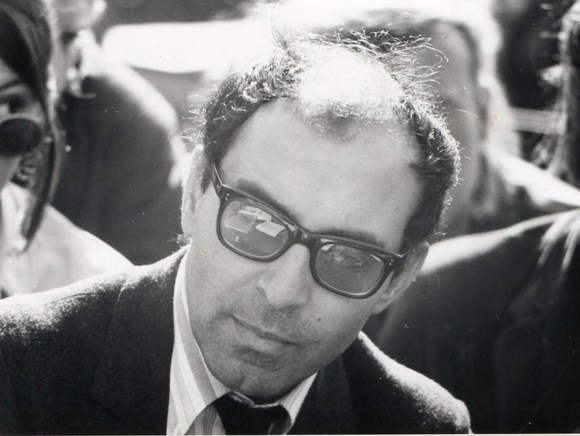

Jean-Luc Godard, the enigmatic director who passed away in 2022, is getting kudos for his groundbreaking filmography with a chronological two-month retrospective at the Irish Film Institute on Eustace Street. Organised by David O’Mahoney, IFI’s Head of Cinema Programming, “Truth, 24 Times Per Second: The Films of Jean-Luc Godard” does a commendable job of choosing 24 of Godard’s films from the breadth of his decade-spanning career. Tickets are available in bundles for IFI members only, membership being free for people aged from 16 to 25 years old, with three options available: three films for €30, five for €50, or ten for €100.
Undeniably, Godard’s most influential films are from the 1960s, which take up the majority of the retrospective, when he was a pioneer in the seminal Nouvelle Vague film movement. His debut, Breathless (February 1st), was snappy, chic, and offbeat, breaking away from the rigidity of Hollywood film editing and narrative immersion. His films created French icons: Brigitte Bardot, the star of Contempt (February 10th), who passed away late December 2025, Jean-Paul Belmondo, starring in films such as Pierrot le Fou (February 21st) and Made in U.S.A (February 24th), and Anna Karina, his wife for four years, who starred in the majority of his Nouvelle Vague films including A Woman is a Woman (February 3rd), Vivre sa Vie (February 7th), Alphaville (February 17th), and Band of Outsiders (February 14th). What made Godard so unique were his rebellious techniques that included giving actors their lines while the camera rolled and post-dubbing after, filming tracking shots from a wheelchair, on location shooting, the use of non-professional actors, and natural lighting. His multitude of jumpcuts, overt camera movement, sporadically playing soundtrack and fourth wall breaks constantly revealed the artificial nature of his films to the audience, hoping the reminders of the offscreen world would direct viewers to the societal problems that lay there. Godard’s Marxist and Maoist politics were always at the heart of his films, becoming more obvious by the time of A Married Woman (February 15th) and Masculin Féminin (February 22nd).
These revolutionary politics started to take the forefront in his films by 1967, with a scathing critique of consumerist culture in Two or Three Things I Know About Her (February 28th), and La Chinoise (March 1st), a darkly humorous story about a group of Maoist revolutionaries who plan to express their political beliefs through violent action. His final Nouvelle Vague film, Weekend (March 3rd), tells the story of a bourgeois couple kidnapped by a guerilla group. Fittingly, its closing title card reads “Fin de cinema” (“End of cinema”), and Godard puts this message into practice, afterwards creating unapologetically political films with his radical left wing Dziga Vetov group he founded alongside filmmaker Jean-Pierre Gorin in 1968, one of which is All’s Well (March 7th), a self-aware satire about the corrupting force of capitalism starring Jane Fonda.

After leaving the group in 1973, Godard returned in the 1980s with his lesser known deconstructions of famous myths and stories: First Name: Carmen (March 10th) a self-reflexive, loose modern adaptation of the opera Carmen, Detective (March 15th),a dismantling of the blockbuster where an interwoven plot and cast are reduced to irrelevancy, Hail Mary (March 14th) a contentious modern retelling of the Biblical story of the Virgin Mary, King Lear (March 18th), Godard’s first English feature, a post-apocalyptic and existential examination of Shakespeare’s tragedy, and Oh, Woe is Me (March 21st), a retelling of the myth of Alcmene and Amphitryon, Heracles’s parents, starring French actor Gérard Depardieu.
In the 2000s, Godard’s final films stretched the form of cinema to its limit. More similar to video essays, his films In Praise of Love (March 22nd), Film Socialisme (March 24th), Goodbye to Language (March 28th), and his swan song feature, The Image Book (March 29th), blend 35mm black and white film with 3D technology, archived newsreels, digital colour footage, and paintings, to comment on Colonial history, modern warfare, and humanities increasing apathy. These films respect their audience’s intelligence and expect active engagement and rewatches, a refreshing change to modern films that purposely repeat information assuming viewers will be on their phones.
The retrospective’s title, “Truth, 24 Times per Second”, is a quote from one of Godard’s most controversial films, The Little Soldier (February 8th). Originally released in 1960, it was banned until 1963 for its depictions of state torture during the Algerian War. It was one of the only pieces of media at the time that shed light on Algeria’s fight for independence, which the French media attempted to cover up. The full quote is, “Photography is truth, and cinema is truth 24 times per second”. It is a fitting title that shows the care O’Mahoney put into this event, paying homage to Godard’s core belief throughout his evolving cinematic language: that film is a tool for social action that can spur people to examine the true reality of the world beyond the screen.