
The Irish Football team is closer to achieving something they had not managed since 2002. This milestone, which is two victories away from becoming a reality, together with the huge boost provided by the victory against Portugal thanks to two goals from Troy Parrott, has had consequences for the pockets of their fans.
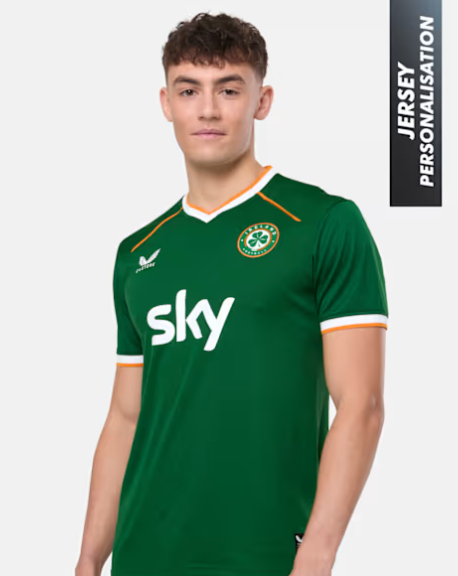
Fashion, ever-present and everywhere, plays a very important role in football. Every football supporter’s dream is to wear their team’s shirt, preferably the authentic one worn by the players. However, this season it will be more expensive for The Green Army fans to get their kits.
This year’s prices for the official shirt range from €105 for the standard shirt to €145 for the pro version. An additional €20 is charged if you wish to personalise it with a player’s or your own name. Prices that have caused quite a stir among Irish football fans.

Social media posts announcing the new kit were filled with a wide range of comments, although the positive and cheerful messages were overshadowed by many others that were not so positive. Among the positive comments about the design and messages of encouragement, many other fans express their strong rejection of the price and Castor, noting that it was not so expensive before. With comments such as: “145 is a joke”, “Get rid of Castor”, “They are dreaming all right if they think they’ll sell them jerseys at that price”, “If it’s Castor it’s… MADE FOR THE BIN”.
But are these prices really out of the ordinary compared to other football teams around the world? We have looked at the prices of several European teams.
Currently, the Spanish national football team is number one in the world rankings. Their jerseys are made by Adidas and are priced at €150 for the pro version and €100 for the regular one. Close behind them in the price rankings are the runners-up in the last World Cup, the French team (third in FIFA World Cup ranking). Their jerseys cost around between €100 and €120, and their brand partner is Nike. Closer to Ireland’s ranking (59th) is Slovenia (57th). The jerseys for this team cost €90 and are also produced by Nike. Furthermore, the material of the t-shirt itself does not change, as all garments of this type are generally made of polyester. Therefore, it can be said that the price itself is not far off from other selections, although within its FIFA ranking, it does seem excessive.
What is truly striking is the significant increase compared to other years. In 2024, the regular jersey cost €95, and in 2023, it cost only €80. Is this price increase really justifiable?
The second complaint, already received in previous years, has focused on the presence of a sponsor’s brand on the kit sold to the public. This has also received much criticism on social media, with comments such as: “Would look class without that Stinkin sponsor” and “why are we the only country with a kit sponsor?”.
FIFA has strict rules of not allowing any national football team to have sponsorships on their kits, protecting their own sponsors that pay a high amount of money for exclusivity. However, Ireland only follows this rule for players, using an unsponsored version of the kit when they play and the sponsor version only in training sessions and the press area, this being the version sold in the official shop.
The reason for this is purely economic, as Sky is the main sponsor of the Irish Football Association. This does not appear to be changing any time soon, as the association and Sky have signed an agreement until the end of 2028. This is not unusual; throughout the history of Irish football, other brands such as Opel and Three have played the same leading role in official kit.
In the end, a garment that was described as “a jersey made for dreams” has caused more than controversy among fans, once again demonstrating how fashion and its price can cause a stir in unexpected pitches.