
Hulda and Lilli sitting in a tree. K – I – L – L – I – N – G. This only begins to sum up what Finnish artist and researcher Maija Tammi’s Empathy Machine was about. Inhabiting the two floors of Photo Museum Ireland in Temple Bar until February 1st, 2026, this multimedia exhibit (free to attend) used photographs and short extracts on light boxes to tell the two stories of Hulda (a chameleon) and Lilli (a locust), before they become one, colliding in a cherry-flavoured filmic crescendo. Challenging the morality of aesthetic pleasure, these three stories investigated the attachment of empathy, compelling you to make some complicated, perhaps even uncomfortable, but pertinent inquiries into the big F-word: feelings. The bifurcated narrative style of Empathy Machine not only suited the physical layout of the Museum but also made for an intriguing experience. Tammi’s book on the project, Hulda/Lilli (which received the prestigious 2023 Finnish Photobook Award), can be read from both ends and the reader has to make their choice before they can begin. The exhibit demanded the same choice.
Once you climbed up the stairs, right there on the first landing, a sign in neon lights asked you to choose: you could either continue on this floor or go further up and start there. On the two floors were the two stories of Hulda and Lilli, a chameleon and a locust, predator and prey. The sign didn’t tell you who was on what floor so I won’t reveal that either, but suffice it to say that the choice you made determined your emotional trajectory throughout the course of the exhibit.
The different stories were told in similar ways. Hulda and Lilli were anthropomorphised in little pieces of numbered texts that spoke of them feeling distinctly human feelings: self control, introversion, fascination, anxiety, dilemma, and trauma, to name a few. Detailed, visceral and playful photographs punctuated the words, charting the life of the two creatures from birth up to the present moment. In this present moment, Hulda was about to lay her eggs and therefore could not stop eating. But if she ate too much, she would likely produce too many eggs and die from exhaustion. Lilli was the only one of her siblings to have survived. Still too young to fly, she jumped to escape danger and loved munching on pretty flowers. The lizard and locust crossed paths on a cherry tree, on which, beguiled by the bright red orbs, the hungry lizard caught sight of the edible locust. For the final showdown, Tammi changed medium, moving from text and image to film.

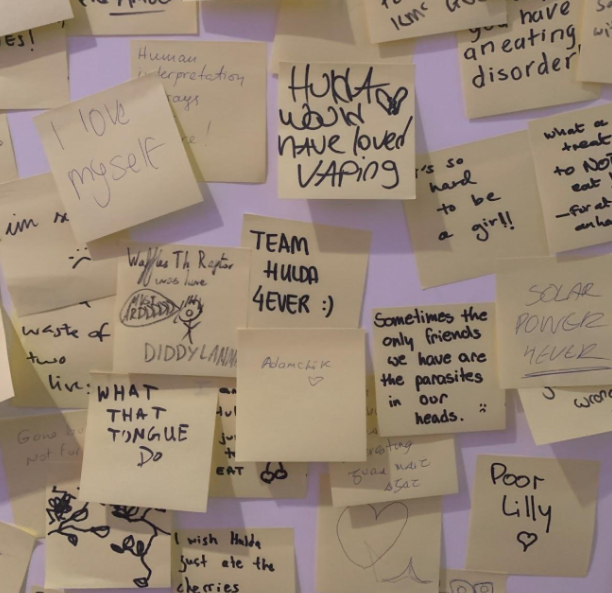
Structurally, irrespective of the choice you made, this film was the median of the exhibition, which meant that you met one creature before and one after becoming aware of the narrative’s conclusion. Empathy Machine ended in what was termed a “debriefing room”, a place designed for introspection. In a small nook on the first floor, there were benches, a couple of pamphlets, yellow sticky notes, a guest book and some pens. Prompted by the reading material made available and the comments left by others, you were supposed to contemplate what you had just experienced and ask yourself whose side you ultimately chose to be on.
It all came back to choices and the feelings behind those choices. Tammi provided no facts or context on the preliminary choice between Hulda and Lilli, essentially making it arbitrary. By the end, we knew enough to make an informed choice, but the making of that choice was far from easy – the exhibition made sure of that. More than the texts and the film, it was the images that left lasting impressions and made the decision perplexing. Hulda hid in her photographs in plain sight, playing a clever game, and Lilli was almost turned into an ornament, especially in the photograph modelled after Dutch floral still life paintings. The cycle of nature and the morality of pleasure were brought into discussion by Tammi’s employment of small animals in her work. The locust lived where others died at birth, and the lizard might have died while giving birth. In this equation, they were both equally the prey as they were the predator. These categories were then aestheticized to a high degree. Can a reptile and a grasshopper be beautiful? Can the violence between them evoke a sense of pleasure? The question remained: why did you feel what you felt?
Like all good exhibits, Maija Tammi’s Empathy Machine leaves you with more questions than answers. At its centre lies the choice of empathy, which is made accessible by simultaneously creating proximity (through anthropomorphization) and distance (through constant medium shifts) between the viewer and the animals. Initially, the exhibit forces you to decide, since it cannot begin unless you choose between the two floors, but by the end, the issue of choice is deconstructed and stripped down to the issue of feelings. In a transcribed interview on one of the pamphlets in the debriefing room, Tammi wonders if our historical moment is the age of emotional intelligence. By placing the empathy of each individual viewer in a pivotal position, Empathy Machine does not depend on prior knowledge of or even interest in photography (or lizards and locusts); it is fueled purely by feelings.