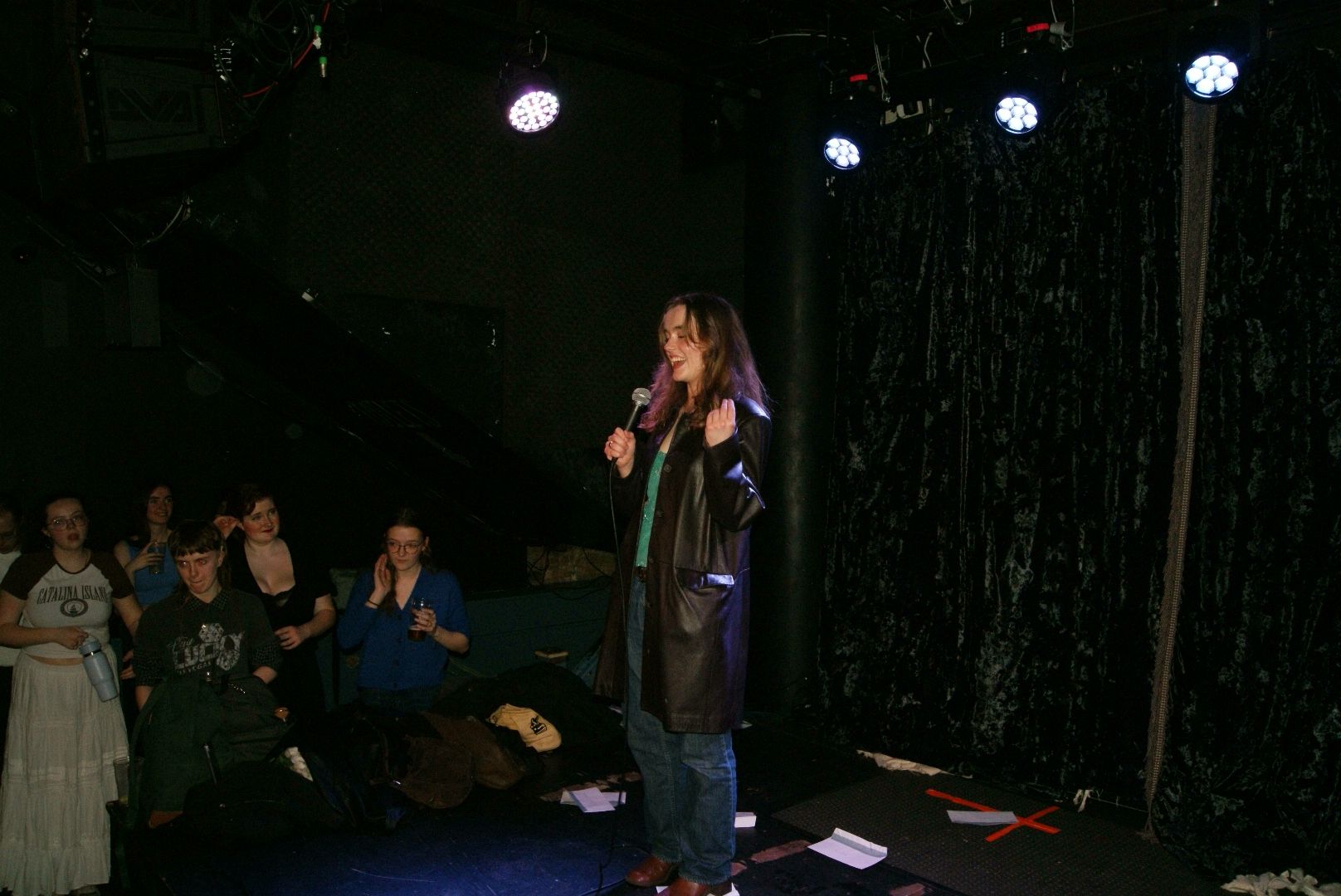
Around 7.45pm, President of the University Philosophical Society (the Phil) Liam Corcoran opened the debate on the motion “This House Believes Journalism is Dead” in collaboration with the University Times. On the side of proposition, Zoya Kherani, Auditor of the Trinity College Law Society, Sydney O’Reilly, and Law and Politics scholar Ben Kieran-Glennon, argued that journalism is dead. Opposition featured Roan McArdle, the Deputy Sports editor of University Times, Harper Alderson, the current Deputy Editor of University Times and candidate for editor in the upcoming elections, and James O’Brien as a guest speaker. O’Brien is a journalist and presenter for the London Broadcasting Company (LBC).
After a welcome speech by Fionn Graham, the debate was opened by Kherani. Opening her argument, she stated that “journalism is not dead because journalists don’t exist anymore”. Instead, she pointed to the current state of journalism, which, according to her, is primarily concerned with content creation aimed at profit maximisation. She continued to illustrate how social media dictates public discourse more than professional journalism does, pointing to the genocide in Gaza as an example. Reminding the audience of the key functions of journalism in democratic societies, she claimed that, rather than fulfilling these functions, the media landscape represents a chaotic realm of unverified information, which “can become lethal in moments of crisis”. She acknowledged that whilst social media can aid journalistic work, the fast-paced nature of 21st century journalism “rewards misinformation”, whereas journalism is meant to be slow, dangerous work, requiring meticulous fact-checking, rather than “30 second videos”. Further, she pointed to the danger that journalists are exposed to, which often goes unrecognised. In light of this, Kherani ended her speech saying that “journalism did not die when newspapers closed […], it died when journalists were killed for telling the truth” and that “a profession that requires blood to be delivered is already dead”.
Opening the case for side opposition, Roan McArdle took the stage next. He claimed that the prime question of the evening is “not whether journalism is dead, but whether journalism as we know it is dead”. He agreed with the preceding speaker, saying that journalism requires facts, fact-checking, and discourse and acknowledged that while journalism is not dead, it is surely under attack. However, he noted that rather than giving in, it is crucial to find ways to move forward, repeatedly asking “what are we going to do about it?”. Sharing his own experience as Deputy Sports Editor for the University Times, he recalled how rewarding the work of a journalist is. He then illustrated his argument with an example from his own specialty, recalling just how important Irish sports journalist Paul Kimmage was in uncovering Lance Armstrong‘s doping case. He transferred this case to student journalism, emphasising its importance and potential in disseminating information. Closing his speech, he reminded the chamber of the importance of fact-checked information provided by quality journalism.

Continuing the proposition’s case, Sydney O‘Reilly claimed journalism was “dead by overdose”. They then admitted to having wanted to be a journalist “just like Drew Barrymore, Sarah Jessica Parker, and Julia Roberts” growing up. However, they said, they were soon faced with the “cold hearted reality that journalism is a dying business, or rather, a dead one”, and as such had to “pick a real career”.
Asking the audience when they last saw someone read a newspaper, O‘Reilly emphasised that “journalism is dead to me”. To highlight their point, they noted that the New York Times has more people playing their games than reading their news. Like Kherani, they argued that social media is at fault for this. Rather than providing quality information to the public, they claimed that journalists can be seen as content creators chasing virality. With speed becoming more important than validity, they claim that media outlets themselves contribute to the spread of misinformation in a “race to the bottom”. As such, they claimed that trust in journalism is in decline, addressing the audience by saying that “you’re part of the problem”.
Alderson was called for her speech next, which she began by emphasising the importance of an informed society for democracy, highlighting that “truth makes us free”.
Therefore, she stated, the work of journalists is to enlighten the electorate. However, she admitted that the current media landscape has flaws, particularly highlighting the profit-orientation of media outlets that are owned by large corporations, and the focus on Search Engine Optimisation (SEO). Speaking directly against the proposition‘s previous claim, she argued that social media can be beneficial to this task. Alderson mentioned examples of footage showing the atrocities against Palestinian people or police brutality, which play key roles in informing the public and holding governments accountable. While she admitted the potential dangers of social media in spreading false information and producing “information overload”, she said that “it is a good thing that everyone can be a journalist”. Further, she acknowledged that local journalism is on the decline, emphasising the importance of student journalism in counterweighing this. Closing her speech, she reiterated that media consumers are “smart, capable, rational and fundamentally good”, arguing that “the second we stop feeling angry, sad and disappointed is when journalism is dead”.
Ben Kieran-Glennon took the stage next to close the case for the opposition. First, he admitted that journalism is in many ways not dead, pointing to the University Times. He argued that it is media consumers themselves that have contributed to the alleged death of journalism, claiming that attention spans have shrunk so much that engagement with full length journalistic content has become unappealing. Elaborating on his side’s core arguments, he claimed that social media has led to a disengagement with nuance, as users are only engaging with content that confirms their own views. He then claimed that trust in journalism has declined as a result of bad journalistic conduct in recent years. He concluded his speech in an optimistic manner, acknowledging that there is hope, and called on the chamber to engage with traditional journalism, rather than solely consume short-form content.
Finally, guest speaker James O‘Brien opened his speech, saying “this is awkward, I am a journalist”. He pointed out how historically, journalism has always been said to be dead by people concerned with corruption and unethical journalistic conduct, recalling personal experiences with colleagues behaving unethically. O’Brien then explained that he was originally going to call the audience to action and save journalism, and as such, democracy. Yet, he acknowledged that his original speech would be inappropriate for a room full of university students.
Quoting George Orwell, he called on the audience to not give up on journalism, since “if you can cling on to the truth, even if you are the only one, you will not go mad” and as such, “if you can cling on to journalism, journalism is not dead”. Speaking about journalists that have been killed on the job, such as those reporting on the atrocities in Gaza, he said that “I would struggle to look them in the eye and tell them that their profession is dead”. Putting the debate into perspective, he said that just because there are some incompetent journalists, doesn‘t mean that the whole profession is dead. In an inspiring end to his speech, the LBC journalist said that “journalism will not be dead until we are”.
The chamber voted against the motion.