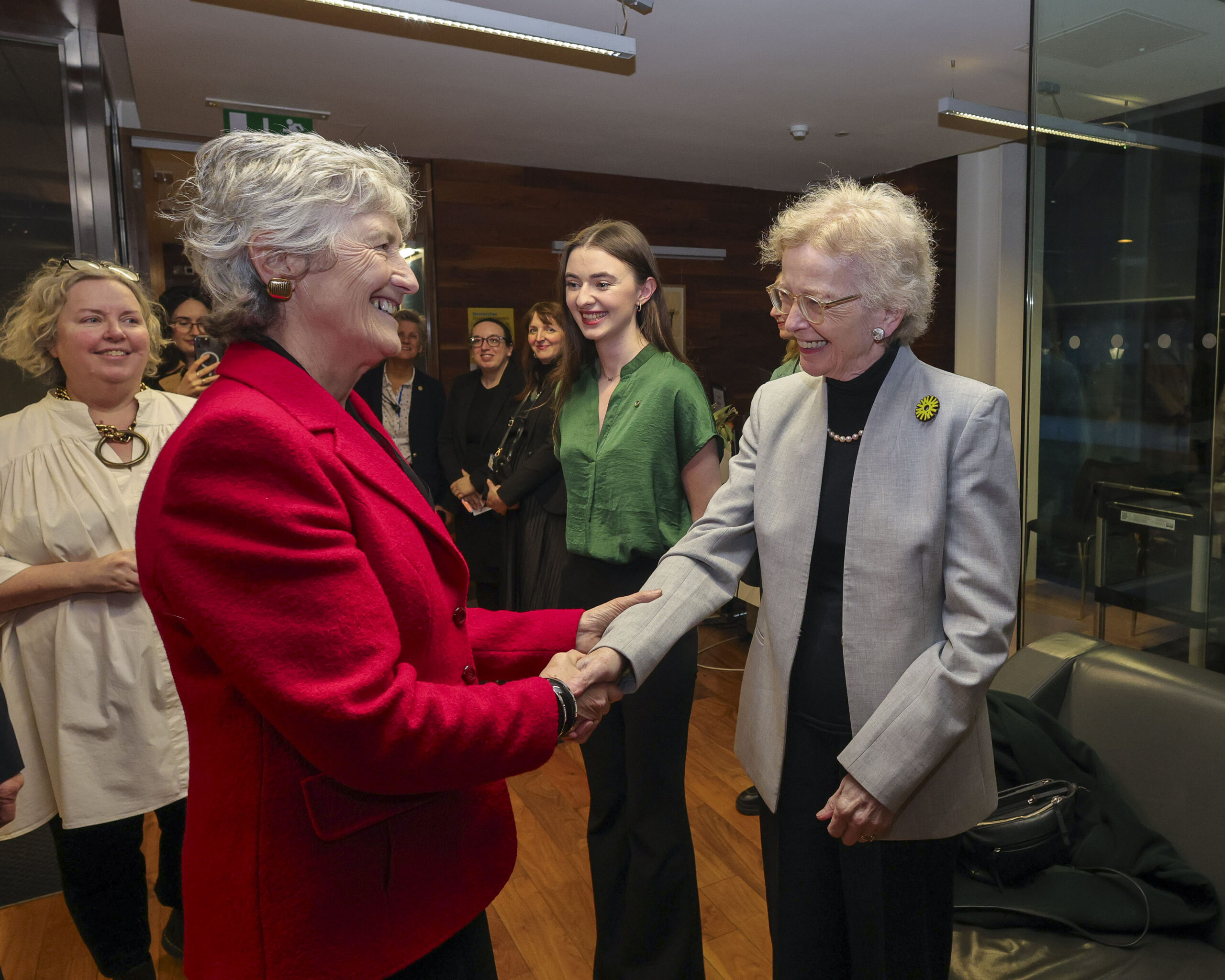

At 6pm on February 24th, Trinity Women in Law (TWIL) and The Society for International Affairs TCD (SOFIA) hosted the Irish premiere of The Veto, attended by President Catherine Connolly. A discussion panel followed featuring former President Mary Robinson, former UN Secretary-General and Senior Adviser at Article 109 Olav Kjørven, and former Irish ambassador and Permanent Representative to the UN, David Donoghue.
The evening began with an introduction from Provost Linda Doyle, warmly welcoming the guests, with a special mention of Trinity Alum Mary Robinson. Doyle kept her opening brief with just two distinct points, highlighting that the event was organised by students and the cruciality of student and society life in the College. She proceeded to emphasise the significance of the film’s theme and its relevance to higher education. Outlining the challenging political climate we are in the midst of, Doyle stressed the need to “fiercely defend higher education” and its role in creating a world in which we all want to live.
Doyle was followed by the communications manager of Article 109, Saul Kenny. Kenny, himself a former student of Trinity, described the vision and pertinence of Article 109: a coalition dedicated to renewing the Charter of the UN, appropriately named after the article in the Charter that legally supports their mission of renewal by permitting amendments to the Charter if agreed upon by two-thirds of the members of the UN. Article 109 has never been invoked.

Kenny referred to today’s state of the world as a “moment of rupture” and reminded the audience of how timely The Veto is. February 24th, 2026 marks the four-year anniversary of Russia’s invasion of Ukraine. On the eve of this anniversary, Hungary exercised not one, but two vetoes to block sanctions on Russia and a €90 billion loan to Ukraine. The question of veto rights possessed by different countries in different supranational organisations is an emergency. Kenny brought a hopeful message to the audience, assuring young people that “there is space for idealists and optimists in the big bad world beyond campus”. He urged all guests, from students and senators and to the Head of State, to reach out and get involved with Article 109.
The lights dimmed, and the film began. An amalgamation of historical clips and interview segments gave a comprehensive insight into the development (and the lack thereof) the UN has undergone in its 80 years. Footage of past UN sessions demonstrated veto power in action, showing the permanent five-member states (P5) overruling numerous historical decisions. The first instances of vetoing evoked dismay as countries dismissed proposals with the raising of a hand, but this dismay descended into frustration when the instances recurred time and time again. The film does not leave this issue hanging without a solution; despite recognition of “existential threats” to the UN, there was a prevailing sense of hope for the future, and for the creation of a path towards reform.
Director Tim Slade, who could not be in attendance due to air-travel disruptions in New York, appeared on screen in a pre-recorded video outlining his gratitude to the audience and particularly President Connolly. Slade focused on the impact veto power has had since the film was created, including its misuse to obstruct the path to peace for Palestine. He voiced concerns regarding the “worrying trend that the general assembly is essentially under the control of permanent members”. He advocates for this to be combated with “boldness in civil society […] and the boldness to stand up for the Charter”.
Dr Gillian Wylie, Head of Trinity’s School of Religion, Theology, and Peace Studies, moderated the discussion and prompted the conversation with some questions of her own. Wylie began by asking Kjørven’s perspective on both the promise and issues posed by the UN Charter. Kjørven explored the intricacies of Article 109 and used his experience as UN Secretary General to outline the nuances required in the process of Charter reform in order to effectively restructure a rules-based world order.
Wylie then directed her attention towards former president Mary Robinson. Robinson expressed her pleasure in attending an event organised by students, and accentuated the theme of youth participation. Honing in on Security Council Reform, she explained the need for an expansion not of veto-holders, but of Security Council members to reflect the shifting global power dynamics. Throughout the event, there were mentions of the volatile politics of the U.S. and their omnipresent influence on global politics. Recently, Robinson discussed Trump’s ‘Board of Peace’ on RTÉ’s Morning Ireland, calling it a “delusion of power”. She further discussed this at the event, calling it an “unfettered one-man power”, specifically regarding Trump’s recent enshrinement as the Chair in perpetuity, stating “it is a threat, it is intended to be a threat to the United Nations”. She concluded her answer by stressing that the UN should endeavour to serve the first three words of the charter: “We the peoples”.
Trinity student and member of SOFIA Ella Hammerich opened her contribution, stating her intention to represent young people. Hammerich addressed the need for intersectionality when approaching representation, with specific reference to the growing youth populations in certain African countries yet their continued lack of representation in global politics. As Wylie began to point out the under-representation of young people in “The Veto”, Robinson deftly chimed in with, “not many women either”. Hammerich proposed a withdrawal from the models of youth participation that tokenise young people. Her two-pronged, alternative approach first requires the dismantling of barriers to youth participation at local, national and international levels. Secondly, Hammerich proffered shifts in agenda-setting in order to prioritise concerns of young people including climate action, conflict and the cost-of-living crisis.
Bringing valuable input as a former Irish ambassador to the UN, David Donoghue brought a perspective shaped by his lived experience working within the UN. Witnessing the birth of the Sustainable Development Goals, Donoghue has seen the power of effective dialogue. However, this is starkly contrasted by the new reality in which Donoghue views the “paralysed” and “polarised” Security Council as an existential threat. Veering down the constructive path, he proceeded by suggesting pathways for change, including “embarrassing P5 members” through provoking excessive vetoes. In terms of actions specific to Ireland, Donoghue tentatively suggested the involvement of Ireland in the Article 109 Coalition.
After emphasis from all speakers on the importance of civil society, Wylie began to take questions from the crowd. Addressing the struggle to remember the common goals of humanity regardless of nationality, Robinson delivered three anecdotes from her experience in International Relations, each underscoring the importance of a global interconnectedness. Hammerich echoed Provost Linda Doyle and revisited the role universities play in the deconstruction of prejudices that inhibit global dialogue; “we need to facilitate spaces where that shared humanity comes to light […] university is one of those crucial spaces”. Drawing on Trinity as an example, Hammerich noted the large international community and how informal settings are crucial for students to find common humanity, but these settings must work in tandem with the uncomfortable individual reflection on personal stereotypes and prejudices. Kjørven’s closing remarks outlined the future of Article 109, mentioning the global interest the coalition is receiving and the increasing participation from civil society. Donoghue concluded his contributions by relaying his hope for a new dynamic within the Security Council, where vetoes are not a casual practice but treated with the appropriate level of apprehension.
Throughout the event it was stressed that in its infancy, the UN Charter was revolutionary and offered humanity a circumstance never formally seen before, with mass global participation in dialogue, and the formation of an organisation that condemned force and instead ruled by law. Now, this instrument for justice needs to change. Placing the now outdated Charter anachronistically at the centre of modern decision-making processes undermines the aims, obligations and capabilities of the UN. Once the event concluded and the room broke out into hurried discourse, the role of the youth became palpable. An event organised by students, which was enthusiastically attended by past and present students to listen to one another’s thoughts and to help build meaningful solutions to shared challenges. The College’s facilitation of this poignant event is just one more reason for students to fiercely defend Higher Education as a vehicle for global change.
Additional reporting by Sarah McGuire