
Laced with knife-edged mockery, ‘Sirât’ laughs in the audience’s face. It delivers blows that I witnessed jolting people in their seats when I had the pleasure of watching its press screening in the IFI. The fourth feature film from Galisean director Óliver Laxe, which won the 2025 Cannes Jury Prize and Soundtrack Award, is set to release in Irish cinemas on February 27th. The Arabic word ‘Sirât’, is defined in the prologue’s quote as a bridge between “Hell” and “Paradise” from Muslim belief that everyone’s soul must cross, that is “thinner than a hair” and “sharper than a sword”. An apt title since the film’s plot can certainly be described as such a journey.
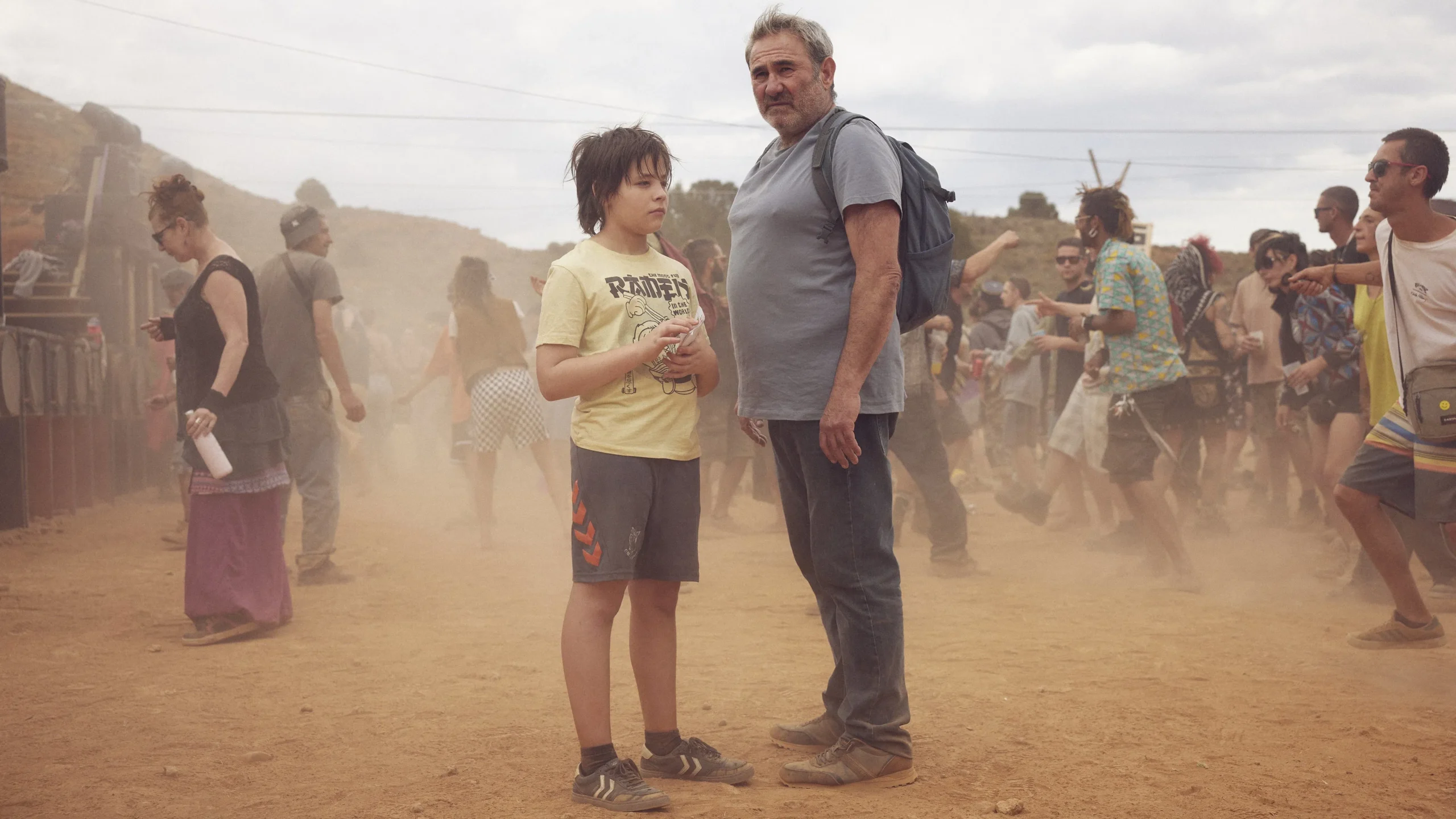
It starts with an apparently conventional missing persons plot, set in a startlingly contemporary dystopia in which WWIII is on the horizon. Spanish father and son, played by Sergi López (“Luis”) and Bruno Núñez (“Esteban”), a talented child actor, are looking for their missing daughter/sister Mar at a desert rave in Morocco. Their search is interrupted by the Moroccan military, who declare a state of emergency and order all European nationals to evacuate to the airport. Luis and Esteban defy these orders, instead following a group of nomadic ravers who are travelling to a secret rave in the midst of an even harsher desert, hoping to find Mar there.
The focus on raves should bely the importance of music to ‘Sirât’. The original soundtrack is the film. ‘Sirât’ is a film with the power of music at its core. Produced by the experimental, Berlin based Kangding Ray (David Letellier), the score is the medium where the characters and audience experience catharsis. It is a film that demands to be heard, with better speakers resulting in a better experience, so unless you are the owner of high grade speakers, run to your nearest cinema and try to resist the urge to dance in your seat. Enhancing this auditory journey is Mauro Herce’s stunning 16mm cinematography, which earned him Best European Cinematographer at the 38th European Cinema Award, a well deserved award considering the eerie and mystical presence he imbues in all his scenes. Herce’s shots of the desert landscape’s steep walls and flattened earth creates a beautiful visual speaker, where we watch the character’s emotions reverberate amongst themselves.

These characters are all played by nonprofessional actors, who shine the strongest during their dances. Their physicality contains so much nuance and insight into their interiority, like Luis’s slowly bursting grief in his first and only dance, and Tonin Janvier’s (“Tonin”) rhythmic pounding of his prosthetic leg with barely suppressed rage. With their wacky piercings, oddly shaved haircuts, and unique charm, especially Richard Bellamy’s (“Buigi”) childlike aura, the cast has defined itself as one of the most memorable from recent films. Their chemistry within their found family dynamic makes it impossible to tear your eyes away from the screen, with their vivacious bickering and drug induced chaos all held together by Stefania Gadda’s maternal Steff, whose maturity helps connect solemn Luis and Esteban with the free-wheeling nature of the fellow members.
If you are debating whether to watch the experience that is ‘Sirât’, give a listen to the soundtrack, which is now available on Spotify, and see if you are convinced otherwise. Try your best to avoid spoilers since this film rides into the most unexpected directions, but do not be afraid to go in with high expectations, because this is a film that is not afraid to blow them away.