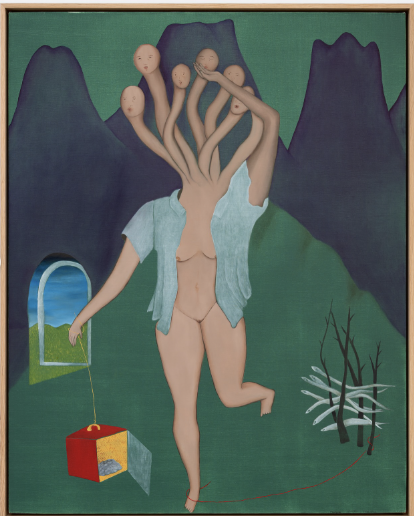

Hanging installations made of wool, sticks, and wire. Surrealist paintings of fleshy figures with doors and keys hanging off their heads. A soundscape room lined with beanbags, imitating the call of the endangered Curlew.
These describe just a few of the many different rooms of Reverse Migration: A Poetic Journey, the first solo exhibition in Ireland by Chilean poet and activist, Cecelia Vicuña. The exhibition is currently on display at the Irish Museum of Modern Art (IMMA) and showcases work from nearly every stage of Vicuña’s multi-decade career.
We’ve all experienced museum fatigue – all those paintings and bronze sculptures and videos begin to blend until you’re not sure what to take away, or even what you were looking for in the first place. Reverse Migration had the potential to fall into this trap, given the incredible amount and variety of work on display. However, the exhibition is masterfully constructed to represent the ideas and causes closest to the artist’s heart, chiefly the interconnectedness of human life and the connection of humans with the earth. Reverse Migration is not only a solo exhibition, it’s an invitation into a life led through care – care for humanity and for the world we inhabit.
One way Vicuña explores interconnectedness is through the power of words and language. In 1975, she moved from London to Bogotá and created her Palabrarma works. The word itself is an act of poetic creativity, playing with the Spanish terms “word” (palabra), “to work” (labrar), and “weapons” or “arms” (armas). While working in both London and Bogotá, Vicuña responded to the rise of Latin American dictatorships by harnessing the active potential of words and transforming them into sculptural poetic works. Poetry and art can feel insignificant, or even frivolous, in times of crises, but Vicuña’s erasure of the boundaries between written and visual media acts as a testament to the impact of both forms of resistance. Language’s potential to be harnessed for collective means is demonstrated in her 1980 video “What Is Poetry to You?” (¿Qué es para Usted la Poesía?), during which Vicuña asked artists, police officers, sex workers, and people passing by what poetry means to them, revealing the power of words and art.

In this same video, Vicuña discusses Colombian wildlife with Professor of Biology S. Idrobo from Colombia’s National University. The moment is stark amidst the joyful, spontaneous responses from the previous interviewees, and made all the more impactful with Vicuña’s statement that “poetry depends on life”. Idrobo describes the loss of nearly two-thirds of Colombia’s original wildlife due to colonisation and climate change, but also discusses the beauty and diversity that still remains. This moment in the video speaks to the elements of the exhibition that are deeply connected to the environment and natural world, such as the Curlew soundscape and the room dedicated to Vicuña’s 2006 trip to Ireland with her partner James O’Hearn; just as the materialisation of words revealed their power, so too does her representation of the environment and pre-colonial ritual objects illuminate the world’s beauty, and the increasingly dire need to protect what remains of it.
I don’t mean to make these environmental elements sound like the crying of end-times. In fact, the reason I enjoyed the exhibition so much – and why I recommend that you make the trip to IMMA – is because I left with an incredible feeling of hope and possibility. Reverse Migration will not provide you with a solution for how to save the world, but it will remind you why the world needs saving, how much more there is to see and understand, and how to simultaneously honour and work to prevent further loss.
One of Vicuña’s best-known works provides an apt metaphor for this idea. The quipu is an Indigenous-Andean system of communication using knotted cords which, like words, act as symbols for ideas. The exhibition draws parallels between the quipu and the designs of Aran sweaters, demonstrating how similar craft traditions evolved thousands of kilometres apart, both based on materials sourced from the environment. Reviving and transporting the pre-colonial communication system of the quipu into this exhibition underscores the overlap between human practice and the environment. Like her palabramas, boundaries are blurred and untangled: those that separate one culture from another, humanity from nature, ancient practice from contemporary.
Vicuña’s life’s work is committed to revealing the “every” in everyone, and her multi-faceted exploration of interconnectedness will undoubtedly call you to return again and again.
Reverse Migration: A Poetic Journey will be on display at the Irish Museum of Modern Art until July 5th, 2026. Admission is free.