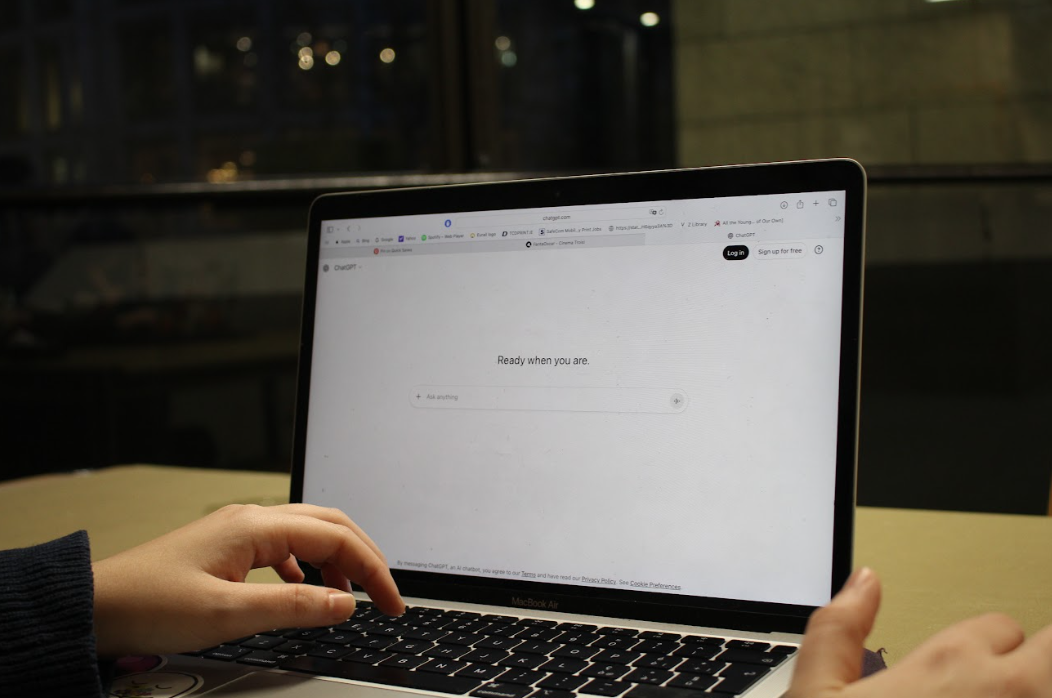

The last time I wrote an essay on one singular topic was during Michaelmas Term of Junior Fresh, in 2023. After that, almost all essay titles released by the English Studies Department followed the same script: “considering two or more pieces covered in the module”. This change was addressed by teaching assistants and professors, summarily, as a way to prevent the use of AI in our essays. So, when last term I was forcing together two novels in one of my essays and trying to explain my idea to that module seminarist, we inevitably ended up talking about the changing of examination modes due to the surge of AI. One thing she said specifically got stuck in my mind: as one can never actually be one hundred per cent sure about the use of AI in essay writing, she believed that there would be an even bigger increase of in-person exams than what has already happened thus far.
I genuinely dreaded the idea for multiple reasons. Firstly, I do not see the educational point of in-person exams in a humanities degree. During the second half of the course of an English Literature degree (just as any other humanities-based degree), our modules become much more monographic and research-based (which can be seen in how seminarists let us decide our own essay titles). Two hour-long exams contradict that, in emphasising quantity over quality of writing and rote memorisation over actual understanding of the subject.
Surely, doing in-person exams in English helps in thinking faster, but also really only enhances our capacity of memorising things rather than analysing them. Moreover, valuing fast writing over good writing is educationally counterproductive to any humanities degree, above all one that is strongly based on a form of communication, as Literature or Film or Classics can be. We should be learning how to write well rather than how to write quickly, as the skill of language must remain as important as the passage of information. As a student whose first language is not English, I have made in my two-hour in-person exams grammatical slips that would have cost me a whole class-grade were they found in a submitted essay. This would have been correct, as my degree is in English “Studies”, which includes the study of the English language and its usage. Sacrificing the ability to communicate properly in favour of the quick demonstration of knowledge is just a slip in the cracks of the frenzy that permeates the entirety of today’s world, which is slowly putting us humanities majors out of work.

Moreover, in-person exams inevitably cause a level of pressure that the submission of essays normally does not generate. In an in-person exam there is the real possibility of not being able to answer one question (therefore dooming the entire final result), as both the amount of analysis and the time which one has for said analysis is limited. Which, again, is the complete opposite of what we are being taught to do in our tutorials and seminars: we learn how to push the boundaries of our understanding, to delve as far as we can in the topics that pique our interests; not how to memorise every Allen Ginsberg line. That one should be a trick we can use at the Pav to impress the crowd, not something we are evaluated on in finals. A few days ago, a current Senior Fresher asked me how one of the exams we had in common had gone last year, and I realised I could barely tell her what I wrote on. On the other hand, I remember every thought process behind all of my essays, from first year until now. But when it comes to past in-person exams I can only recall a couple of names; all I remember was wanting to get it over with and feeling like I was sitting a high school exam all over again. Indeed, in-person exams (in a humanities field) basically force college-level students to remain at a high school-level of critical elaboration of their studies: gluing to our brain as much information as possible, stressing over what questions will come up, only to forget whatever we have written the moment we step out of the exam hall to fling ourselves at the Pav.
All this is underlined by an unspoken frustration. For even those people who do not use AI at all, forcing themselves to think and write their own ideas, at the cost of pulling all-nighters and drinking more Monster than their bodies can stand, will have their learning ability weakened because of the impact of AI. In order to prevent AI from learning in place of students, students themselves are put in worse conditions to learn. And while we pace back and forth in front of exam halls, we try not to think of the Sword of Damocles pending over our heads: we take all of these exams, we follow all these anti-AI modalities, only to get out of college with a degree that is being not-so-slowly put out of work by AI itself. Translations are being done through AI, articles and scripts are being written by ChatGPT, designs and advertisements are automatically generated through prompts. And there is little we can do but stress while waiting for exam results in college and hope to find a job afterwards.