
Traditional agriculture has unlocked a stable food supply, but now it jeopardises the future of our civilization. Farmland expansion drives 80 per cent of deforestation and 70 per cent of biodiversity loss, destroying ecosystems that regulate climate, sequestrate carbon and make soil fertile (given that agriculture occupies half of Earth’s habitable land, these effects are particularly alarming). At the same time, agriculture consumes about 70 per cent of freshwater, putting a strain on our finite resources (less than 3 per cent of water is drinkable). Moreover, chemical runoff from farms is responsible for more than two-thirds of water pollution in Europe and North America, leading to even less drinking water available in the future.
By fuelling climate instability, agriculture is ultimately knifing itself in the back: Rising temperatures, droughts and extreme weather events are already cutting yields, and global crop productivity in some regions is projected to fall by 25-30 per cent by next century. This is compounded by a growing vulnerability of crops to droughts due to soil erosion (predominantly caused by agriculture) that entails poor water retention. Taken together, these problems indicate the need to develop and embrace other food production methods – ones that are local, require less land and water, and abstain from chemical use.
Here is where vertical farming emerges as a wonderful alternative to traditional farming. It is a high-tech method of producing crops in rows that go up rather than side-to-side, occupying 90-99 per cent less space compared to traditional agriculture. Vertical farms operate as closed-loop systems that recycle water and nutrients, which reduces water use up to 98 per cent and may completely remove the need for fertilisers. Furthermore, plants are grown under a controlled environment with no soil, which implies high levels of hygiene that eliminate the need for pesticides.

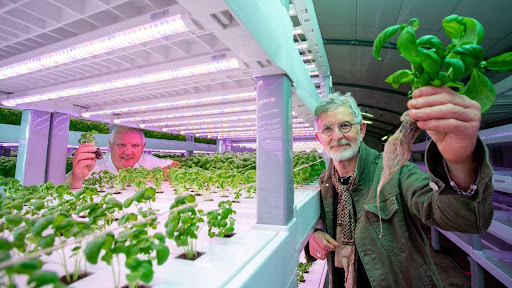
Ireland has long been known for its rolling fields and tradition of agriculture, but it is only recently that the country has started to explore this new way of growing crops. The most prominent example of vertical farming in Ireland emerges from Emerald Greens. Based in Ballyporeen, Co Tipperary, Emerald Greens is Ireland’s first and largest vertical farming company. Their plants (currently limited to basil since the onset of Covid) are grown in highly controlled hydroponic environments of stacked vertical shelves under LED lights, and are nurtured with water, and absolutely no chemicals. The University Times sat down with CEO Brian O’Reilly, who emphasised that his produce was tastier than the equivalent being grown traditionally. When asked about his inspiration behind the foundation of Emerald Greens, he said he was inspired by the vertical farms he had seen in Dubai and saw an opportunity for these to be implemented in Ireland. Using facilities he already owned from his previous mushroom operation, he got to work in 2019 establishing Ireland’s first indoor vertical farms.
When asked about food security, O’Reilly says that he definitely believes it is an issue especially considering that global conflict makes food production and trade unpredictable. But he makes clear that vertical farming cannot provide the complete solution – it is merely “a help”. His reasoning is that vertical farming is only largely suitable for leafy greens and that the concept of sustainability has lost meaning and practice. Despite this, he notes that vertical farming addresses issues of pesticide and water use in traditional farming. When prompted about the negative trade offs of vertical farming, he says it is the vast amounts of energy required to work the farms. O’Reilly says that this, however, is improving with the advent of renewable energy. Solar panels are of particular interest, as O’Reilly reveals that, during summer months, their electricity bill is cut by 30 per cent. Another method of energy efficiency could involve installing vertical farms on the lower levels of city buildings, says O’Reilly. The installation of vertical farms is very flexible, and the CEO of Emerald Greens envisions them being placed in basements, old places and government facilities. However, he believes they are more suitable for urbanised, highly populated areas.
Running a vertical farm in Ireland is not without its challenges. O’Reilly tells us that his biggest obstacle is marketing and changing the attitudes of the public. He requests people to just “come to my (his) farm” and “taste it (his produce)”, and their minds would be changed. The barrier to this changing of minds is cost. This manifests into competition with wholesalers who argue they can find cheaper alternatives. The CEO tells us that his greens are 50c more expensive than traditionally grown plants, but he counteracts this by reminding us that there is a lower importing cost considering the local scale of his farm. When asked about the potential for vertical farming to expand across Ireland, O’Reilly says he has little hope considering that sustainability is all talk and no action. Yet steps forward can be taken and are taken through government policies. O’Reilly is particularly grateful for the Department of Horticulture.
Two thirds of the produce from Emerald Greens goes towards one customer specialising in pesto making, with the rest going to wholesalers. Public response has largely been positive towards O’Reilly’s farm. He says people have called him “very brave” and admire his risk taking. On the other hand, banks are not fond of his risks, and so, O’Reilly reveals that much of his finance comes out of his own pocket. In terms of work, vertical farming requires far less manual labour, and neither is the work as difficult. O’Reilly says anyone can do it as long as they have “green fingers”. Community opportunities for his farm are to a large extent in the form of education. O’Reilly enjoys receiving Leaving Certificate agricultural science students and showing them the works.
In a nutshell, while vertical farms are unlikely to replace fields in the nearest future, they are a powerful way of growing more with less. If adopted where viable, they could help feed growing city populations and safeguard future food supplies – all while reducing miles and agriculture’s environmental footprint.