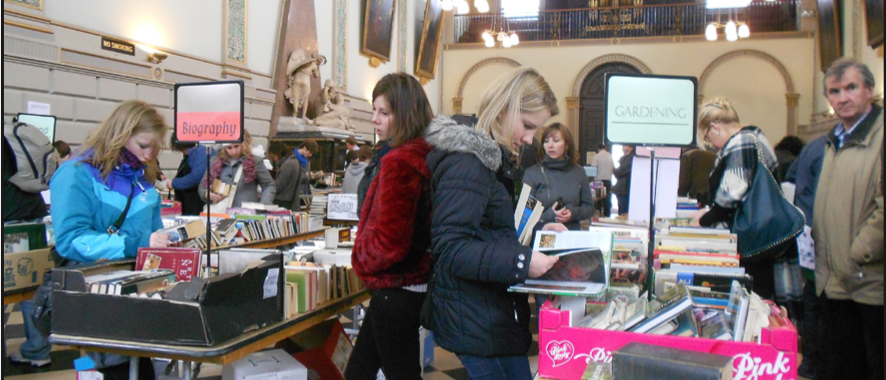

Over three days, from February 10th to 12th 2026, Trinity Sustainability – Trinity College Dublin’s strategy to embed climate action – has led its successful 33rd Secondhand Booksale taking place in the Exam Hall, Front Square. First established by Daphne Wormell in 1989, as part of the University’s Quatercentenary celebrations, the event has raised over €500,000 in 33 years, with all of the funds going into purchasing research materials for Trinity’s libraries. Admission was €3 on the opening day and remaining free thereafter, welcoming students, staff, alumni and visitors to browse through books ranging from art and literature to science, hobbies and more. This was all made possible thanks to current staff and alumni volunteering. An evening auction was also held on the first day, adding to the event’s overall experience. Much more than an initiative to fund the libraries, this event also highlights the environmental benefits and Trinity’s commitment to sustainability. To mark this year’s Book Sale, here are five engaging environmental books, both instructive and enjoyable to read, helping you understand climate change on a deeper level – a crisis affecting us all today.
The first book is the classic environmental science book Silent Spring by American marine biologist Rachel Carson, published in 1962. Even if published decades ago, it still resonates today with its focus on pesticides and their destructive effects. She explains the harm caused by the use of pesticides during the Second World War by the United States, and how it polluted streams, harming both animals and humans with an increase in medical problems and a reduction in animal populations. She criticises governments and industry leaders who allow the development of these products without understanding their consequences. The American Chemical Society describes this book as “a landmark in the development of the modern environmental movement”.
The following book is a classic that will take you back to your childhood. The Lorax, a small illustrated children’s book written by American author Dr Seuss in 1971, is well known for its environmental message and has even been adapted for the cinema.

Although at first glance it seems trivial and intended only for children, its message is actually aimed at all ages, with a deep critique of capitalism. The story follows a young boy who meets the Once-ler and listens to his story and the tale of the disappearance of the Lorax. The Once-ler, who arrived in a green valley, decides to cut down the trees to start his business, which ends up being a success at the expense of the environment. As soon as the young man cuts down a tree, the Lorax appears as a spokesperson for trees. But the Once-ler does not listen, and little by little, species disappear to make way for industrialisation. This book is therefore a depiction of the threat of nature’s destruction by industry and our duty to protect it, transcending generational boundaries and addressed to everyone.
The next book is the climate fiction novel New York 2140 by American author Kim Stanley Robinson, published in 2017. This book sets the story in New York City in the United States in the year 2140, in a post-apocalyptic world where the city is submerged due to rising sea levels. The story follows several characters whose lives are completely different, their only commonality being that they all live in the same building while a financial crisis erupts. This novel explores the link between environmental crisis and economic systems, and how to adapt to ecological crisis, offering critical optimism. The Guardian writes that this book “challenges us to pay attention”. Between generational conflicts, relationships of trust and betrayals, this novel will immerse you in a post-apocalyptic world where everyone is trying to survive and recover from the crisis.
Another note-worthy book to mention is the four-part novella Latitudes of Longing by Indian author Shubhangi Swarup, published in 2018. This book is one of the first Indian novels to engage with environmental changes, and its success has been recognised with multiple awards, including the Tata Literature Live! First Book Award – Debut Fiction in 2018, the Sushila Devi Literature Award for Best Book of Fiction Written By a Woman in 2020, and the Emile Guimet Prize for Asian Literature in 2022. The novel follows four human lives in four distinct locations (Islands, Faultline, Valley and Snow Desert), portraying how humans are connected to their environment and how landscapes shape our experiences.
The last book worth mentioning is the novel The Living and the Dead by Irish writer Conor W O’Brien, published last year. This book has been very successful. Pádraic Fogarty, ecologist and author of Whittled Away, describes it as “a remarkable dive into the world of Ireland’s extinct animals and the astonishing return of some of them. An evocative exploration of the tragic loss of some of Ireland’s natural wonders”. O’Brien travels across Ireland in this breathtaking book recounting his adventures, offering readers a glimpse into Irish wildlife, showcasing both those who protect endangered species and those who reintroduce species that were once endangered. This book explores the connection between humans and wildlife, offering us a realistic view of the threats animals face.
To conclude, all of these books offer a different and new perspective on climate change and how deeply connected humans are to nature. They all remind us that learning about it is the first step into taking action and protecting our planet.