
The last thing I saw at Dublin International Film Festival (DIFF) this year was probably my favourite screening of the festival, and I say screening not film. On the final day of what is perhaps Dublin’s biggest film event, I walked through Smithfield Square – which was coincidently celebrating an enormous gathering of horses and ponies – to the Light House Cinema to watch Kokuho, a 3-hour long Japanese film that became the all-time highest grossing live action in its home country last year. The cinema complex was almost entirely empty; you could tell that the festival was coming to an end. But I was pleasantly surprised to see a full house in the theatre itself. There was no introduction, no Q&A and no volunteers guilting you into voting for the audience award. Without the fuss and frills, this screening was simple, distilled and actually about the film.
The film Kokuho is an adaptation of Yoshida Shuichi’s novel, directed by Lee Sang-il and shot by the Tunisian cinematographer Sofian El Fani. It follows Kikuo, the son of a Yakuza leader, who becomes an apprentice to the renowned kabuki actor Hanjiro Hanai after the death of his father. Kikuo trains alongside Hanjiro’s son Shunsuke and the boys become best friends. Soon after the two start performing in theatres, professional aspirations lead to conflicts and complications. The rest of the film focuses on Kikuo’s ambition to become the greatest ever kabuki actor, an ambition that becomes dangerously Faustian. The story also handles biological determinism, an ideology that still pervades much of East Asian thought; Kikuo is Yakuza by blood but Hanjiro by upbringing and profession. Visually and musically a treat, Kokuho ultimately made some very safe choices. It could also have done with considerably more trimming. But its celebration and reverence of the kabuki art form are definitely commendable. Lee allots dignified time and space to the many theatrical performances featured in the film. I couldn’t help but think of Chen Kaige’s 1993 epic historical drama about two Peking opera actors, Farewell My Concubine.
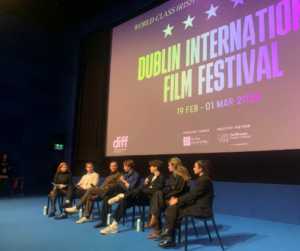
Q&A. All That Glitters, dir. Peter Lavery. Photo by Khushi Jain
Kokuho played in Screen 2 at the LightHouse, the smaller and unassuming screen sitting right next to the enormous Screen 1. The more you go to the cinema, the more you realise the importance of the venue. It is not only about where you sit in a theatre – in the back or in the first row, in the middle or in the corner – but also the size and layout of the theatre itself. Character-driven narratives like Sentimental Value and intense dramas like Marty Supreme fare better on a smaller, intimate screen, whereas epic stories like Hamnet and visually sensitive films like The Secret Agent do better in bigger cinemas with larger screens. At DIFF, venues are picked based on the prestige and “type” of the films. Archival, traditional and more parallel films are shown at the Irish Film Institute in Temple Bar, and commercial, popular and “modern” films at the Light House. DIFF’s retrospective, for example, played at the IFI and the Josh O’Connor starrer Rebuilding was at the Light House. Since films are only scheduled for single screenings at the festival, venues aren’t something you get to choose. Imran Perretta’s Ish should perhaps have been in IFI’s smallest theatre and the Hong Kong classic The Arch in Light House 1. At the end of the day though, all films were projected and they worked, but putting some thought into where a film would be received best would not only have enhanced the viewing experience but also shown a degree of care for the film itself.

DIFF, like other European festivals, seems to be going through an identity crisis. Film festivals these days are about everything else but film. Red carpets, the quality and popularity of the visiting talent, hosting industry events for the sake of hosting industry events and a screening process that is profit-oriented are contaminants that have become the sad reality of a majority of large and medium-sized film festivals across Europe. From Cannes in France to Locarno in Switzerland to Black Nights in Estonia, these events, which were supposed to honour the art and experience of cinema, and provide a space for like-minded individuals to deliberate, are becoming more and more commercial. Furthermore, they are beginning to cater to values established by social media algorithms and audiences. This is not to say that the financial side isn’t important or that screenings should be for the elite literati only but rather the opposite: festival philosophies should endeavour to promote underappreciated films (and their makers) and introduce audiences to materials that not only comfort but also challenge them as cinema-goers. Perhaps festivals have been underestimating the creative, intellectual and emotional potential of their audiences.
DIFF’s commitment to spotlighting homegrown productions is fantastic but doing something similar with regard to the international cinematic landscape can develop the festival into a global connoisseur of films. For Irish audiences, this would mean a diverse and sensitively programmed festival comprising brilliant and daring features and shorts.
DIFF did have a sample of such films, which included, among others, Imran Perretta’s Ish, Mascha Schilinski’s Sound of Falling, Lionel Baier’s Prénom: Mathieu, T’ang Shushuen’s The Arch and Joe Hsieh’s Praying Mantis, but the programme was predominantly composed of that which would sell. The commercial aspect bled into other parts of the festival as well, particularly the opportunities for community and connection, or rather the lack thereof. Given the nature of most of what was shown, there was no impetus to have post-screening discussions or stimulating Q&As. I also felt the absence of a quiet and accommodating physical space where impromptu gatherings could take place before or after screenings. And then there was the haste with which attendees were asked to leave theatres and adjoining areas so that the staff and volunteers could prepare for the next screening on the schedule.
I said Kokuho was my favourite screening of the festival and a big reason for that was that the film was a conversation-starter. Add to this the afternoon timing, the venue of Light House 2, the lack of an introduction, and the calm in the complex, and you have a moment ripe for strangers to exchange some words with each other (before they are rushed out). I am glad that DIFF 2026 ended with Kokuho for me. I share a personal history with the festival and this screening left me with some hope, hope that film festivals can still be genuine, intelligent and caring.