
Before Collins Barracks became the home of the National Museum of Ireland (before Collins Barracks was even named after the Irish revolutionary), and when the British Army used the “Royal Barracks” to suppress uprisings, Harry Clarke was producing some of the finest artwork of the Irish Arts and Crafts Movement. A stained glass artist and book illustrator born in Dublin in 1889, Clarke is now on exhibition at the National Museum in collaboration with Crawford Art Gallery. Stepping into a sea of navy, the exhibit gives a full spotlight to stained glass, each standing illuminated in the dark room. As one of Ireland’s preeminent stained glass artists, Clarke is celebrated for his distinct style and technical skill. Using methods such as multi-layered plating and repeated acid etching, Clarke created a unique gothic depth and striking fluidity in his religious and secular pieces that in turn helped revive the artistic medium, as seen in the six career-encapsulating works on display at the National Museum.
Growing up, Clarke was no stranger to the colourful refraction of light nor the process through which stained glass was created, as his father Joshua Clarke operated a church-decorating business that included a stained glass manufactory. Clarke was formally apprenticed in the craft in 1907, attending evening classes (later full-time) at the Dublin Metropolitan School of Art (now the National College of Art and Design), and winning numerous awards and scholarships in his early career for his talent. Even as he delved further into the art community, the intrinsic ties between stained glass and religion continued, and is clearly evident in the pieces presented by the National Museum. The first piece that draws one’s attention in the exhibition is “The Unhappy Judas” (1913), a long, thin panel showing Judas with the Angel of Death holding a rope around his neck. Judas wears a jaded yellow tunic adorned with pieces of silver, which he received in return for betraying Jesus, as the top half of the panel presents eight angels who surrounded Judas’s soul entering heaven. The piece won first prize in the Royal Dublin Society’s Art Industries Exhibition in 1913, as well as a third consecutive medal at the South Kensington examinations in London, 1913. The following three pieces in the display are also religious, being “The Meeting of St. Brendan with the Unhappy Judas” (1911), “The Consecration of St. Mel, Bishop of Longford, by St. Patrick” (1910), and “The Godhead Enthroned” (1911). The latter two are closer portraits of their subjects, allowing viewers to see Clarke’s distinguished abilities. “The Godhead Enthroned” captures the omnipresence of Christ in rich colour and detail, his intense gaze surrounded by Evangelist symbols of the four Gospels in “The New Testament”. A bench positioned directly opposite invites viewers to contemplate this. On the other hand, the representation of Saint Mel’s consecration is placed more firmly in the tradition of the Celtic Revival, with the subjects themselves being Irish.
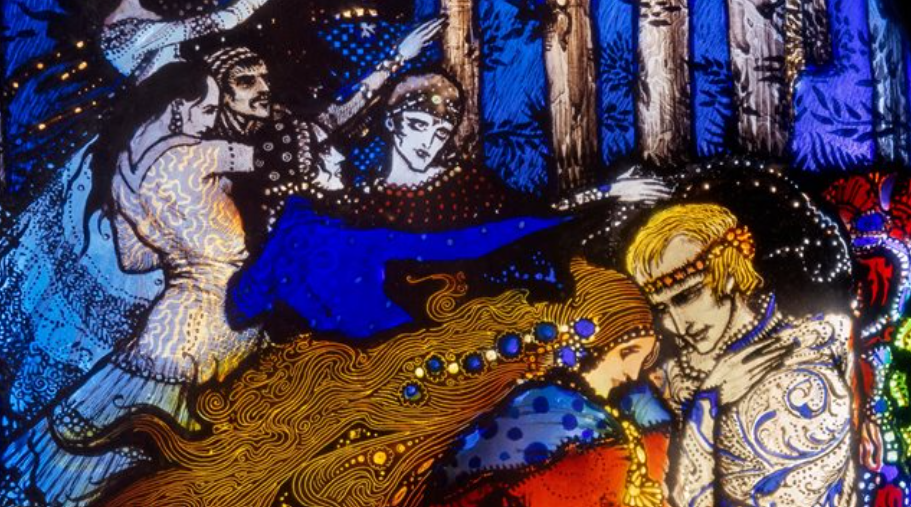
Further along, the two final pieces of the exhibition are smaller, secular pieces that nonetheless demonstrate Clarke’s immense talent. Inspired by the German Romantic Poet Heinrich Heine’s poem “Begegnung”, “A Meeting” (1918) details a mermaid and merman meeting surrounded by other dancers. It is notable for its extremely intricate sheets of ruby and navy, which were individually acid-etched, painted, and plated together. From 1915 onwards, Clarke began producing pieces for domestic settings, bringing the less-common stained glass medium to a larger audience. The exhibit leaves off on a nationalistic note with “Richard Mulcahy” (circa 1925), a portrait of the Irish revolutionary leader and politician surrounded by a wreath of floral and gem shapes. Far from the fantastical ideas and symbolic representations of Irish identity seen in previous works, the somber portrait reflects the challenge of Irish independence faced at the time. Notably, it was Mulcahy, then-Commander in Chief of the National Army, who renamed the previous “Royal Barracks” after his predecessor Michael Collins, who had died four months prior. This portrait situates Clarke within the Irish fight for independence and, further, as an important figure in Irish art history and culture.

Alongside this exhibition in Collins Barracks, Clarke’s work can be found across 16 counties (mainly in churches), in the National Gallery of Ireland in their permanent collection, and even in the windows on the iconic Bewley’s Café on Grafton St.