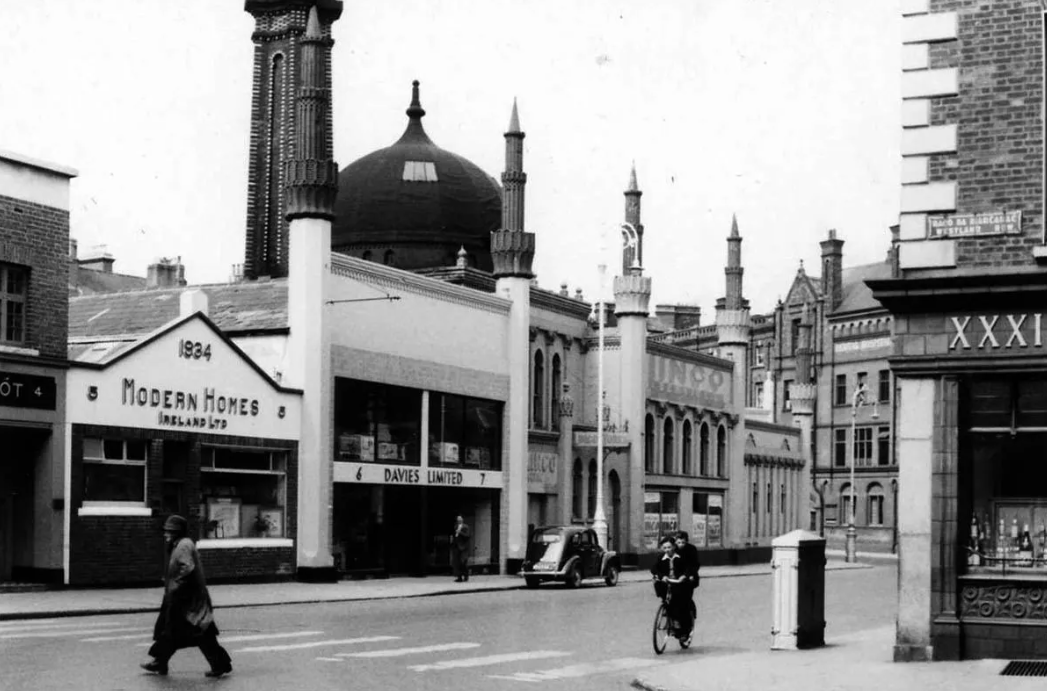

Steam floated upwards beneath a domed ceiling as Dubliners in the Victorian era stepped from one heated chamber to another, sweat forming in the dry air. Outside Lincoln Place, the building looked completely out of place. Adorned with minaret-like towers, ornate brickwork, and an enormous central dome rising above the street, it resembled a small mosque. When this Victorian Turkish bath opened on February 2nd, 1860, Dublin gained a unique architectural landmark and a bathing tradition that had originated centuries earlier in the Mediterranean, Middle East, and North Africa.
The mid-nineteenth century was a period of growing attraction to health cures, hygiene, and forms of leisure. Victorians became increasingly interested in what is now called “spa culture”, leading to the fashionable trend of Turkish baths spreading across Ireland and Britain. Also known as a hammam, these bathhouses were designed as spaces where people could wash and relax while moving through an array of heated rooms.
In Dublin, the bathhouse was designed by Dr Richard Barter, a physician from County Cork, who strongly believed in hydrotherapy and the healing effects of heat and water. The first establishment of its kind in the city was the Turkish bath on Lincoln Place, located just behind Trinity College. With separate facilities for men and women, visitors would progress through gradually warmer rooms before cooling down again; this bathing sequence was inspired by both Roman and Ottoman traditions. However, the experience was not just about the health benefits, since the building itself deliberately evoked the architecture of the East. It featured a towering ogee-shaped dome, half-moon windows, and patterned tiles. Attendants were even dressed in scarlet dressing gowns and Turkish slippers to serve coffee to the bathers as they rested, all in an attempt to recreate the ambience of a traditional hammam.

This strategy evidently worked, as the baths were an immediate success. During the first four years, nearly ninety bathers visited each day. Customers came from all around Dublin, and the establishment even included stables behind the building for visitors who came on horseback. The unusual architecture also captured the city’s imagination. In his book Ulysses, Irish author James Joyce has his protagonist Leopold Bloom refer to the building as the “mosque of the baths”, reflecting how striking the Eastern-inspired appearance must have appeared among the surrounding streets.
Turkish baths soon began appearing elsewhere in Dublin, such as establishments on Leinster S, Saint Stephen’s Green, and Upper Sackville Street, now O’Connell St. The trend spread beyond the capital as well, with bathhouses opening in Bray and Cork City.
However, their popularity was short-lived. As private bathrooms became more common and accessible, and competition between bathhouses increased, the Lincoln Place baths were forced to close around 1900.
Today, nothing remains of the baths on Lincoln Place. The domes, minarets, and steam-filled rooms have long vanished from the Dublin streetscape. Yet, for a few decades in the nineteenth century, a bathing tradition from the Mediterranean became an unlikely part of Dubliners’ everyday life in the city. It was an unexpected fusion of cultures. The building itself is gone, but its presence remains in traces, whether in literature like Ulysses or photographs showing how the structure stood behind Trinity College. The baths show how Dublin has been shaped by cultural influences from beyond its shores. The now-iconic spice bag, a distinctly Dublin-Chinese takeaway meal, is another small instance of how traditions mesh and evolve in the city. Examples like the Turkish baths are reminders of how a city’s history can be shaped by ideas that are adopted from abroad, woven into daily life, and leave traces after they are gone.