
Now that’s it’s been several months of this column advancing slowly into the modern age of pranks, mischief, and general hijinks at Trinity, I think it’s time to wind it back to past, where so many juicy bits of history lie in wait for those willing to wade through endless dusty volumes of otherwise drab texts. Lucky for you, I’ve again taken it upon myself to find this history for you, and believe me, there’s a lot to find.
In the fragile years after the Jacobite Rebellion and Battle of the Boyne in Ireland, many of the students were split between Jacobite and Loyalist tendencies, their fathers having fought on either side of the war. In commenting on how this time has passed in college, historian Peter Boyle states that “we are told that the lecturers didn’t lecture, and that the Fellows neither prayed in Chapel or dined in Hall”.
Given the lack of Pav Fridays and DUDJ sets in this era, this was basically the equivalent of absolutely zero campus life whatsoever. Yet, with the lack of organised entertainment and diversion on campus, there was the obvious opportunity for a more disorganised version of College life to flourish. Many students decided to test themselves as fighters, using Dublin’s inner city as their Colosseum. Raucousness reigned, and soon Trinity campus itself was its own semblance of a war zone.

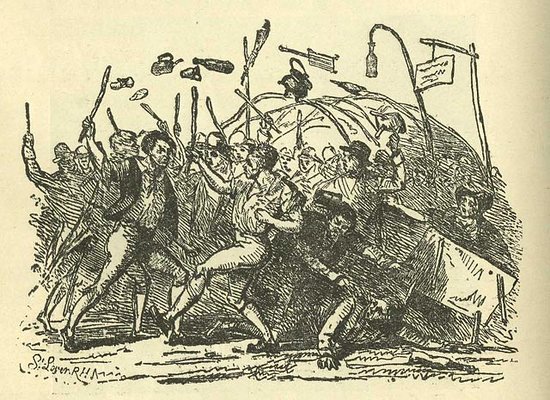
Perhaps I am being a bit dramatic, but all in all, it was not a peak time to be a Trinity student, since there was a nonzero chance that your jaw could be spun around en-route to a lecture. However, this month’s Tall Tale starts specifically when Provost Richard Baldwin, a staunch Loyalist and no stranger to weathering his fists, began to hear of more and more Trinity students expunging their anger out in the streets. Sons of respected Lords would tear at each other’s coiffed wigs and gold-trimmed smocks, students brawled with workmen and sailors around the quays, and there was even a riot at the Smock Alley Theatre that nearly set fire to entire city block.
The final straw came as a result of an already existing gang war on the south side. Young members of various trade guilds had long been vying for each other’s territory. The “Butchers” stood on one side, while the tailors and weavers, collectively known as “the Liberty Boys”, stood on the other. In keeping with the trend at the time, several Trinity students picked a fight with a few dozen Butchers. They lost, badly, and were carried off by the gang to their hideout, fittingly situated in an old meat locker.
For context, the Butchers were no average street gang. It’s said that they earned the name for their brutality, not their profession, as they hung their victims by the jaw from meat hooks in freezing cold refrigerators. When the Butchers fought, according to Boyle, their numbers could reach the thousands, brawling it out in the streets with thousands more.
Back to Baldwin, who again was no stranger to a brawl. The Provost finally now had some use for his students’ willingness to throw down with the general public. Baldwin saw the opportunity at hand, and set out to allow his students to (for once) use their fists to build, rather than destroy. He put the call out to the general student body, and the best brawlers, boxers, and bruisers of the lot were rounded up. The posse, with Baldwin at the head, set out to clear the Butchers and rescue their friends and coursemates. When the Butchers were finally found near the Liberties, the students closed ranks around their Provost. Baldwin, however, refused to allow his charge to put themselves into harm’s way for his sake. It is rumoured that he pushed to the front of the fray and shouted a rallying cry: “Follow me, my lads, and I’ll head you, and I’ll fight for you till I die.” With his students behind him, it’s no surprise at all that the Butchers, outnumbered in spirit, were driven back. One eyewitness student, according to historian John Engle, reportedly said that Baldwin was “as courageous as a lion”. The students pursued the Butchers back to their hideout, where they thankfully found their friends unharmed and strung up on hooks by their belts, rather than their jaws.
The Butchers’ uncharacteristic mercy towards the students could have been due to fear of other scrappy Trinity students coming for vengeance, or perhaps the wrath of Baldwin himself, or maybe it was a fear of revenge from the students’ powerful families. Either way, the Butchers proved themselves cowards that day. Not even being able to get along with those outside your trade is, after all, poor precedent for having the numbers to take on hundreds of students.
With that being said, it’s important to note that these weren’t just students. After all, while their fathers fought bloody battles with each other across the Irish Sea, they decided to work together and unite under one banner, that of their Provost. Baldwin, while a Loyalist himself, showed that he would die for any student under his charge, no matter the side for which their fathers fought.
Today, we have many endlessly entertaining options available at Trinity aside from going out and winning streetfights. The fog has lifted. Yet, despite the desire of many to go back to the era before the Academic Registry, awful Brutalist architecture, and lacklustre Trinity Ball headliners, we can have gratitude. After all, now we can allow our fight-or-flight instincts to dull-over in favour of a sharp eye in the society clothes swap and a keen ability to detect ragebaiting behaviour. Some people, though, including myself, sometimes yearn for that era in which you could very well expect your Provost to lead you into battle. What’s important, though, is that what we have now should not be gauged as better or worse, rather, it is simply different. We are products of the modern world, and while I would love to spar some ruffians with Linda Doyle like some Errol Flynn knockoff, at least I was born just in time to enjoy a blueberry matcha. For that, I will remain grateful.