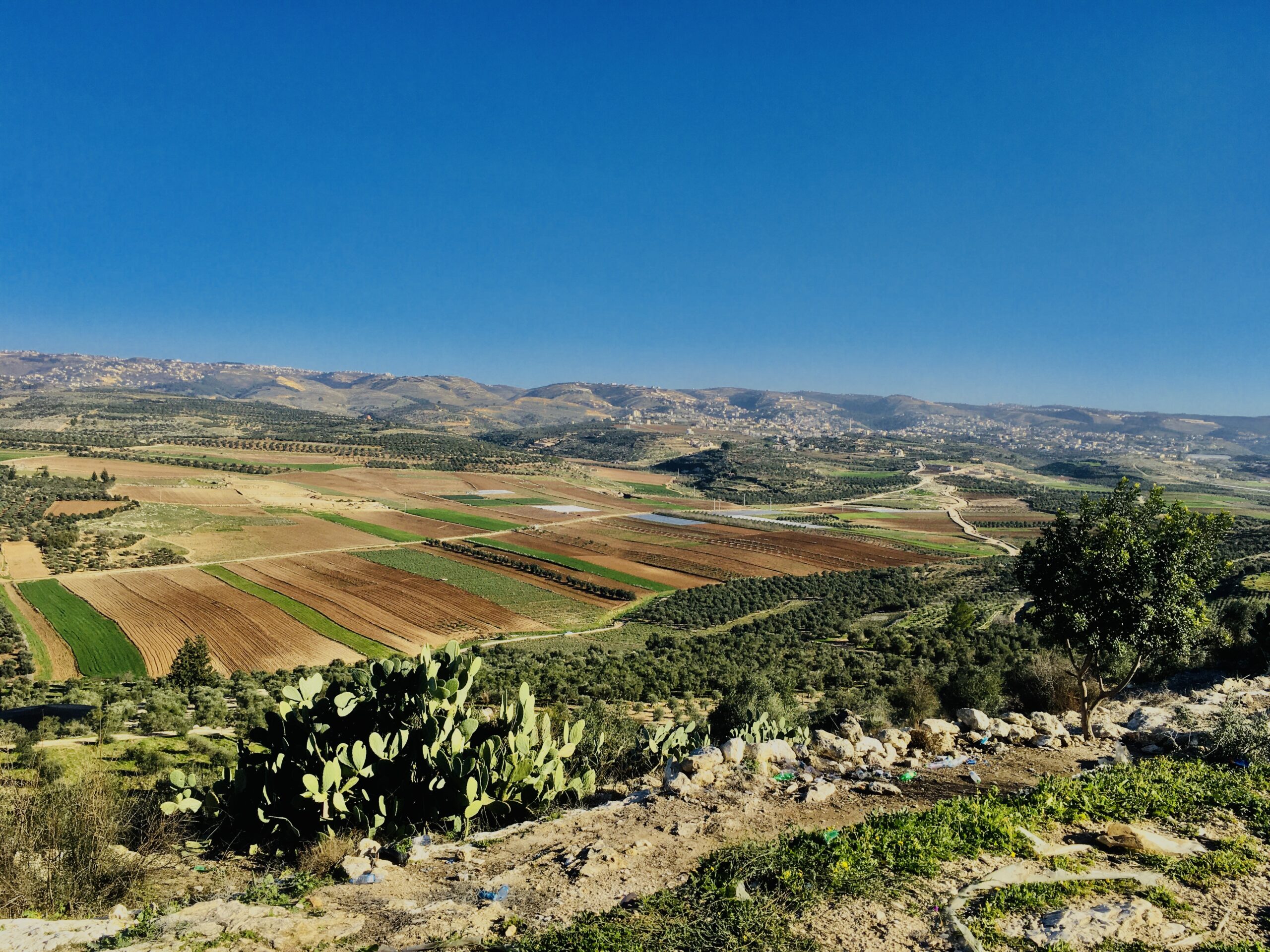

Every year, Palestinians await the first autumn rain. Usually occurring in October, the raindrops serve as nature’s cue for “Mawsim al-Zaytoun”, the olive harvest season. Once the rain has rinsed the olives and softened the soil, families emerge with their ladders and begin the two-month-long harvesting. Palestine is home to some of the oldest olive trees in the world, some standing at 3,000 years old. Its resilient root system has adapted to the dry, rocky soil of the arid region allowing it to survive frost, flood and fire.
Palestine sits to the east of the Mediterranean and while its borders are contested and disrespected, there are two distinct and physically disconnected regions of Palestinian territory. Gaza and the West Bank are separated by a 30 to 50km stretch of Israeli territory. The aptly-named West Bank lies on the Western bank of the River Jordan while Gaza overlooks the Mediterranean.
The fertile and adaptive ground of Palestine once yielded bountiful produce: fig trees, pistachio trees and wild herbs like za’atar thrived. Ancient olive groves and evergreen Palestinian oak supported ecosystems that served as rest-stops for migratory birds. These edenic characteristics were preserved by sustainable, indigenous practices. From sophisticated irrigation systems, to the patient cultivation of heritage crops, the Palestinian population intertwined their lives with the land.

Now, piles of rubble cover the surface of Palestine. The dismantling of Palestinian ecosystems has been underway for years but has irrefutably been catalysed since October 7th, 2023. Colonialism has pushed Palestine into ecological disequilibrium. The fragility induced by long-term ecological warfare, was finally shattered by Israel’s invasion.
In 2007, the Gaza Blockade escalated and formalised pre-existing restrictions upon movement of Palestinian goods and people. Gaza is slightly smaller than Louth (Ireland’s smallest county) and is home to 1.4 million people, all confined by air, land and sea restrictions. More than 80 per cent of Palestine’s designated fishing waters have been largely inaccessible since 2007. This has removed fish, a key food resource for Palestinians, altering the food chain. Even if fishing rights were restored, much of the marine biodiversity off the coast of Gaza has been destroyed by sewage pollution, toxic debris including unexploded ordnance and explosive chemicals from military activity. The force of explosions has demolished much of the coral habitats that marine life once resided in.
If you manage to cross the Israeli territory separating the Palestinian regions, you reach the West Bank situated along the river Jordan. Despite proximity to a significant source of water, only thirty-six per cent of Palestinians in the West Bank have access to running water. The chronic water shortage comes after years of Israel diverting water from the Jordan and rerouting the river through the construction of large dams. Military orders made in 1967 established rain water as Israeli property. The lower part of the River Jordan has become little more than a stiff moving volume of sewage and agricultural runoff. With all Palestinian wastewater treatment plants destroyed and restrictions on wells and springs, what little water that is available to Palestinians is poisoned with sewage and high salinity levels. This contaminated water has given rise to a public health crisis of waterborne illnesses such as typhoid, polio and dysentery.
Nestled between Jerusalem and Bethlehem lies the village of Battir, renowned for its ancient irrigation system utilising groundwater. Designed 2,000 years ago, water from natural springs is collected in a four-metre-deep pool, powered by gravity, equally distributed through channels to surrounding areas, and used to irrigate land for growing olives, fruit and vegetables. Incredibly, this system is still functioning. Eight local families manage the system using stones and cloth to block and open water channels. The construction of the “Iron Wall” surrounding Gaza doesn’t just hinder the movement of people above ground, but the movement of groundwater beneath the surface. The wall is fortified by metres of underground concrete, with the exact depth undisclosed. This halts the movement of underground water systems, trapping contaminated and stagnant groundwater in Gaza.
Indigenous plants in Palestine have been under threat for years due to the mass plantation of foreign plant species. Israel has used afforestation (the establishment of a forest or stand of trees in an area where there was no recent tree cover) to fulfill a number of motivations in Palestine. Tree cover conceals pillaged communities and distracts from the ecological destruction that took place to make space for foreign trees. Since the 1920s, the Jewish National Fund (JNF) has planted 250 million trees and created at least 115 national parks. These projects allow afforestation to be green-washed as a climate-friendly practice. In reality, the JNF focused on pine trees – a non-indigenous tree that harmed local ecosystems. For example, when pine needles fall and decompose they acidify both greenery and soil. Animals of Palestinian shepherds can no longer feed on the acidified greenery, and native Palestinian plants can no longer survive in the soil’s altered pH levels. Native plants cannot thrive under these conditions, and so areas that were once filled with various, diverse flora and fauna, are replaced with pine monoculture.
Regardless of the species of tree being planted, the carefully selected locations for the 115 national parks suggests their weaponisation as a tool of erasure. National parks are concentrated in areas where Palestinians once resided. For their construction, large numbers of Palestinians had to be displaced and moved into overcrowded regions, meanwhile afforestation could be greenwashed and commercialised as a climate-friendly initiative. The planting of pine trees and subsequent decline of indigenous trees deletes the landscape that pre-dated Israeli occupation. An official speaking on behalf of JNF in 2009 said “initially, [Israeli] tree planting was not perceived as an ecological practice but rather as a way to physically freeze undeveloped [Palestinian] land for future Jewish development”. This statement has begun its materialisation; Israel is currently planning to uproot hundreds of trees in its oldest forest in order to power its central district. The plans to oust the planted pine trees in order to develop Israel reveals that climate restoration was never at the heart of afforestation.
The degradation of Palestinian ecosystems at the hand of Western imperialism makes Palestinians more susceptible to the consequence of the global climate crisis. Contested territories of Israel and Palestine will be impacted very differently by climate change due to stratified access to crucial resources and technology. This manufactured disparity is a result of eco-apartheid framework.
Oftentimes, vivid descriptions of ecological collapse in Palestine are missing from the conversation when Western powers sit around tables, participating in dialogue regarding the conflict and a path to peace. President Trump’s recent innovation, the Board of Peace (BoP), outlines a proposed path to rebuild Gaza; however, the path is littered with flaws. The Executive Board overseeing the BoP lacks any Palestinian representation and instead features Trump’s son-in-law Jared Kushner, who previously proposed the Gaza Strip as valuable beachfront property. He stated, “From Israel’s perspective, I would do my best to move the people out and then clean it up.”
AI-generated images shown at the BoP’s inaugural meeting proffer a vision for “New Gaza”, featuring data centres and marketing the land as a tourist destination – a Gaza built by and for The West. Urbanising Gaza acts as a guise for further interference with Palestinian land. The proposal for the utopic “New Gaza” requires the literal and metaphorical burial of Palestinian remains. Plans suggest the foundation of “New Gaza” to be made from recycled debris. The debris is an amalgamation of materials such as unexploded ordnance, concrete, and human remains. “New Gaza” would be built atop the sediments of native plants, the rubble of vicious warfare and the bones of Palestinians.
The cloaking of Palestine – be it with pine trees or data centres – creates a disconnect between Palestinians and their land. Traditionally in Palestine, the land was used to connect younger generations to those who came before them. Families harvest the same olive trees today that their ancestors cultivated thousands of years ago. The water, the soil, the flora, the fauna, constitute the Palestinian people’s common ground between their ancestors. They share this ground with all those who went before them, who walked the same land. The land is a vital thread of commonality between Palestinians and their history. Dismantling their ecosystems by tearing down trees, redirecting water, changing the composition of the ground, removes this essential connection.
With all that being said, Palestine is not an idle victim. The land itself expresses its resistance to colonialism through the persistent survival of native plants. Non-indigenous plants are not adapted to the Palestinian climate, and so are more susceptible to ailments, pests and the survival challenges unique to Palestine. Olive trees – despite years of Israeli repression – are still managing to sprout by slicing through the trunks of pines. The small acts of resistance carried out by Palestinians include the aforementioned maintenance of ancient irrigation systems, the continued harvesting of olives to be processed into the golden elixir of olive oil, the utilisation of indigenous knowledge. These expressions of hope and defiance are termed “Sumud”, Arabic for steadfastness. The Palestinian people are embodying this value every single day. In the face of environmental destruction, sumud exemplifies commitment to the future of Palestinian common ground.