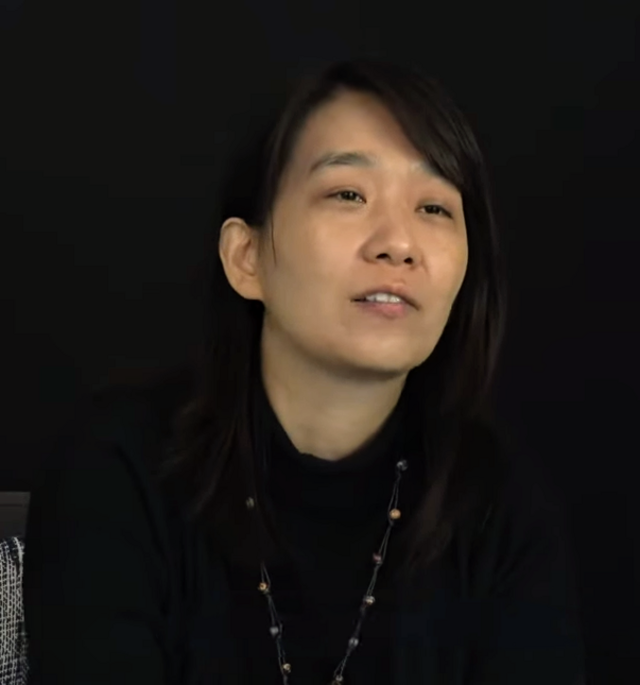

Han Kang is a South Korean poet and novelist, born in 1970 in Gwangju. She comes from a literary family, her father is the novelist Hang Seung-won, and two of her brothers are also writers. She started writing as a student at Yonsei University, where she was studying Korean language and literature. Her writing was initially met with a mixed reception in Korea, as many older critics viewed her work as strange, extreme, bizarre, or perverse. At least some think that the cold reception was partly political. As her English translator, Deborah Smith put it, in a country which criminalised marital rape only in 2011, the older male establishment might have found a writer who “explores this pervasive structural violence” as confusing and bizarre. But Han’s work was slowly growing in popularity, especially among female readers who did not find a description of their lived experience strange or confusing, and her novella ‘Mongolian Mark’, later to be the second part of The Vegetarian, won the prestigious Yi Sang Literary Prize. It was the English translation of The Vegetarian that would catapult Han to international fame. In 2017, the English translation by Smith won the International Booker Prize, which skyrocketed its sales and led to many other translations.
But the novel’s English translation has come under an attack in South Korea, with numerous news outlets calling it unfaithful to the original and calling out several errors, most of them minor. It did not help the translation’s credibility that Smith had only started learning Korean six years before translating The Vegetarian, which was her first translation. Most of the criticism focused on changes in the novel’s style, blaming Smith for taking Han’s brisk, matter-of-fact narration and turning it into something much more poetic and lyrical. Smith defended herself by saying that no novel is perfectly faithful and that any translation is by necessity a compromise, and that a finished book is always going to be different from the original, especially when the languages are as different as Korean and English. “Translating from Korean into English involves moving from a language more accommodating of ambiguity, repetition, and plain prose, to one that favours precision, concision, and lyricism.”’ She also said that she consulted her translation with Han, who thought it captured her style accurately.
In 2024, Han was awarded the Nobel Prize in Literature for her “intense poetic prose that confronts historical traumas and exposes the fragility of human life”. Her win came as a surprise, with the consensus being that Han is likely considered too young by the Nobel Committee to receive the prize. At 53, she is one of the youngest writers to have been awarded the prize. The betting odds on her were not favourable, even though it was suspected that the Nobel committee might try to fix their bias in not awarding Asian literature, especially Asian women. Other Asian writers were the betting favourites, namely the Chinese experimental novelist Can Xue. In December of 2024, Han delivered her Nobel lecture entitled ‘Light and Thread’, where she talked about the themes that she keeps returning to over and over again, such as the human capacity for cruelty and violence, but also love, and how they manifested in her most famous novels.

Her most famous work is the novel The Vegetarian, originally published in three parts in Korean. The book is about Yeong-hye, a woman who, after having a dream about human cruelty, decides to stop eating meat. It ends up completely transforming hers and her family’s life. Yeong-hye’s husband is a mediocre man who picked his wife because she seemed to be “completely unremarkable in every way” and unlikely to overshadow him or have high demands. One night, after coming home from work, Yeong-hye’s husband is surprised to see all the meat taken out of the fridge and the freezer. Yeong-hye says that she is not going to eat meat anymore, and when queried as to why, she replies laconically: “I had a dream.” It is not her refusal to eat meat that annoys her husband the most; it is her refusal to explain her decision with any understandable reason, and the fact that she is “letting herself go”. When she refuses to have sex with him and “fulfil her duty”, he rapes her. While on a business dinner with her husband and his boss, she embarrasses him by not wearing a bra and by refusing to pin her decision to not eat meat to any fashionable diet. The first part of the book ends with Yeong-hye’s father forcing her to eat meat, striking her when she refuses. She is committed to a mental hospital after she tries to commit suicide. At the hospital, she escapes for a while and is found holding up a dead bird in her palm with toothmarks on it. “Have I done something wrong?’” she asks.
Yeong-hye is only defined by others’ opinions of her, she barely speaks, and the only time we get to hear her inner voice is in her dreams. All three parts of the book are written from the perspective of different characters. In the first part, her husband wants to control her, to have her as an accessory and a maid. Her refusal to cook him meat and have sex with him makes her useless for both. In the second part, her brother-in-law, an artist, wants to possess her in an “artistic way”, he becomes obsessed with her after seeing a floral birthmark on her. Other characters want to possess and to control Yeong-hye, but she does not try to wrestle the control back or become the dominant one in turn, rather, she refuses to participate in any human rituals. She decides to become a plant. It is this gesture of refusal as an attempt to regain control of oneself in an immoral world that keeps recurring in Han’s work. In The Vegetarian, Yeong-hye tries to turn herself into a plant, in Greek Lessons, the main character becomes mute partly as a rejection of the violence inherent in language. In an interview for The White Review, Han mentioned that she was haunted by a line by the Korean poet Yi Sang. “I believe that humans should be plants.”’ It is then natural for Yeong-hye to turn into a vegetable. Having recurrent nightmares of human cruelty, she makes the first step to renounce it by stopping to eat meat, and also, to stop paying attention to her body. But the world reacts to her rejection of her body by an even more intense punishing of it; her father hits her, her husband rapes her. Yeong-hye realises what Han calls “the (im)possibility of innocence”; everyone is to some degree a participant in the rituals of human cruelty, as Yeong-hye seems to realise after killing a bird. Yeong-Hye tries to take herself out of the cycle of cruelty only to find out that the only way she can do so is to do it completely. Yeong-Hye first rejects common human activities, then slowly, her own body, and in the end, humanity itself.
Yeong-hye is not allowed to become a vegetarian or a vegetable; she is force-fed, first meat by her father, then force-fed at the hospital. Han shows how any woman who steps out of the social standard for acceptable female behaviour is beaten down, physically if necessary. But The Vegetarian is not just a feminist tale of society’s inability to handle uncomfortable women who refuse to conform, or an exposure of South Korea’s patriarchy. It is not Kim Jiyoung, Born 1982. It is also a mystical and almost religious treatment of humanity’s capacity for violence, the other great theme of Han’s work. It is a theme that, according to Han herself, goes back to her learning of the Gwangju massacre. When Han was nine, her family moved to Seoul from Gwangju, four months before the uprising in her hometown, where a student-led movement against the recently established dictator Chun-Doo-Hwan was violently suppressed by the military. It was an event that would shape Han’s outlook on the world, even if she only found out about it three years later, when she discovered a photo album of the massacre hidden on her father’s shelf. The images of mutilated bodies shook her deeply. She told the Guardian: “If I had been 20 years old when I saw them maybe I could have focused my hatred on the military regime, but I was very young and I just felt humans are scary and I’m one of them.” Her writing reflects this childhood fascination with violence, it is at once terrified of and fascinated by images of cruelty. It certainly does not lack political dimension, but there is always the feeling that while a military regime, patriarchal society, or a capitalist system are outward manifestations of violence, the current runs deeper and through every person’s heart.
Han dealt with Gwangju specifically in Human Acts, a novel told from the perspective of multiple narrators, all of whom have been affected by the massacre. She has also dealt with another dark chapter in South Korea’s history, the Jeju massacre, in the recently published We Do Not Part. Han described Gwangju as a situation where human violence and dignity coexist. The book describes the extremes of both, from physical and sexual torture to people donating blood to injured protesters. In preparation for the book, she has studied human atrocities from Nanjing and Auschwitz to Bosnia. In the first chapter, bodies are laid out in a school gymnasium, a testament to the experienced brutality, yet even the mutilated bodies are treated with respect, even as the narrator says that there is no longer any soul to them, he lays white sheets over them and lights candles. Han gives dead bodies the dignity with which they were not treated with when alive, the dignity which they once deserved and which becomes the last refuge of the inflated corpses. The depiction of bodies has changed from her previous work, but the way they can be commodified remains the same. In The Vegetarian, the bodies of women and men are changed and transfigured by ritualistic acts of passion and outbursts. In Human Acts, the bodies are destroyed by an overwhelming military force. The two states of corporeal frenzy are shown as merely two sides of the same coin, where beauty and violence mingle, from lovers coupling with flowers painted all over them to a woman’s face mutilated by a bayonet.
In her Nobel lecture, Han spoke about how the driving force in her writing was the tension between the two sentences ‘Why is the world so violent and painful? And yet how can the world be this beautiful?’ Both answers have something to do with humanity. In The Vegetarian, Yeong-hye’s last words to her sister are “I am not an animal anymore”, as she is well on her way towards a vegetative state. She makes no distinction between being a human and being an animal. When she killed a bird and left her toothmarks in its neck, she was just participating in the oldest of human rituals, those titular human acts, one of whose many manifestations were the Gwangju or the Jeju massacres. And yet, as shown by Yeong-hye’s sister in The Vegetarian and numerous characters in Human Acts, the capacity for caring coexists with one for inflicting hurt. One does not have to turn into a plant to be guiltless, it is enough to show compassion to the suffering. Surviving on just water is possible only for plants. When a human attempts it, there arises a fundamental contradiction between killing oneself to save others, harming oneself to spare others harm, absolving humanity by relinquishing one’s role in it; and being in a state of contradiction has seldom worked out for martyrs and saints.