
When the statement, “I don’t sway the opinion around here, I am the opinion”, is declared by the head nun working at Colm and Peggy’s school, Mortal Sin affirms its position in the canon of theatre and literature that commemorates the ordinary people of Ireland who were harmed by their government and the Catholic Church. This perceptive and erratic work of theatre goes beyond the typical portrayal of 1960s Ireland, and provides a distinct perspective into the spirit and hope of Irish youth that persists to this day.
Whenever I go to see a play in Bewley’s Cafe on Grafton Street, I have learned to expect innovative and stellar theatre. Not only because they spotlight both emerging and established talent, their history of hosting triumphant productions, or their location at the heart of such an artistically-inclined city, but simply because the humble stage forces the director to push the boundaries of what “theatre” can mean.
On Tuesday the 18th of August this point was substantiated. I queued on the narrow stairs of the second floor of the Cafe waiting to be let in for the debut of Mortal Sin, directed by Lee Coffey and written by Benjamin Reilly. Noticeably, the play attracted a majorly American audience, doubtlessly intrigued by the portrayal of 20th century Ireland in the context of such a major event for the United States, namely the assassination of JFK. When the doors opened, we were each taken to a seat and as I did so, I noticed two figures standing on the stage, coated in darkness and staring at the walls either side of the small room: evidently, the show had already begun.

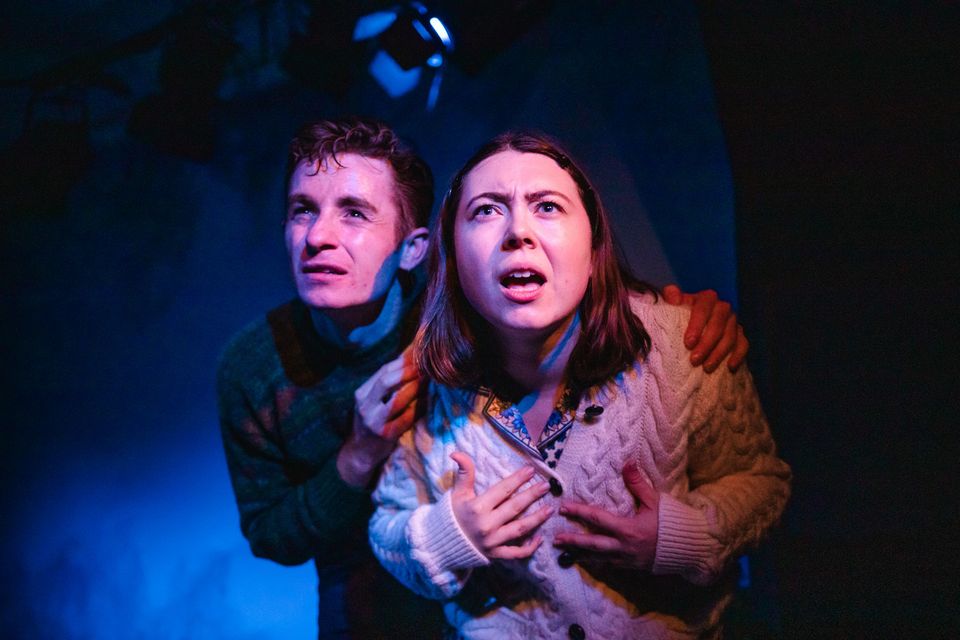
Mortal Sin follows the lives of Peggy, played by Isolde Fenton, and her best friend Colm, Benjamin Reilly, as they make preparations for a protest to get a day off school after the assasination of JFK. This is foregrounded by their exploration of school life, their respective sexualities and their seemingly unattainable dreams. Peggy yearns to be on the stage, yet her life in a small country-side Irish town confines this aspiration to the realm of dreams. She and Colm spend hours in her room fantasising about the future and all that they will achieve once they leave their town. This hopeful naivety beams with nostalgia and sincerity to such a degree that I couldn’t help but revel in their idealism.
However, the parochial attitudes of 1960s Ireland has other plans for them.
Straying from any notion of a chronological sequence, Mortal Sin leaves a series of impressions rather than a cohesive narrative. The scenes fluctuate between the past and the present with little to no signalling except for a change in lighting and dialogue, creating a sense of flicking through a series of photographs on a roll of film. This sense is further supported by the outstanding pace with which the actors worked. Fenton and Reilly each played multiple characters of different demographics, and switched between them with such ease that I could have sworn that there was a larger cast, were it not for the lack of costume changes which identified them.
Despite the seemingly tumultuous nature of having the same actors playing different roles, the tone and mood were surprisingly well-controlled. I was often caught in emotional whiplash as the play diverted from its initial humorous tone, such as poking fun at the difficulty of the modh coinníollach, to a far more sincere one, presenting an unimpeded view of the consequences of deeply instilled shame in Irish culture. The play exposes the cruelty of the church through light and humorous banter, playing on the naivety of the two protagonists to highlight its failures. This crescendoing atmosphere captured all the broken promises made by the church and was directed with a mastery that can only be credited to the writer and actors themselves.
The production of the play peaked with the creativity that went into utilising and innovating with lighting. That lighting plays a major role in any play is no surprise to anyone, yet it wouldn’t be too outlandish to declare the light as a third actor in Mortal Sin. The mere act of stepping inside or outside the light declared changes in circumstance, mood, or even signalled the end of a life. Light performed a trojan work in hitting the nail on the head in the final moments of the play and leaving the audience, including me, with a haunting and hollow feeling. The final sequence involved a side-by-side comparison of Peggy and Colm narrating their imagined futures, which was then followed by the resulting realities, a sequence so moving that it left many in tears.
Mortal Sin ran in Bewley’s Cafe from the 18th of August until the 6th of September 2025. However, this is certainly not the last that Dublin will hear from these outstanding performers. Isolde Fenton recently wrote and performed In a Bad Way at the 2025 Dublin Fringe Fest and has won the PJ O’Connor Radio Drama Award for her debut play Chalk and Cheese. Benjamin Reilly wrote his debut play, Danny Ryan, and produced it in Smock Alley Theatre in July. Fenton and Reilly are forces to be reckoned with and are certainly worth keeping an eye on for any upcoming projects.