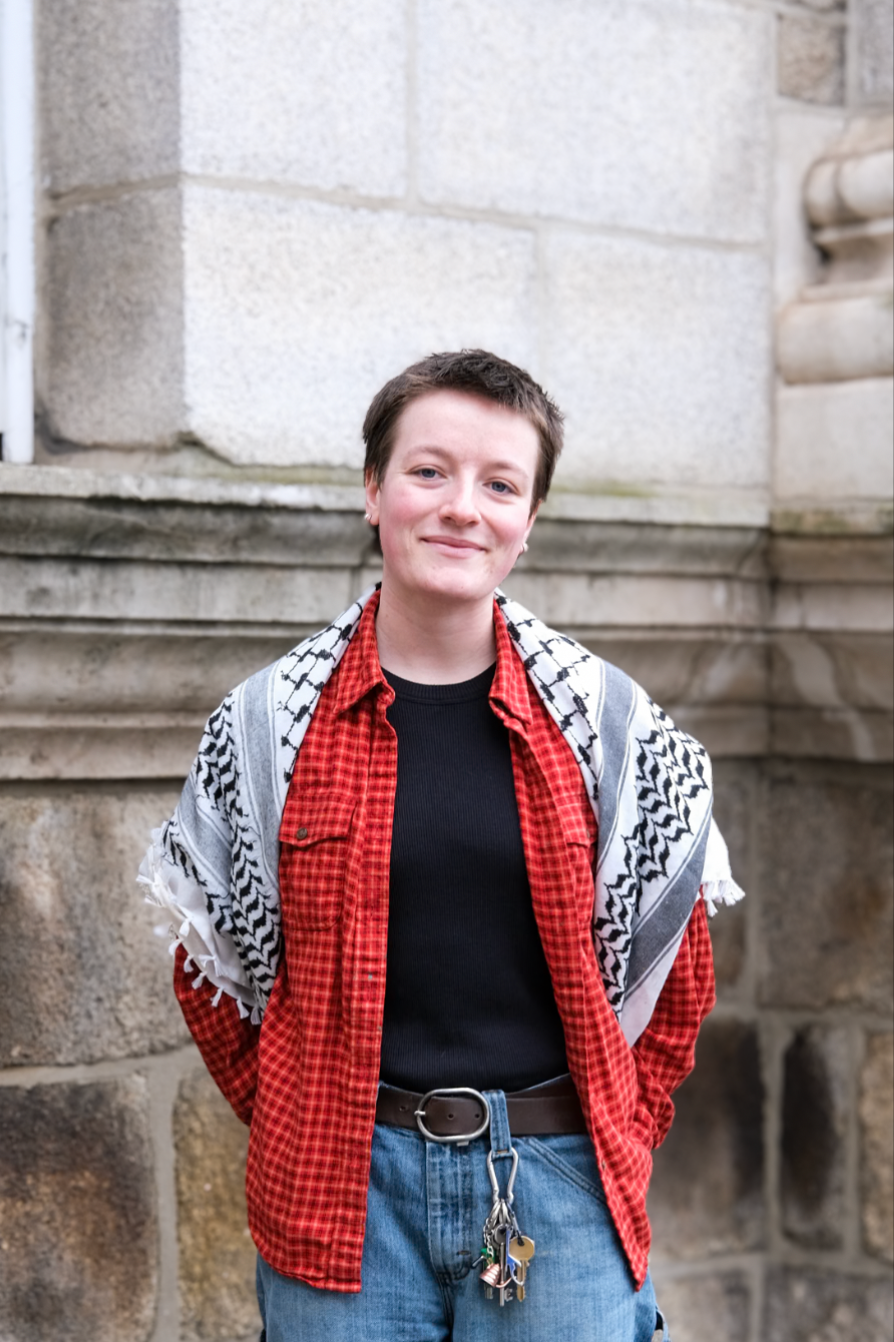
On a bench outside the arts block, Rossa Bolger, candidate for SU Welfare Officer, tells me that campaigning is new to him. He decided to run only two weeks ago. “My friends sat me down on Wednesday evening and were like you should run for this. You’ll be good”. The idea of running a campaign daunted him but so far “it’s actually been quite fun”. He has been surprised by people asking to be on his campaign team. “It’s really cool to see people want to help out”.
Bolger sees the position as a “real opportunity” to impact the lives of students long term. “It’s an amazing job. All the case work is great. I’d love to do that”.
He is in his final year studying Social Work. “Ironically, I was doing welfare stuff before I even came into college. That’s the role I took in social settings before I came here. It’s the role that I took in my family as well. So I think it is something that comes quite naturally to me at this point, making sure people are okay”. This has now “culminated into something that I want to do for the rest of my life. Some people will be like, “I didn’t really have a choice in that”, but I really enjoy what I do. It’s really nice.”

Safety, accessibility, and awareness are the three core aspects of his manifesto. Safety is “at the very top” because “that is what will have the most tangible impact on people’s lives in college”. Bolger intends to run an anti-sexual violence campaign, involving active bystander training. “If that makes one person change their behaviour in a positive way, or if that protects one person… then that’s an endeavour that’s really worth it”.
He would put up posters with information for victims of sexual violence “if they just want to talk to someone, they don’t even have to make a complaint. Whether it be me as the welfare officer, or whether it be Trinity dignity and respect, or it be the counselling service, that is their decision”. He would also reintroduce drink covers and PH testing strips in the PAV. “People may not use it, that is completely people’s choice but the idea that they are there and they are visible, that sends a message to what we accept within college”. Research shows that this kind of action often leads to a rise in people coming forward with information. “We project into college what is acceptable within our society”.
On accessibility, Bolger sees it as being about “creating an equal playing field for us all to participate in college”. Bolger plans to make more buildings around campus wheelchair accessible. He also would advance a campaign to have lectures recorded to give students, especially those who are working or have caring responsibilities, “just a little bit more flexibility”.
“If you only want to come into college two days a week, whether that’s because you’re working the other two or the other three, that should be an option that you have. It’s something that you’re paying for”.
A lot of students “don’t get to engage in college life and college societies as much because they’re working” so “the very least we can do is make their life a little bit easier”.
On awareness, Bolger wants to better signpost the resources the SU and the college has to offer. He sees food vouchers as one of the “best things” that the welfare officer does. “Someone who is eating one meal a day because they can’t afford to get through the week and are waiting for that next SUSI grant to come in…that is real”.
“Just asking for that support and being able to get through the week that little bit easier, that is the core of what everything the SU should do, welfare wise. Meeting people where they’re at, essentially”.
Charity fundraising through campaigns is also key to Bolger’s plans. “There’s a lot of good charities here in Ireland [sic] that we can raise money for. And if you have a little bit of craic – whether that be SHAG week or whatnot – along the way, there’s no harm in that”.
He also would expand the SU’s social media presence and website to better signpost useful resources. There is currently no “compiled list of funds that students can apply to” on the SU welfare page. “That should be there”.
He’ll ask each sabbat next year to make a video explaining how they help students. “It makes it more personable, you see a face, but also people can explain what their job is. Especially considering there’s a graduate officer this year which is a completely new role, and it’s going to be really good for people that aren’t in around the SU to understand what that role does”.
Case work is “central” to the work of the welfare officer. “Typically, a lot of case work is signposting, so someone will come to you with an issue […] And you can obviously sit with them and talk and see what you can do”. Mental health issues are often “exacerbated by external factors, whether that be housing or not being able to afford food”. “Even sometimes it’s just like FOMO of people not being able to afford to go out […] A lot of it is affordability issues right now obviously, it’s an affordability crisis”.
Going beyond this, “it’s people who are struggling in college, whether that be because of their sexuality or their race or their gender. One of my friends, their professor said the N word in class. We’ve had that happen in our lectures as well. Unfortunately, it’s more of a ubiquitous issue than we think”. Bolger would like to introduce cultural competency training, particularly for lecturers. “I spoke to the head of the Muslim society and the head of the Afro Caribbean society and that came back from both”.
“People find their way to welfare for many different reasons”. Bolger’s degree has given him a sense of this. “Everyone comes into college with their own sets of beliefs and what they think to be right in the world and how the world should work. Social work kicks you in the teeth a lot of the time. You think it’s bad, and then you go out […] And you’re just, like, it’s so much worse than you think”.
His first year placement was in a family homeless hostel in Galway, where he’s originally from. “It was really, really tough, both as a starter to social work, but also, I think it was important”. “The parents, all they wanted was the best for their kids.”
“There’s not too much I feel I haven’t seen in my four years in college. Whether that be outside of college but also I feel like I have gotten a really good sense, even especially over the last week, of what students experience”.
On specific issues, Bolger tells me that “the prayer space for Muslim students is way too small. I think that’s particularly relevant because it’s coming into Ramadan”. “People have to pray outside that room, in the hallway, just because there is absolutely no space”.
Bolger will be doing Ramadan for his third year in a row. Campaigning will take place during this. “It’s a bit different, because it is my choice”. “I find it really humbling that idea that you don’t get to eat when you want. It is very much a first world concept of if I’m hungry I can just walk to Tesco and get a meal deal”.
“There’s still two billion people that live in poverty and there’s a few billion more that live with food insecurity”. Doing Ramadan, “it does feel like you can understand a little bit more how lucky we are to live where we are”.
In Bolger’s opinion, casework is “the best thing every welfare officer does every year”. The work often goes unseen but that doesn’t matter. “You can meet someone face to face and you feel like you’ve helped them in their life just a little bit for a day”. That, at the end of the day, is “the thing that most of those students are going to remember”.