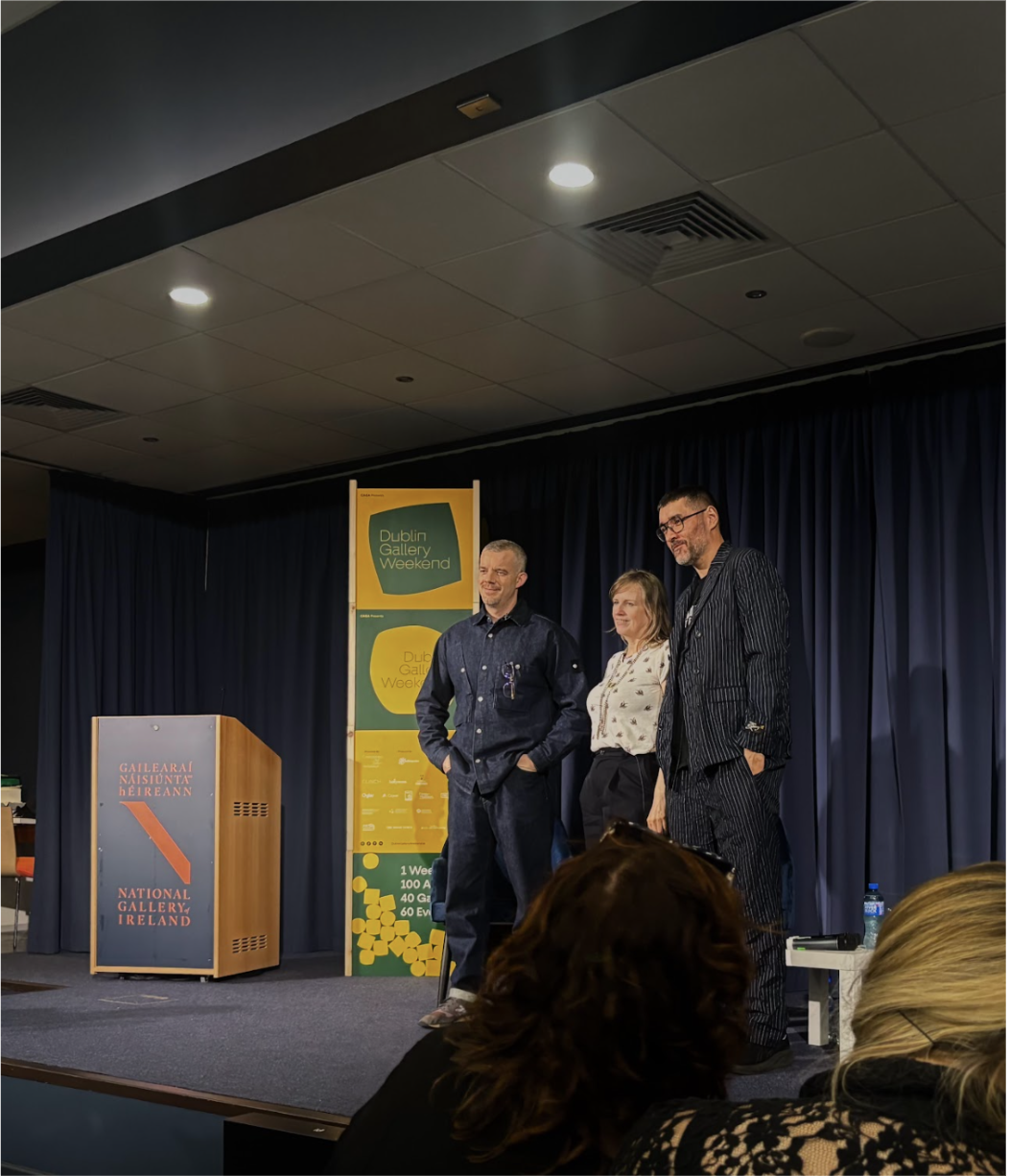
When I walked into the National Gallery at noon, the room felt like the inside of a paused breath. People shifted into seats, tightened scarves, checked their phones, and then quieted as if someone had turned the sound down. Outside, Merrion Square held its usual November light. Dublin Gallery Weekend had the city scattered with shows and openings, the Picasso rooms and the AIB Portrait Prize pulling people through the building, and Talk Art was planted quietly in the middle of it all as a free but ticketed lunchtime event. Russell Tovey and Robert Diament set up like two people you might meet at a party and keep talking to until the kettle boils.
Robert started with one small, blunt truth.. He said he felt chaotic, and when he added that art helps him “make sense of chaos”, the sentence landed like a report from the trenches. It was the sort of offhand confession that makes the room lean in because it sounds like the real reason someone comes to a studio or a gallery. The hosts had been introduced as custodians of a generous, public archive, and they carried that tone into the hour. The evening felt oriented by accessibility – by a deliberate refusal to make the audience feel like outsiders. Everyone in the room was allowed to be curious without being tested.
When Isabel Nolan joined in, the tone changed. She spoke with a careful, alert gentleness and said that she adopts a “willingness to be confused by other people”, rather than rushing straight to comprehension. Her examples were small and particular rather than heroic. She talked about seeing a Michael Cullen at the Butler Gallery and realising an artist could be “completely normal”, about the shock of a Rodin sculpture in Paris, and about a James Coleman at IMMA that made possible what she called “space in the world to not understand things”. Those memories weren’t a CV. They were the private openings that made her practice possible.
She spoke about Dublin shaping her in the way the weather does the land. The city gives her both curiosity and a kind of urgent impatience, she said, and that combination shows up in work that moves from learning to making. Nolan used the sea as a way to explain how a subject can be looked at from many angles at once – scientific, poetic, and spiritual, all in the same breath. She pushed back against the modern itch for tidy answers and argued that ambiguity isn’t a flaw but a method. That idea made the conversation feel less theoretical and more like the notes stuck on her studio wall.
Nolan talked about research as “self-imposed homework”, and laughed that her love for Gothic cathedrals “has nothing to do with God”. The audience understood this immediately – or, at least, I did: loving something without needing it to fit into a category, loving something beautiful simply for what it is, not for what it stands for. She described color in the studio as an intrusive force that demands an answer and then starts arguing with itself. And when the conversation shifted to aphantasia – the inability to visualize mental images – something in her voice brightened. She said that her diagnosis “explained everything bad or not brilliant” about her. She talked about how her work anchors her memory, how she often can’t picture a finished piece after it leaves her hands. Drawing, she said, is thinking on paper and a way to hold her own inner weather when images refuse to appear.
The hour wound down with small, generous details. When asked about miracles, she told a medieval story that read less like doctrine and more like a human desire for reconciliation. She admitted she’d steal Paul Heck’s Dwarf Parade if law were kinder to thieves, and named pink as her favorite colour because it’s hard to use well. The last pieces of advice she offered were practical: “onto the next” and “have a little laugh at yourself before you go to bed”. They felt like a pocket toolkit for a slow, stubborn practice. Walking back across Merrion Square, the city looked the same and not the same. The afternoon had rearranged a few things inside of me, as any good conversation is meant to do.