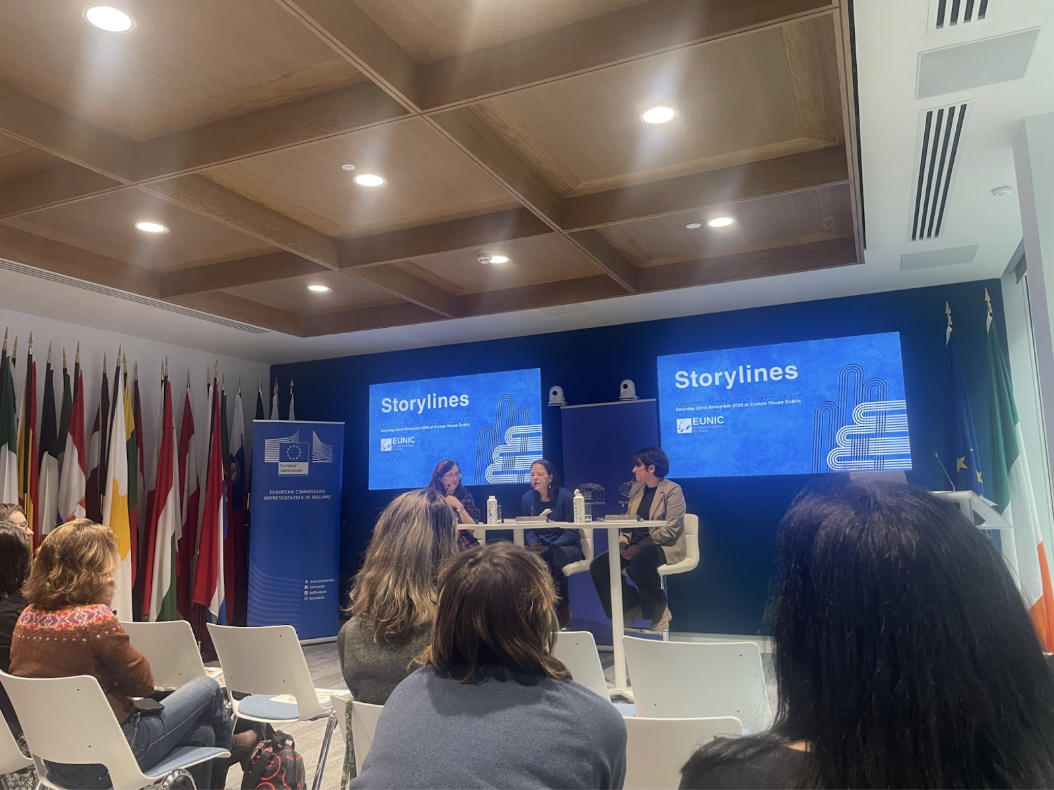

On Saturday, November 22nd, the European Parliament Liaison Office in Ireland, in cooperation with the European Union National Institutes for Culture (EUNIC) Ireland, hosted the event Storylines Europe. At the event, which was a “celebration of European literature, translation and ideas”, authors from nine different European countries spoke not only about their works, but also about related topics such as identity, language, memory, and creativity. The event marked the start of what will now be an annual series, which will serve as a “vibrant platform for European literature in Dublin” in the future.
The event offered a programme of eight talks. I visited two of them, which I personally found most interesting, each reflecting two very different key themes in contemporary European literature: language and modern relationships.
“Language being a home”

This sentence particularly stuck with me from the conversation between the award-winning translator of Polish literature, Antonia Lloyd-Jones, and the author, teacher and publishing house founder Anne-Marie Reuter. Both offered two intertwined perspectives on the unifying and sometimes divisive nature of language.
Reuter, a born Luxemburgisch, who founded the English-language publishing house Black Fountain Press, writes exclusively in English herself. In her debut novel, M for Amnesia, she tells the story of Millie, an elderly woman who has lost her memory and lives with a tormenting sense of guilt. Millie feels the “phantom pain of memories”: pain from memories she no longer has, but which exert power over her. Driven by the fear that she may have done something terrible in her past, she tries to reconstruct her life piece by piece in a world marked by an unequal distribution of technology and physical optimisation. Her work was inspired by already existing methods in medicine and psychology, including trauma therapy, which can be used to alter memories. A reading from her novel revealed the power of Reuters’ style: vivid, detailed and carefully crafted language. The task of tidying a wardrobe becomes a vehicle for memory. She describes the beauty of the mundane, even in a dystopian world.
For an author whose native languages are Luxembourgish, German and French, the question arises: why choose a non-native language as the language for your works? Reuter explained that she was influenced early on by her father, who taught English, and that she feels English is the place where her writing resonates most strongly. Writing in English was not a conscious decision for her, but rather a development: “It’s part of who you are, it’s part of your identity.”
She considers the question often asked of her, why she does not write in her actual mother tongue, to be misguided. Every language is “foreign” at the beginning of the writing process – you always have to immerse yourself in it anew. Reuter understands language as a space of identity: “Language being a home”. However, this idea does not in any way exclude the possibility that people can have several linguistic homes. Luxembourg, a country where multilingualism is part of everyday life, is a prime example of how languages can coexist. Her publishing house is therefore not privileging English, but rather responding to Luxembourg’s increasing internationality.
Antonia Lloyd-Jones also emphasised the close connection between language and identity – and did so with a very personal story. Lloyd-Jones, based in London, decided to learn Polish during her studies after visiting friends in Warsaw and wanting to report on the political upheaval in the country. This decision changed her life. Since 1991, she has translated numerous works by Polish writers, journalists and poets.
According to Lloyd-Jones, translating is always a kind of acting: the ability to slip into the voice, mood and thoughts of another person. It would always be necessary to very carefully analyse what the author wanted to express; she told me later in a personal conversation. This is especially true of cultural allusions or humorous passages, which can sometimes be difficult to convey.
She has been working full-time as a translator since 2001, a job that no longer seems as promising as it once did. “I am terrified for the world out there”, she said, referring to AI translation tools, which smaller publishers in particular are increasingly using for cost reasons. But how can a machine grasp the sensitive subtext of a literary work, let alone authentically convey its heart, humour and cultural nuances?
The second conversation I followed was between the French writer Nolwenn Le Blevennec and the Spanish author and journalist Anna Pazos. The conversation focused not only on the ethical boundaries and requirements of artistic and journalistic professions, but also on friendship and love.
Yes, friendship is the “more sustainable form of love”!
That was the answer of Le Blevennec to my question about whether friendships are becoming more important in our younger generation, and I’m sure some of you have an idea what she means. In her novel Les Amis, Friends and Lovers, she writes about motherhood as a major turning point in life, accompanied by thoughts about appearance, desire, men and breaking out of one’s own life, and how friendships accompany and shape this transformation.
Le Blevennec does not romanticise friendships but describes them in all their ambivalence. In addition to closeness, support and intimacy, she also addresses the downsides: feelings of envy, subtle competition or relationships that become so close that they can feel restrictive. She speaks of a “fusion relationship”, a connection that becomes almost symbiotic and thus creates its own tensions.
In summary, the event did one thing especially: it made me want to read, because the books presented were, just as the event’s advertising suggested, fascinating due to their focus on contemporary, perhaps even banal, topics of our everyday lives. The fact that the event also brought European nations together was a very nice experience for me. One criticism could be that the discussions did not always provide an opportunity for the authors to engage in very in-depth reflection. The duration of less than two hours per discussion with two authors and readings from the books seemed very short. It was not always clear whether the discussion should focus on the specific works or on these underlying, more abstract themes. Nevertheless, the event provided thought-provoking and, in some cases, intimate insights and highlighted the diversity, political nature and unifying power of literature.